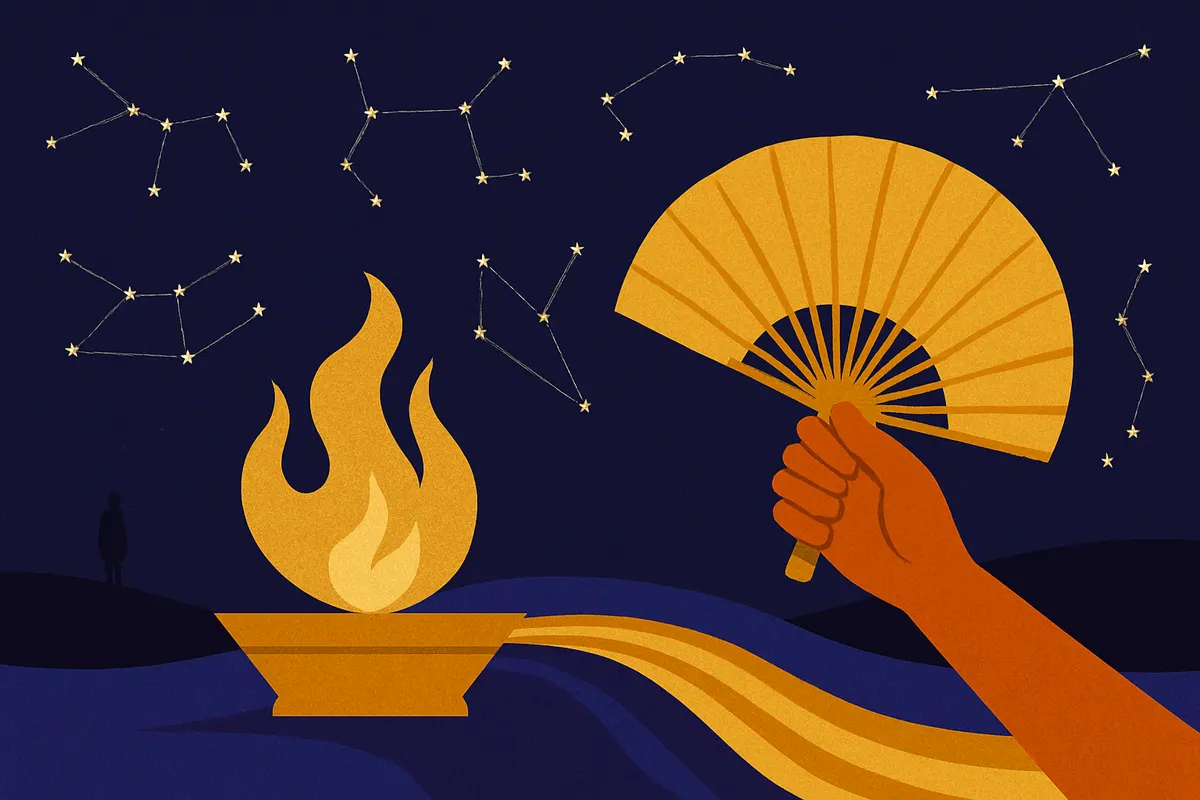
Purva Ashadha Nakshatra is the 20th of the 27 nakshatras (lunar mansions) in Vedic astrology, spanning 13°20'–26°40' of Sagittarius. Its ruling lord is Venus and its deity is Apas, the cosmic Waters. Its name means "the early undefeated", its symbol is a hand-held fan, and it describes an inner conviction that a cause taken up will prevail, not a guarantee of winning every contest.
Purva Ashadha is also spelled Purvashadha, Purva Ashada or Poorvashada, and in Devanagari it is पूर्वाषाढ़ा. It is a nakshatra, meaning a stretch of the Moon's path, and lies within one rashi, Sagittarius, between 13°20' and 26°40'. Look up your own with the free Nakshatra Finder.
What does Purva Ashadha Nakshatra mean?
The Sanskrit name breaks down cleanly: purva means earlier or first, ashadha means undefeated. Together, "the earlier undefeated one" describes a native who carries an interior conviction of eventual success before any external evidence has arrived to justify it. Classical sources are careful to frame this as a claim about spirit rather than about outcome — the promise is that the native's resolve will not be broken, not that every specific contest will be won. That distinction matters in practice: the difference between the two is exactly the work an unintegrated Purva Ashadha native has to do.
The presiding deity, Apas, reinforces the theme of renewable rather than finite resource. In the Vedic hymns, the Waters are addressed as a living, plural presence that heals what has been wounded and refreshes what has been wearied — continuing to flow even after visible drought. Purva Ashadha natives are read as carrying this quality in two concrete ways: energetic resilience that does not deplete the way it does for most people under sustained pressure, and a purifying presence that tends to calm rooms that have become tense or stuck.
Why is Venus the ruling lord of Purva Ashadha Nakshatra?
Venus rules Purva Ashadha at the nakshatra level (the lord cycle that starts at Ashwini reaches Venus at the twentieth nakshatra), while Jupiter rules the Sagittarius sign that contains it. This combination — Jupiter's dharmic fire at the sign level and Venus's diplomatic warmth at the nakshatra level — produces the persuasive, socially fluent temperament classical sources consistently describe: eloquent speech, a gift for negotiation and public-facing work, and genuine skill at building and holding coalitions over time. A native whose Moon falls in Purva Ashadha opens life in a twenty-year Venus Mahadasha — the longest of the nine Vimshottari periods. The nakshatra follows Mula and is followed by Uttara Ashadha.
What are the four padas of Purva Ashadha Nakshatra?
All four padas of Purva Ashadha fall within Sagittarius, but each carries a different navamsa sub-lord, running Leo, Virgo, Libra and Scorpio in sequence.
- Pada 1 (Leo navamsa, Sun-toned): the most visibly confident of the four, producing natural spokespeople and public-facing leaders. The integration task is matching the visibility with genuine service to a cause larger than personal recognition.
- Pada 2 (Virgo navamsa, Mercury-toned): a careful, analytical persuader — the policy writer or editor whose argument wins through preparation rather than charisma alone.
- Pada 3 (Libra navamsa, Venus-toned): the most relationally textured pada, carrying the strongest concentration of the nakshatra's Venusian warmth. These natives persuade through relationship rather than argument, and often build careers in diplomacy or long-term partnership work.
- Pada 4 (Scorpio navamsa, Mars-toned): the most intense of the four, adding Scorpionic depth and Mars-driven seriousness to the underlying Sagittarian fire. The risk here is over-investment in a single cause at the cost of a more balanced life.
What is the Venus Mahadasha like for a Purva Ashadha Moon?
Because Venus rules this nakshatra, its twenty-year Mahadasha (the general picture is in the Venus Mahadasha explainer) is usually the chapter in which a Purva Ashadha native's relational and public gifts reach their fullest expression. Practical guidance for this period, drawn from the classical material:
- Treat the first two to three years as strategic positioning — take the role you actually want, not merely the one that happens to be available.
- Invest deliberately in your relational network; Venus rewards warmth that has been genuinely given rather than performed.
- Use the long arc. Twenty years is enough time to build something durable — short-term campaigns will not exhaust the period's potential.
- Watch the Saturn sub-period within the Mahadasha closely; it is classically the testing chapter where the foundations built so far are confirmed or shown to need rebuilding.
Where the natal Venus is afflicted — debilitated, combust, or aspected by a malefic without redemption — the same period can bring public visibility bundled with relational difficulty or scrutiny. The classical remedy is sustained Friday observance to Venus and a deliberate practice of relational generosity throughout the dasha. For a comparison of how differently a Mahadasha of unequal length plays out, see Sun Mahadasha, the six-year period that follows Venus in the Vimshottari sequence.
What careers suit Purva Ashadha Nakshatra?
Purva Ashadha's career signature is the sustained, multi-year effort rather than the rapid win. Practical takeaways:
- Choose work that rewards persistence over speed — this nakshatra's gift compounds; it doesn't flash.
- Take public-facing roles seriously rather than shying from them; suppressing the declarative gift this nakshatra gives tends to produce long-term dissatisfaction.
- Build your relational network on purpose. The Apas signature — energy that renews rather than depletes — compounds specifically through friendships kept faithfully over years.
- Avoid roles that demand disposable weekly output and punish the long view; this temperament does badly in them even when it performs well in the short term.
How does Purva Ashadha Nakshatra affect marriage and Manglik status?
Purva Ashadha is, by classical reputation, one of the more relationally harmonious nakshatras — Venus rules it, Apas presides, and the underlying Sagittarian dharma orients partnerships toward something shared rather than purely private. The strongest marriages for this nakshatra tend to involve a visible joint project outside the household — shared civic work, parallel careers, common advocacy — rather than a purely inward-facing bond. The failure mode to watch for is pouring all the relational energy into the public campaign and leaving the private bond to run on whatever is left over; the practical fix is scheduling deliberate household time and treating it as non-negotiable.
On Manglik status: Mars placed in the first, fourth, seventh, eighth or twelfth house carries the standard signature. Pada 4 (Scorpio navamsa, Mars-ruled) deserves an earlier conversation in any marriage discussion than the other three padas. Standard matching and counselling still apply regardless of pada — see Manglik Mitigation: The Classical Exception Clauses for the recognized cancellation conditions.
What happens in Sade Sati for a Purva Ashadha Moon?
Purva Ashadha-Moon natives have their natal Moon in Sagittarius, which puts their Sade Sati at Saturn's transit through Scorpio, Sagittarius and Capricorn — the roughly seven-and-a-half-year passage covered in full in Sade Sati: The Three Phases of Saturn's 7.5 Years. For this nakshatra specifically, the classical counsel is to keep the public campaign from overriding relational maintenance during all three phases, since the testing this transit brings tends to fall hardest on friendships and partnerships built during the preceding years.
What parts of the body does Purva Ashadha Nakshatra govern?
Classical sources place the thighs and upper hips under Purva Ashadha's governance, extending to the body's larger joints and its general locomotive power — consistent with the mansion's Sagittarian association with sustained forward motion. In the classical constitutional scheme, this nakshatra is read as predominantly Pitta with a secondary Kapha: the dharmic fire of Jupiter at the sign level combined with the relational warmth of Venus at the nakshatra level produces a constitution built for sustained, vigorous activity over long stretches, with enough grounding to hold the long arc of a multi-year effort. The main caution is Pitta-aggravation from an unpaced enthusiasm — the classical counsel is regular cooling practice and deliberately scheduled rest within any long campaign, rather than pushing straight through to the end. These are preventive measures, not treatments; for any specific health concern, consult a qualified medical professional.
What are the traditional remedies for Purva Ashadha Nakshatra?
Three practices carry most of the classical remedial weight here. Venus (Shukra) observance — regular Friday recitation of Venus-related stotras and mantras — supports the relational gift. Apas-specific practice centers on reciting the Vedic hymn to the Waters at dawn, ideally near moving water, as a daily renewal of the nakshatra's signature refreshment. Charitable giving (dana) framed around public-facing institutions and educational or advocacy causes aligned with the native's own commitments is the third, understood as strengthening the very capacity by which the native's public contribution is built. For natives with a well-placed natal Venus, diamond is the classical gemstone recommendation, but only after a full chart consultation confirms it is appropriate.
How do I know if my Moon is in Purva Ashadha Nakshatra?
A Purva Ashadha Moon has a sidereal longitude from 13°20' to 26°40' of Sagittarius. To find yours, give the Nakshatra Finder your birth date, time and place; it uses the sidereal zodiac and the Lahiri ayanamsa, like every tool listed at /tools.
The pada then gives the navamsa sign (Leo, Virgo, Libra or Scorpio). None of those is Sagittarius, so no Purva Ashadha pada is vargottama. Because Venus rules the nakshatra, the first dasha is Venus, twenty years at most, and your birth degree sets how much is left. Open /kundli/new for the full picture.
Frequently asked questions
What is Purva Ashadha Nakshatra?
Purva Ashadha is the twentieth of the 27 nakshatras in Vedic astrology, spanning 13°20' to 26°40' of Sagittarius. Its name means "the early undefeated", its ruling planet is Venus, and its presiding deity is Apas, the cosmic Waters. Its symbol is a hand-held fan.
Who is the ruling planet of Purva Ashadha Nakshatra?
Venus rules Purva Ashadha at the nakshatra level, while Jupiter rules the Sagittarius sign that contains it. A person whose Moon falls here opens life in a twenty-year Venus Mahadasha, the longest of the nine Vimshottari periods, with the balance set by the Moon's exact degree at birth.
Which zodiac sign is Purva Ashadha Nakshatra in?
Sagittarius, from 13°20' to 26°40', so a Purva Ashadha Moon is always a Sagittarius Moon. Its padas fall in the Leo, Virgo, Libra and Scorpio navamsa. A vargottama pada would need the Sagittarius navamsa, which lies in the next nakshatra, so none of the four padas is vargottama.
What are the characteristics of Purva Ashadha Nakshatra natives?
Classical sources describe strong friendships, eloquence, philosophical inclination and an unusually resilient spirit that recovers from setbacks faster than most. The temperament is declarative: these natives tend to announce a position and defend it rather than move quietly, and they persuade through warmth and negotiation.
Does Purva Ashadha Nakshatra guarantee success?
No. The classical claim is that the native's inner spirit is not defeated, which is a narrower and more demanding promise than guaranteed outcomes. The practical work is separating genuine conviction from outer results, which still have to be negotiated like anyone else's.
What remedies does classical astrology suggest for Purva Ashadha Nakshatra?
Friday observance to Venus, daily recitation of the Vedic hymn to the Waters near moving water where possible, and charitable giving toward public-facing educational or advocacy institutions. Diamond is a conditional gemstone recommendation that needs a full chart consultation first.