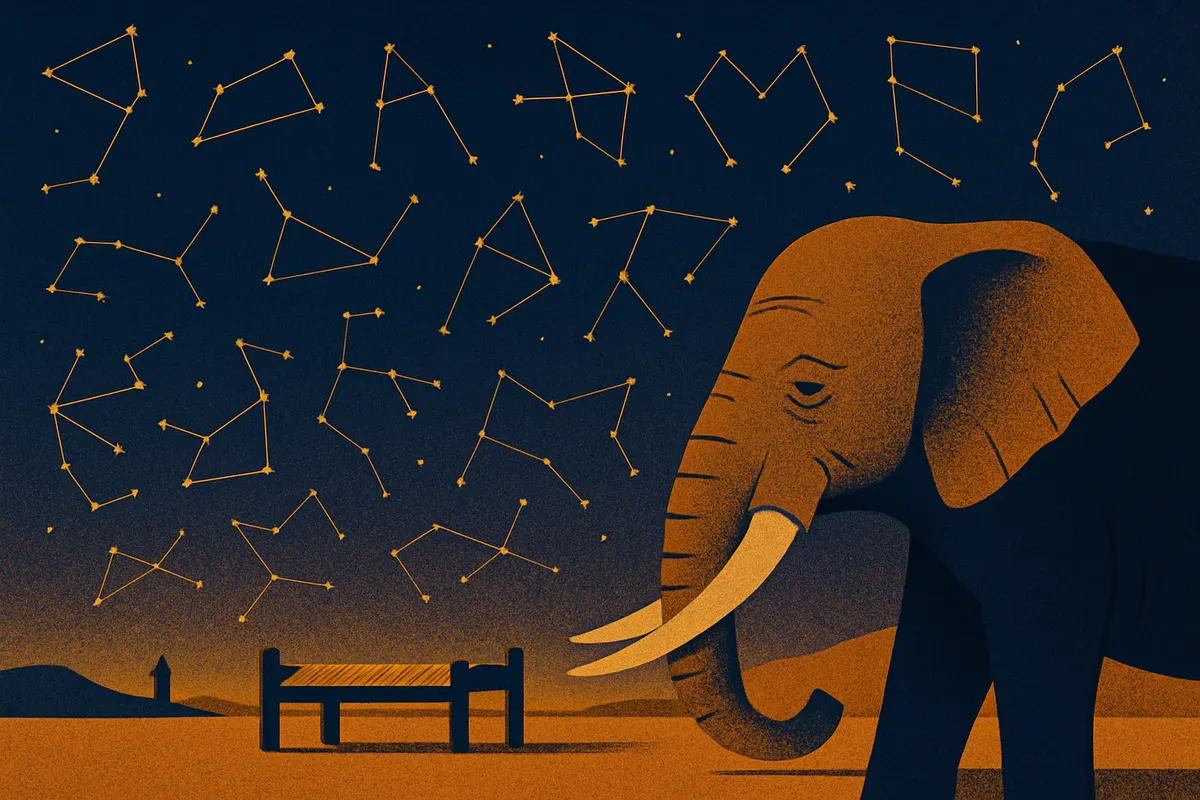
Uttara Ashadha Nakshatra is the 21st of the 27 nakshatras (lunar mansions) in Vedic astrology, spanning 26°40' of Sagittarius to 10°00' of Capricorn. Its ruling lord is the Sun and its deity is the Vishvedevas, the assembly of the universal gods. Its name means "the later invincible", its symbol is an elephant's tusk, and its natives tend to form convictions slowly that, once formed, hold.
Uttara Ashadha is also spelled Uttarashadha, Uttara Ashada or Uttarashada, and in Devanagari it is उत्तराषाढ़ा. It is a nakshatra, not a rashi, and it is unusual in belonging to two rashis: Sagittarius holds pada 1 and Capricorn holds padas 2 to 4. Find where your Moon falls with the free Nakshatra Finder.
What does Uttara Ashadha Nakshatra mean?
Uttara Ashadha's name is generally translated as "the later invincible," a name it shares in structure with its predecessor Purva Ashadha ("the earlier invincible"). Where Purva Ashadha's conviction arrives early and forward, Uttara Ashadha's arrives slowly and settles. Classical texts describe this asterism's natives with a particular kind of quiet steadiness: they rarely bring sudden upheaval or the magnetic forward pull of their sibling constellation. Instead they arrive at a reading, or at a life decision, with convictions that have had time to mature into something close to certainty — long obligations honored for decades, work that comes to fruition only in the second half of the working life.
Which signs does Uttara Ashadha Nakshatra span?
Uttara Ashadha spans two signs: Sagittarius 26°40'–30°00' (pada 1) and Capricorn 0°00'–10°00' (padas 2–4). The first pada sits in the closing degrees of Sagittarius, Jupiter's mutable fire sign of expansive dharmic seeking; the remaining three padas sit in the opening third of Capricorn, Saturn's disciplined cardinal earth sign. The native is therefore positioned precisely at the seam where Jupiter's expansive fire hands off to Saturn's consolidating earth — and the mansion's signature reflects that handoff directly: an ethical conviction (Sagittarius) that becomes durable, established institution (Capricorn).
Why is the Sun the ruling lord of Uttara Ashadha Nakshatra?
The Sun takes the twenty-first place in the lord cycle that starts at Ashwini, and its rulership here gives Uttara Ashadha natives the temperament of the mature elder: outwardly composed, carrying the kind of steady ethical conviction that a surrounding community turns to when something needs deciding. Classical texts describe the pairing as fitting: a nakshatra that straddles the boundary between dharmic seeking and disciplined consolidation needs precisely what the Sun offers — a steady, visible center that holds while the underlying energy shifts from seeking outward to consolidating inward.
Who are the Vishvedevas, the deities of Uttara Ashadha Nakshatra?
Uttara Ashadha is presided over by a convened assembly, the Vishvedevas or "all the gods," rather than a single named deity, typically enumerated as ten and invoked together in the older Vedic liturgy whenever a community's shared dharma is being ratified or its long-running covenant renewed. This collective presidency is the structural key to the mansion. Uttara Ashadha natives, by this signature, carry convictions oriented toward what an entire community can eventually recognize as legitimately shared ground, rather than the partisan convictions of a single faction. This is why these natives so often end up in the chair of the board, on the elder council, or as the convener whose rival factions are still willing to accept as steward of their disagreement — the native who has learned to convene rather than command arrives at the second half of life with a standing that more directive temperaments rarely match.
What do the classical texts say about Uttara Ashadha Nakshatra?
Brihat Parashara Hora Shastra gives this nakshatra the qualities dhruva (fixed, permanent) and sthira (steady, established) — a pairing that describes both a fixed reference point the surrounding community orients around, and work built to last rather than improvised for the moment. Phaladeepika describes a Moon in Uttara Ashadha as kind and firm, flourishing in roles of long-running responsibility, and — this is the mansion's most distinctive classical note — arriving at its mature form later in life than most other nakshatras, after decades of patient earlier work lay the foundation. Saravali connects the mansion to the steady establishment of durable institutions and to a public-facing fairness that earns trust across factions who might otherwise be at odds.
None of this promises that a native wins in any given contest. Aparajita, "unconquered," is a negative construction — it describes not being defeated, not prevailing outright — and the distinction matters. The Uttara Ashadha signature is endurance: a conviction still standing after the opposition has exhausted itself, an institution that outlasts several hostile administrations. A native can spend an entire career on the losing side of an argument and still fully carry this signature, because what the tradition credits is that the conviction was not broken by it.
What are the four padas of Uttara Ashadha Nakshatra?
Because Uttara Ashadha straddles a sign boundary, its four padas show more variation than a mansion contained entirely within one sign.
The first pada (Sagittarius navamsa, 26°40'–30°00' Sagittarius) is sub-ruled by Jupiter, is vargottama (its navamsa sign matches its rashi), and produces the most expansively ethical of the four — natives often serve as the moral convener, the elder whose standing lets them articulate the group's shared values. The second pada (Capricorn navamsa, 0°00'–3°20' Capricorn) is sub-ruled by Saturn, is also vargottama, and produces the most formally institutional of the four, common among long-tenured directors and senior judicial figures. The third pada (Aquarius navamsa, 3°20'–6°40') is also sub-ruled by Saturn, but with an outsider's edge that favors founding new institutions where established ones have failed. The fourth pada (Pisces navamsa, 6°40'–10°00') is sub-ruled by Jupiter again, this time through water, favoring a more contemplative or devotional expression of the same convening role — the senior teacher within a tradition, the long-tenured scholar of religious texts.
What is the Sun Mahadasha like for an Uttara Ashadha Moon?
Because the Sun rules this nakshatra, its six-year Mahadasha tends to be the chapter in which the mansion's late-ripening signature becomes visibly formal: a directorship offered, a committee chair accepted, a senior teaching role consolidated. Classical texts describe the years preceding this period as ones of quiet accumulation — the standing being built before it is formally recognized — and warn that where the natal Sun is afflicted, the same period can bring the visible role together with health pressure or friction with the institutions the native serves. The classical remedy is sustained observance of the Sun, particularly recitation of the Aditya Hridaya at sunrise and the offering of water to the rising Sun on Sundays.
What happens in Sade Sati for an Uttara Ashadha Moon?
Because the nakshatra straddles two signs, natives born in the first pada (Moon in Sagittarius) experience Sade Sati through Saturn's transit of Scorpio, Sagittarius, and Capricorn, while natives of padas two through four (Moon in Capricorn) experience it through Sagittarius, Capricorn, and Aquarius. For the second group, the middle phase falls in Saturn's own sign, giving that central period a particular intensity. In both cases, the classical reading is that this transit tests the native's institutional commitments — what is brittle in them dissolves, and what is genuinely durable is consolidated and emerges more clearly the native's own.
Does Uttara Ashadha Nakshatra guarantee victory?
No, and the name invites a specific misreading worth setting straight. It does not promise victory in any given contest, only endurance through it. Nor does its late-ripening signature guarantee that the ripening arrives automatically — it describes how the native's gifts are typically shaped, not a promissory note against the native's own effort. And its fixed, steady qualities describe conviction that holds under pressure, not an inability to be moved by evidence; a native who cannot be argued out of a position even with clear evidence in front of them is not expressing this nakshatra's actual gift.
How does Uttara Ashadha relate to Purva Ashadha and Shravana?
Uttara Ashadha follows Purva Ashadha, the mansion of the earlier, forward-moving invincibility, and precedes Shravana, the mansion of patient, receptive listening. The pairing with Purva Ashadha is the more instructive of the two, since the two mansions share the same root name and are read as a matched set: Purva Ashadha's conviction arrives early, publicly, and with momentum; Uttara Ashadha's arrives later, is tested by the intervening years, and becomes durable rather than merely forceful. A chart carrying strong placements in both mansions — Moon in one, Lagna or a significant planet in the other — often shows exactly this progression across a single lifetime, from early forward energy to later consolidated standing.
The Sun Mahadasha that opens for a native with the Moon in Uttara Ashadha is worth reading against this same arc. Because Surya's period is the shortest of the nine, at six years, it rarely completes the mansion's characteristic late ripening on its own; the fuller picture usually requires tracking the Sun period against the native's subsequent Jupiter or Saturn periods, since Uttara Ashadha's convictions tend to mature across decades rather than within any single dasha.
How do I know if my Moon is in Uttara Ashadha Nakshatra?
The Moon is in Uttara Ashadha from 26°40' of Sagittarius to 10°00' of Capricorn. Enter your birth date, time and place into the Nakshatra Finder for the nakshatra and pada, on the sidereal zodiac with the Lahiri ayanamsa (background at /tools).
The pada decides your Moon sign here: pada 1 is Sagittarius, padas 2 to 4 are Capricorn, and that moves the timing of Sade Sati. Padas 1 and 2 are also vargottama. Your first dasha is the Sun's, six years long before adjusting for birth degree. /kundli/new gives the full timeline.
Frequently asked questions
What is Uttara Ashadha Nakshatra?
Uttara Ashadha is the twenty-first of the 27 nakshatras in Vedic astrology, meaning "the later invincible". It spans the last 3°20' of Sagittarius and the first 10° of Capricorn, is ruled by the Sun, and is presided over by the Vishvedevas, the collective assembly of the universal gods.
Who is the ruling planet of Uttara Ashadha Nakshatra?
The Sun is the ruling planet of Uttara Ashadha. A person born with the Moon here begins life in a six-year Sun Mahadasha, often associated with the early establishment of a public or family role whose fuller ripening comes across the following decades.
Which zodiac sign is Uttara Ashadha Nakshatra in?
Both. Pada 1 lies in the last 3°20' of Sagittarius and padas 2, 3 and 4 lie in the first 10° of Capricorn, so the Moon sign is Sagittarius for pada 1 and Capricorn for the rest. That split is why Sade Sati is timed differently within this single nakshatra.
What are the personality traits of Uttara Ashadha natives?
Classical texts describe these natives as steady, patient and fair-minded, with convictions that mature slowly but hold firmly once formed. They are typically drawn to roles of long-running responsibility and often reach their most visible achievements later in life than average.
What careers suit Uttara Ashadha Nakshatra?
Careers involving long-tenured institutional leadership suit this nakshatra well: the judiciary, senior administration, education and any founding role sustained across decades. The mansion favours slow, durable achievement over rapid early success, and its natives often end up convening others rather than commanding them.
What is the symbol and deity of Uttara Ashadha Nakshatra?
The symbol is an elephant's tusk or a wooden cot, both images of weathered, load-bearing strength. The presiding deities are the Vishvedevas, the collective of universal gods invoked when a community's shared dharma is being affirmed or a long-running covenant renewed.