Timing & dasha
Mahadasha
Mahadasha is the major planetary period in the Vimshottari Dasha system: a stretch of 6 to 20 years during which one of the nine grahas is treated as the dominant influence on life. Everyone passes through the same nine Mahadashas in the same order, but the planet you start with, and so every date afterwards, is set by the Moon's Nakshatra at birth.
Mahadasha is also written Maha Dasha or Mahadasa, and in Devanagari महादशा; people search "mahadasha order" and "which mahadasha am I in" for the same idea. It is not a transit (Gochara), not the sub-period inside it (the Antardasha), and not the whole 120-year system, which is the Vimshottari Dasha.
What is a Mahadasha?
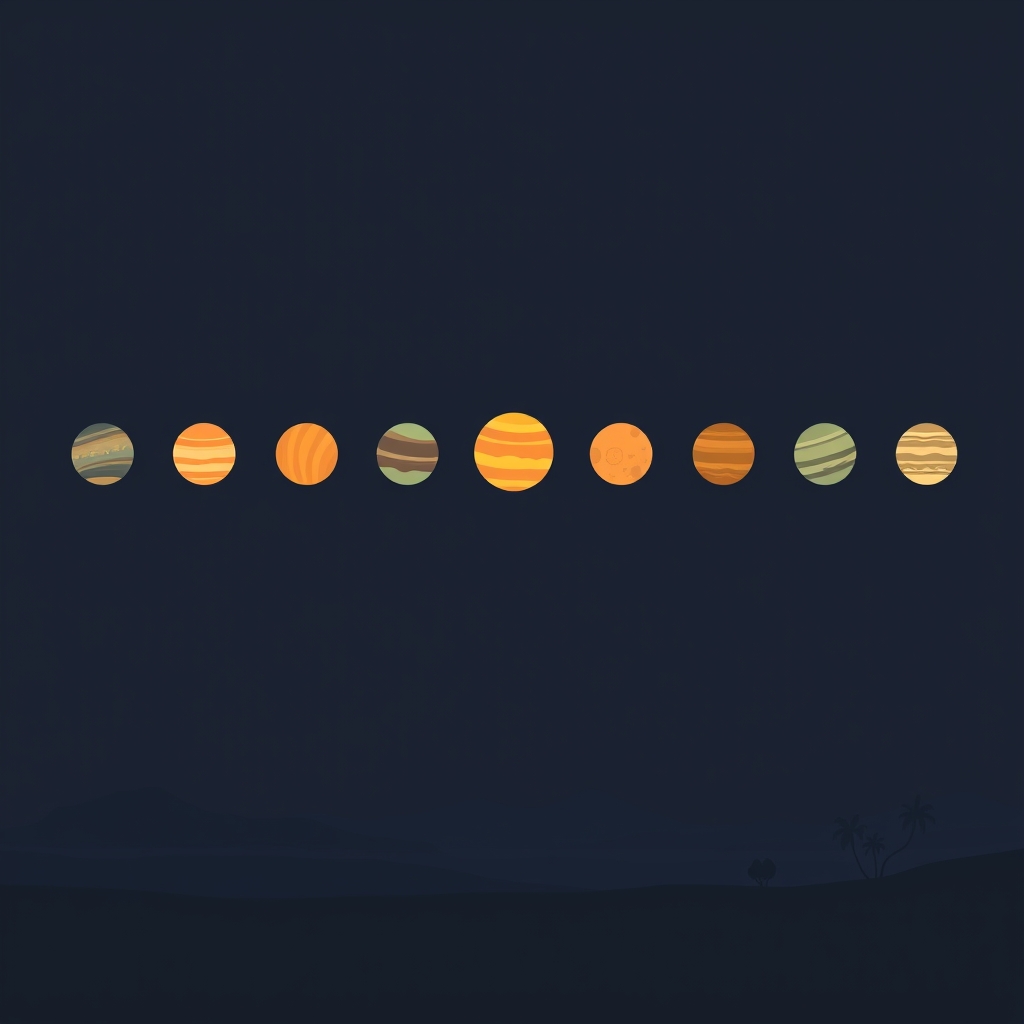
Mahadasha means "major period" — the span of years during which one of the nine grahas is treated as the dominant influence on a life. It is the top level of the Vimshottari Dasha hierarchy, and it is widely used as the single most consulted timing tool in day-to-day Vedic practice. A Mahadasha is rarely read as a flat block: it colours a stretch of years with its ruling planet's themes — expansion for a Jupiter period, discipline and slower structural work for a Saturn period — and is then refined by the sub-periods inside it.
Mahadasha order and years
The nine Mahadashas always run in this order, with a fixed length in years: Ketu (7) → Venus (20) → Sun (6) → Moon (10) → Mars (7) → Rahu (18) → Jupiter (16) → Saturn (19) → Mercury (17). Venus is the longest at 20 years and the Sun the shortest at 6. After Mercury the cycle returns to Ketu. Neither the order nor the lengths change from chart to chart; only the starting planet does.
Which Mahadasha am I in?
Start with the Nakshatra the Moon occupied at your birth: its ruling planet is your first Mahadasha lord, and the Moon's exact degree within the Nakshatra sets how much of that first period was left at birth. Add the fixed lengths above in order from there and you reach the Mahadasha running today. The Dasha calculator does the arithmetic from your birth date, time and place, and shows your current Mahadasha with its start and end dates. Because dates move by months per hour of birth time, use the most accurate time you have.
Is a Mahadasha good or bad, and can it be skipped?
Neither, by itself. Classical practice reads a Mahadasha's themes together with how well-placed and supported its ruling planet is in the individual chart, plus the Antardasha running within it, so the same planet's Mahadasha can play out very differently across two charts. No Mahadasha is skipped: across the full 120-year cycle everyone runs through all nine in the same order, and a person born part-way through one simply enters the sequence at that point. Each Mahadasha subdivides into nine Antardashas, then Pratyantardashas.
Mahadasha at a glance
- Mahadasha order (always): Ketu (7 years) → Venus (20) → Sun (6) → Moon (10) → Mars (7) → Rahu (18) → Jupiter (16) → Saturn (19) → Mercury (17).
- The nine Mahadashas total exactly 120 years, the full Vimshottari cycle.
- The longest Mahadasha is Venus at 20 years and the shortest is the Sun at 6 years.
- The starting Mahadasha is set by the ruling planet of the Moon's Nakshatra at birth.
- Each Mahadasha subdivides into 9 Antardashas, and each Antardasha into 9 Pratyantardashas.
Frequently asked questions
What is a Mahadasha?
- A Mahadasha is a major planetary period in the Vimshottari system, ruled by one of the nine grahas and lasting between 6 and 20 years. The Mahadashas of a life follow each other in a fixed order across a 120-year cycle, and the current one is the main background theme against which everything else is read.
What is the order of Mahadashas?
- Always the same nine-planet sequence: Ketu, Venus, Sun, Moon, Mars, Rahu, Jupiter, Saturn, Mercury, lasting 7, 20, 6, 10, 7, 18, 16, 19 and 17 years, totalling 120. What differs per person is only which planet the individual sequence starts on and how much of it was already over at birth.
How do I know which Mahadasha I am in?
- Your starting Mahadasha is fixed by the ruling planet of your Moon's birth Nakshatra, and how far into it you already were is set by the Moon's exact degree within that Nakshatra. From there the fixed durations let you count forward to today, or you can enter your birth details in a Dasha calculator.
How long can a single Mahadasha last?
- It depends on the ruling planet: the shortest is the Sun's at 6 years and the longest is Venus at 20. Because the starting Mahadasha is set at birth, some people spend their whole childhood and adolescence inside one long period such as Venus or Saturn, while others move through two or three shorter ones over the same ages.
Can a Mahadasha be skipped?
- No. In principle every life cycles through all nine Mahadashas in the same fixed order across the 120-year Vimshottari cycle, restarting from the beginning if a lifespan exceeds 120 years. Only the entry point differs: a person born part-way through a Mahadasha starts there rather than at the beginning of it.
Is a Mahadasha always good or bad?
- Neither, by itself. Classical practice reads a Mahadasha's themes together with how well placed and supported its ruling planet is in the individual birth chart, and with the Antardasha running inside it. The same planet's Mahadasha can therefore feel very different across two different charts.
Read more
- Jupiter Mahadasha: 16-Year Effects, Antardashas, Remedies
- Saturn Mahadasha: 19-Year Effects, Antardashas, Remedies
- Moon Mahadasha: 10-Year Effects, Antardashas, What to Do
- How to Read a Vedic Birth Chart: 7 Steps, Lagna to Dasha
See where Mahadasha shows up in your own chart — generate your free kundli.
Related terms
- Antardasha
Antardasha (also called Bhukti) is a 'sub-period' inside a Mahadasha — nine of them, one per graha, in the same fixed order. Its length is the Mahadasha's years multiplied by the sub-period lord's years and divided by 120, which adds finer timing inside the Mahadasha.
- Pratyantardasha
Pratyantardasha (Pratyantar Dasha) is the 'sub-sub-period' inside an Antardasha — the third level of the Vimshottari Dasha system, used for month-level timing. Its length is the Antardasha's length multiplied by the sub-sub-period lord's years and divided by 120.
- Vimshottari Dasha
Vimshottari Dasha is the 120-year planetary period system described in the Brihat Parashara Hora Shastra, calculated from the Moon's Nakshatra at birth. It runs nine Mahadashas in a fixed order and is the default Dasha system in modern Vedic practice.
- Nakshatra
Nakshatra is one of the 27 lunar mansions of Vedic astrology, each spanning 13°20′ of the zodiac — a finer division than the twelve Rashis. The Moon's Nakshatra at birth sets the starting point of the Vimshottari Dasha and is read as a strong indicator of disposition.