A Note Before We Begin
Among the seekers I have read for over the years, the natives of Mūla announce themselves more quickly than the natives of most other lunar mansions. They arrive at the consultation already half-uprooted — having recently left a marriage, a profession, a city, a settled identity that everyone around them assumed they would carry to the end of their life. They describe the chapter that just closed without any of the wistfulness one might expect, as if the closing had been the necessary prelude to the question that brought them to the consultation. They want to know what lies beneath, and whether the surface arrangements of their life had ever in fact been the foundations they had imagined them to be. Reading their charts, I find Mūla recurring with a frequency that confirms what the older astrological tradition is essentially saying about this asterism: this is the nakshatra of the seeker who must reach the root, and the seeker who reaches the root must first be willing to lose the surface.
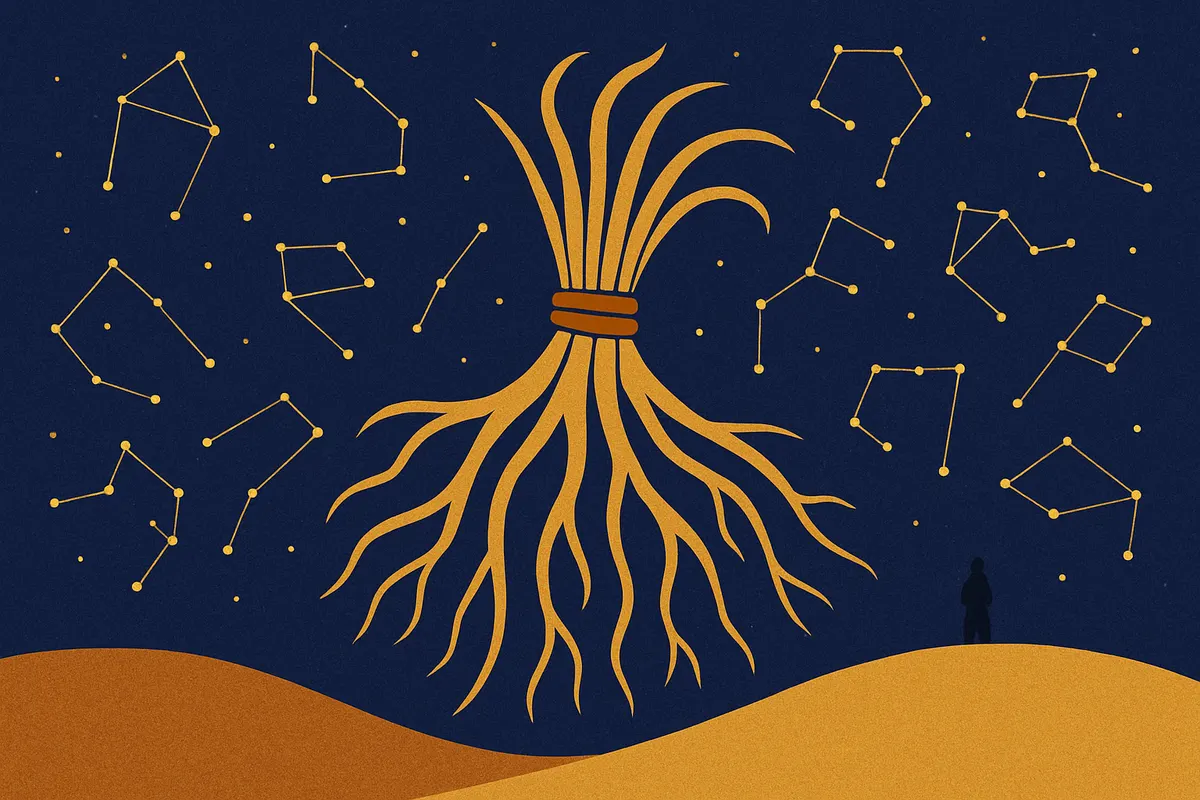
The classical sources describe Mūla through several images, and each opens a different window onto the same signature. The most ancient is the bundle of tied roots — the mūla-baddha — pulled out of the earth and held together by the harvester's cord. The second is the lion's tail, given by older commentators to indicate the closing flick of an animal's body where the long line of the spine ends and the next motion begins. The third is the elephant goad, the aṅkuśa, by which the great beast is turned in a new direction by the small but precisely placed pressure. The fourth, developed across the older Vedic literature around Nirṛti herself, is the threshold itself — the place where one phase of life is dissolved so that the next may begin. Each of these images returns us to the same theme: a moment of decisive uprooting that the asterism asks its natives to undergo, willingly or unwillingly, so that what was hidden at the root may be brought into view.
This article is for the seeker who has just learned that their Moon, their Lagna, or another sensitive point in their chart sits in Mūla. We will move slowly, beginning with what the classical texts actually say, then turning to Nirṛti and the Vedic theology of dissolution, the gandānta threshold at the Scorpio-Sagittarius border, the four pādas across the opening third of Dhanus, the Ketu Mahādaśā for these natives, and finally to the practical questions of body, livelihood, and the relationships in which Mūla natives most fully come into their own. Read this with your chart open if you have it. Underline what feels true.
Where Mūla Sits in the Wheel
Mūla is the nineteenth of the twenty-seven nakshatras. It occupies the zodiacal range from zero degrees to thirteen degrees twenty minutes of Dhanus (Sagittarius), which means that all four pādas of this nakshatra lie squarely within the Jupiter-ruled mutable fire sign of dharmic seeking. Unlike Anurādhā before it, which sits in the central body of Vṛścika, or Pūrva Aṣāḍhā after it, which lies further into Sagittarius and away from the boundary, Mūla opens the Sagittarius arc and carries the particular weight of being the asterism that begins the new sign. The native born under this nakshatra is therefore stationed at the very threshold where the deep waters of Vṛścika are left behind and the dharmic fire of Dhanus is taken up.
The lord of Mūla is Ketu, the south lunar node, whose nature in the classical reading is the opposite face of Rāhu — where Rāhu hungers for new experience, Ketu releases attachment to experience already had. The pairing of Ketu's rulership with Dhanus's seeking gives Mūla natives a temperament that the older texts read as the spiritual researcher's signature: outwardly directed toward truth, inwardly carrying the willingness to let go of every interim resting place along the road to that truth. The classical reconciliation is that Ketu's gift to a Sagittarius nakshatra is precisely what the dharmic fire most needs — the renunciatory edge that prevents the seeker from settling for an answer that is merely partially correct. Where Jupiter-ruled Sagittarius without Ketu might solidify into a comfortable orthodoxy, Ketu-ruled Mūla keeps the search alive by continuously dissolving the resting place the search had reached.
The presiding deity, Nirṛti, is one of the most distinctive divinities in the older Vedic pantheon, and the seeker reading about Mūla for the first time should be prepared for the fact that the classical sources do not soften her. Nirṛti is the goddess of dissolution, of decay, of the unbinding force that takes apart what has been built. She is invoked in the older Vedic hymns as the deity who must be propitiated when a phase of life ends, when a household disperses, when a body returns to the elements. The name itself — nir-ṛti, meaning without ṛta, that is, outside the cosmic order — points to her function: she is the threshold-deity who oversees the dismantling of the existing order so that the new order may take its place. To be born under Mūla is to be born under the protection, and the testing, of the deity who specialises in endings.
What the Classics Actually Say
Brihat Parashara Hora Shastra, in its enumeration of the lunar mansions (BPHS, Nakṣatra Adhikāra), names Ketu as the lord of Mūla and Nirṛti as the presiding deity, and assigns to it the qualities of tīkṣṇa — sharp or piercing — and dāruṇa — fierce or harsh. The pairing of these two terms is, in BPHS's diction, an unusually unsoftened description. Most nakshatras are given a primary quality and a softening secondary; Mūla receives two qualities that together emphasise the asterism's edge. Parāśara is not warning the reader away from Mūla natives — he is preparing the reader for the fact that the nakshatra's signature is one that does not present itself with the gentleness of, say, Mṛga or Anurādhā. The Mūla native cuts through to the matter, and the matter that is cut through to is often something the surrounding people would have preferred to leave in its undisturbed condition.
Phaladeepika by Mantreśvara (Chapter 2 on nakshatra qualities) elaborates that natives born when the Moon is in Mūla tend toward a philosophical temperament, a willingness to ask the difficult question the rest of the assembly is avoiding, and a constitutional inclination toward inquiry into first causes. Mantreśvara is explicit that this nakshatra produces natives who flourish in investigation — the older translation reads as mūla-anveṣaka, the seeker of the root — and who often find themselves placed in callings that require the patient excavation of foundations. The capacity is not the diplomatic intelligence of Tulā or the assembling intelligence of Hasta; it is the deeper investigative gift of the Mūla principle, which operates by going beneath the visible and bringing back what was lying at the bottom.
Saravali by Kalyāṇa Varma (Chapter 11 on lunar mansions) emphasises Mūla's connection to early loss and to the spiritual recovery that this loss makes possible. The image he draws is of the seedling pulled up early so its root system could be examined, and of the gardener who, having looked at the root, understands the plant in a way the gardener who only saw the leaves never could. Kalyāṇa Varma is candid that the early life of Mūla natives often carries a chapter of significant uprooting — a parental separation, a relocation that broke the continuity of childhood — that the older sources read as the asterism's first lesson in the impermanence of surface arrangements. The Saravali reading aligns precisely with Phaladeepika's note about philosophical temperament: this is the native whose seeking has been kindled early by the experience of having lost something the other children around them did not lose.
The Jaimini Sūtras give us, again, the Chara Kāraka tool for reading Mūla signatures indirectly. When a planet positioned in Mūla rises to the rank of Atma Kāraka or Amatya Kāraka in a chart, the matters of that planet take on the Nirṛti quality — investigative, dissolution-touched, willing-to-be-uprooted — and the native's soul-task or livelihood-task carries the root-seeking signature of the asterism.
Nirṛti and the Gandānta Threshold
To understand what Nirṛti is asking of a Mūla native, we have to step briefly into the older Vedic theology of dissolution. Nirṛti appears in the Ṛgveda already as a deity who must be addressed when something is to be unbound — a body at cremation, a marriage that is being formally dissolved, a settlement that is being abandoned. She is the keeper of the threshold across which what was held together is allowed to fall apart, and the Vedic ritualist invokes her not because dissolution is desired but because dissolution, when it must happen, is better held within the cosmic order than left to occur outside it. The older liturgy is precise on this point: Nirṛti is outside ṛta only in the sense that she presides over the moments when ṛta's existing form is dissolved to make room for ṛta's next form. She is not opposed to the cosmic order — she is the cosmic order's own caretaker of its renewal.
For the Mūla native, this Nirṛti theology is the structural teaching of the asterism. The dissolutions the native is asked to undergo are not random misfortunes; they are the disciplined moments at which the surface arrangements of the life are dismantled so that the deeper arrangement may be brought forward. The job that ends, the relationship that closes, the city that is left behind, the inherited identity that is set down — these are, in the older reading, Nirṛti's offerings to the native who is being prepared for the next chapter. This is why the Mūla temperament reads as paradoxical on the surface — outwardly marked by upheaval, inwardly anchored by the conviction that the upheaval is taking the life somewhere worth going — and why Ketu's rulership of this Nirṛti-presided nakshatra is, on closer reading, exactly the right pairing. Ketu is the planet that releases attachment to what has been outgrown. Ketu is the planet that prevents the native from clinging to the form whose dissolution Nirṛti is presiding over. Without Ketu, Nirṛti's dissolutions would be experienced as catastrophes; with Ketu, they are experienced as the necessary doorways the seeking life has been asking for.
The further nuance the older texts develop is the gandānta question. Mūla begins at zero degrees of Dhanus, which is the precise junction between the water sign of Vṛścika and the fire sign of Dhanus — the Scorpio-Sagittarius gandānta, one of the three water-fire boundaries that the older astrological tradition reads with particular care. The first degrees of Mūla are the most intense gandānta zone of all the asterisms whose lord is Ketu, and the older sources note that natives born in these opening degrees often carry, throughout their lives, a particular sensitivity to thresholds — a heightened awareness of the moments at which one phase of life is ending and the next is opening, sometimes years before the surrounding people register the same shift. This sensitivity is the asterism's gift in its mature form, and it is the asterism's burden in its unintegrated form, where the native may experience each closing as a fresh wound rather than as the doorway it actually is.
The Four Pādas in the Opening of Dhanus
Mūla's four pādas all lie in Dhanus, but each pāda is sub-ruled by a different Vimshottari lord, and the differences in temperament between the pādas are noticeable enough that two Mūla natives born in different quarters of the nakshatra will recognise themselves in each other only partially. Because the entire nakshatra sits in Jupiter's mutable fire sign, every pāda carries the dharmic seeking as its base layer; what changes is the manner in which that seeking expresses itself, and the relationship the native has to the gandānta intensity that diminishes across the four pādas as the nakshatra moves further into the body of Sagittarius.
The first pāda — zero degrees to three degrees twenty minutes of Dhanus — falls in the Aries navāṃśa and is sub-ruled by Mars. This is the gandānta pāda proper, the most sensitive birth zone in the entire asterism, and the older sources are explicit that natives born here carry the deepest Mūla signature in its rawest form. The Mars sub-rulership adds a forward-impulse quality to the gandānta sensitivity, so these natives are the ones who not only feel the threshold most keenly but also act decisively at the moment of crossing. The classical counsel for first-pāda natives is that the early life often carries one or more significant uprootings, and that the integration of the asterism's gift typically requires the native to come to terms, in adult life, with what those uprootings were preparing them for. The Sanskrit ritual literature recommends Mūla-śānti — the propitiatory ritual specifically designed for first-pāda natives — within the first months of birth where this is feasible, and the contemporary practice of this ritual continues in many traditional households.
The second pāda — three degrees twenty minutes to six degrees forty minutes of Dhanus — falls in the Taurus navāṃśa and is sub-ruled by Venus. This is the pāda of the grounded seeker, the philosophical investigator whose work is steadied by the Taurean love of the concrete. Natives born here often present as the Mūla native most able to hold the asterism's signature without being shaken by it — the Venus sub-rulership gives a sweetness and a sensual rooting that softens the otherwise stark Ketu-Nirṛti combination. These are the natives whose seeking takes the form of patient, beautifully structured inquiry, and whose dissolutions come less as ruptures and more as graceful transitions.
The third pāda — six degrees forty minutes to ten degrees of Dhanus — falls in the Gemini navāṃśa and is sub-ruled by Mercury. This is the pāda of the articulating seeker, the Mūla native whose investigative gift expresses itself in writing, in teaching, in the precise verbal naming of what has been excavated. Natives born here tend to express the asterism's signature through the way they communicate the results of their seeking — through the careful prose, the lecture that reorganises the listener's understanding, the book that takes the reader to the root of a question they had only half-formulated to themselves. The Mercury sub-rulership gives this pāda a textual quality: these are the natives who become the writers and translators of philosophical material, the editors who turn raw insight into readable form.
The fourth pāda — ten degrees to thirteen degrees twenty minutes of Dhanus — falls in the Cancer navāṃśa and is sub-ruled by the Moon. This pāda is the most reflective and emotionally textured of the four. The Cancer-Moon sub-rulership softens the Ketu austerity considerably and gives the native a domestic, family-oriented relationship to the seeking — these are the Mūla natives whose root-investigation often takes the form of inquiry into their own family of origin, their own ancestral lineage, the deep interior life of the home from which they emerged. The dissolutions for fourth-pāda natives often involve the household and the family, and the integration involves the conscious carrying-forward of what the family had failed to bring fully into the light.
The Ketu Mahādaśā for the Mūla Native
Because Ketu is the lord of this nakshatra, the Ketu Mahādaśā in a Mūla native's life carries a particular density of meaning. The seven-year period of Ketu, when it falls upon a person whose Janma Nakshatra is Mūla, tends to operate as the chapter in which the native is asked to release what has been outgrown and to make space for the more essential form of the life that lies beneath. The principle is the one we cited in the Vishākhā discussion: BPHS gives, in the Vimshottari Adhikāra, the rule that the Mahādaśā of the nakshatra-lord acts most powerfully on the matters that the nakshatra itself signifies, and Mūla signifies the root that becomes visible only when the surface has been cleared away.
For natives whose Ketu Mahādaśā has not yet arrived, the years preceding it are usually spent in the slower work of accumulating the surface arrangements — the career, the household, the social roles — that the daśā will later examine. When the Ketu daśā opens, these arrangements come under the Nirṛti-touched questioning. Roles that were not built on the deeper Mūla principle tend to fall away during these years; vocations that were so built deepen further and acquire the specific Ketu-quality of becoming the renunciatory infrastructure of the native's seeking. The same is true of marriages, friendships, devotional practices. The daśā is not destructive of structures — it is testing of them — and the structures that pass the test emerge clarified rather than diminished.
There is a classical caveat that Mantreśvara raises in Phaladeepika (Phaladeepika, Chapter 19, on Mahādaśā fruits). When the Mahādaśā lord is afflicted in the natal chart, the daśā can deliver its results in a way that costs the native more than expected. For Mūla natives whose natal Ketu is afflicted — closely conjunct a malefic without redemptive aspects, or placed in a dusthāna without classical mitigation — the Ketu Mahādaśā may bring the dissolution of arrangements together with periods of disorientation that test the native's hold on the seeking itself. The classical remedy is sustained Ketu-related observance, particularly on Tuesdays when Mars (Ketu's natural ally) is also given regard, and the disciplined practice of meditation that strengthens the native's interior anchor through the daśā.
The antardaśās within the Ketu Mahādaśā that most consistently bring forward the Mūla signature are the Ketu-Jupiter antardaśā (the renunciatory edge meeting the dharmic teacher in Dhanus's own lord) and the Ketu-Saturn antardaśā (the renunciatory edge meeting the patient testing of Śani). Mūla natives often describe these sub-periods as the chapters in which the philosophical shape of their adult life became clear to them.
The Body and Constitution
The classical texts assign Mūla to a particular set of bodily significations that the practitioner reading a chart should hold loosely but attentively. Saravali, in its enumeration of the body parts governed by each nakshatra, places the feet and the lower legs under Mūla's care, with extended significations covering the lumbar region and the sacral root that the older somatic correspondences associate with the nakshatra's name itself. The image is consistent with the rooted symbolism: the feet, where the body's connection to the earth is renewed at every step, are the somatic seat of Mūla's signature, and the lower spine, which the older Tantric correspondence reads as the seat of the foundational energy, provides the rooted base from which the upward seeking of Sagittarius rises.
In the doṣa typology, Mūla is read as predominantly Vāta with a Pitta secondary — the dry, mobile quality of Ketu and the dharmic fire of Jupiter together producing a constitution that is built for sustained mental work but that can become depleted if not steadied by sufficient grounding practice. The Kapha dimension is the least pronounced of the three. This is in keeping with the Ketu-Jupiter rulership pattern: Jupiter's Pitta dharmic fire at the sign level, Ketu's Vāta dryness at the nakshatra level. The Mūla native is therefore typically built for the long inquiry — the philosophical project, the years of research, the patient tracing of a difficult question to its source — but requires conscious attention to the grounding side of the constitution to avoid the Vāta-aggravation that the asterism's natural temperament can drift into.
The classical health cautions that recur for Mūla natives, drawn from the older nirayana sources and the Āyurvedic-jyotiṣa literature, concentrate around the lower-body grounding and around the nervous-system steadiness that Vāta-predominant natives must consciously cultivate. The classical recommendation is regular practice of grounding posture work, walking on the earth in the early morning, and the steady devotional observance that the Ketu temperament most benefits from. These are preventive measures, not treatments. For any specific health concern, please consult a qualified medical professional.
Career: The Calling That Demands Going to the Root
Mūla is perhaps the one nakshatra whose career signature most clearly involves the patient excavation of foundations. The natives of this nakshatra are drawn to callings in which the surface presentation of the subject is set aside in favour of the deeper structure that lies beneath, and in which the practical work of the calling is the steady tracing of a question or a system to its source. The classical sources read this consistently. Phaladeepika's note about philosophical temperament finds its career application here: the Mūla native is the researcher who refuses to settle for a partial answer, the diagnostic practitioner who keeps asking until the underlying cause is found, the long-form writer whose subject is the foundations that the rest of the field has assumed without examination.
This signature shows up across many surface professions: the historian whose work reorganises the field's understanding of its own origins, the diagnostic practitioner who keeps asking the question more transactional clinicians have given up on, the editor whose contribution is to find the structural fault in the manuscript that surface readers had missed. What unites these professions is a calling whose value is created by going beneath the surface, in which the Mūla native's particular gift for excavation produces results that more horizontally-minded natives cannot replicate. The Mūla native is rarely the rapid generalist of a generation; more often, they are the one who returns from the root with what the surface had concealed.
There is a corollary the older texts warn about. The Mūla temperament is poorly suited to callings that punish patient inquiry and reward rapid surface output — the trade where each week demands a fresh shallow report, the role where the appearance of insight is valued over its substance. Mūla natives placed in such callings often do well in the early years, because their philosophical gift can be presented as fresh thinking, but they tend to find the absence of permission to go deep spiritually corrosive. The classical counsel is to seek a calling in which the root-seeking principle, formally honoured by the institution, can be lived rather than merely performed.
The Jaimini Chara Kāraka system gives us a final tool for reading Mūla-positioned career signatures. When the Atma Kāraka falls in Mūla, the soul-task of the lifetime carries the root-seeking quality, and the native is asked to make their primary work the patient excavation of foundations. When the Amatya Kāraka falls in Mūla, the livelihood itself takes on the investigative pattern, and the native should expect their professional life to organise around the long-form inquiry rather than around the rapid surface deliverable.
Relationships: The Bond That Tests Attachment
The relationship signature of Mūla is, in the classical reading, the most explicitly Ketu-touched relational signature of the lunar mansions whose lord is one of the nodes. Nirṛti is the deity of dissolution; Ketu is the planet of release; Dhanus is the sign of dharmic seeking. The native born under this combination is constitutionally pulled between the dharmic impulse to commit to a path with another and the Ketu impulse to release attachment whenever the attachment threatens to obscure the seeking. The relational task of their life is to find — and to remain present with — partners and friends whose temperaments can accompany the Mūla native through the periods when the asterism's signature requires the dissolution of an outer arrangement without that dissolution being mistaken for the end of the bond itself.
Saravali notes, in its discussion of marital indications for Mūla-Moon natives, that these natives often marry partners whose temperament is steadier than their own, whose grounding provides the counterweight that the Mūla native's investigative temperament most benefits from. Marriages for Mūla natives, when they go well, tend to develop into partnerships in which the Mūla native is given permission to follow the seeking wherever it leads while the partner provides the durable household structure within which the seeking can take place. This does not mean the Mūla native is the unbalanced partner; it means that the partnership operates well when the temperaments are complementary rather than identical.
The shadow side, which Mantreśvara hints at in his subtler comments on the asterism, is the tendency of unintegrated Mūla natives to confuse the interior dissolutions that the asterism asks them to undergo with the exterior dissolution of the bond. Because the Nirṛti principle drives these natives to release what has been outgrown, they can mistake the seasonal pruning of a long marriage for an instruction to end the marriage altogether. The classical counsel here is patience and discrimination — the viveka by which the older Vedānta literature is constituted — to distinguish the interior shedding that the daśā is asking for from the exterior dissolution that would, in fact, be unnecessary. The bond that has held through earlier seasons of pruning is rarely the bond that requires final dissolution; the work, more often, is the further interior pruning that the bond itself has been asking for.
For the Manglik question, Mūla natives whose Mars falls in their first, fourth, seventh, eighth, or twelfth house carry the standard Manglik signature. The first pāda of Mūla, in particular, sits in the Aries navāṃśa whose lord is Mars, and natives born here should give the Manglik consideration close attention during marriage discussions. The older sources note that Ketu's rulership of the nakshatra modulates the Mars effect somewhat — Ketu's renunciatory edge tempers the Mars heat — but the standard Manglik counselling and remedy still apply, and the matching of charts during marriage discussions should not be skipped. For first-pāda natives in particular, the Mūla-śānti observance and the careful koota matching are both classical recommendations.
The Sade Sati Question
Mūla-Moon natives have their natal Moon in Dhanus, and Saturn's transit through Vṛścika, Dhanus, and Makara constitutes their Sade Sati — the seven-and-a-half-year passage that the older astrological literature treats with particular care. Because Mūla sits at the very opening of Dhanus, the first phase — with Saturn in Vṛścika — often presses on the natal Moon's opening degrees before the canonical timing is widely registered. The classical counsel for Mūla-Moon natives is to begin the conscious Saturnine observance somewhat earlier than the canonical timing would suggest, and to attend particularly to the dharmic and devotional disciplines that Saturn's transit through Dhanus most rewards.
Traditional Remedies and Practices
The classical remedy literature for Mūla natives concentrates on three areas of practice. The first is Ketu observance through the regular Ketu Gāyatrī and Ketu stotra — the integration of the renunciatory edge is supported by the regular renewal of Ketu's grace. The second is Nirṛti propitiation, addressed through the classical Mūla-śānti observance, given consistently in the older texts as the foundational ritual remedy for first-pāda natives within the early months of birth where the family follows the traditional practice. The third is dāna — the giving of charity — framed for Mūla around the support of those whose surface arrangements have dissolved: the elderly without family, the displaced, the renunciate community, the institutions that care for the dying.
Closing
The teaching of Mūla, heard at depth, is the teaching of the bunched roots pulled up so what grew beneath the surface may finally be seen. Nirṛti presides over the threshold across which one phase of life is dissolved so that the next may begin. Ketu's rulership is the gift of the renunciatory edge that prevents the seeker from settling for a partial answer. The four pādas in the opening of Dhanus give each native their own flavour of the work, but the underlying signature is the same: this is the asterism of the seeker who must reach the root, and the seeker who reaches the root must first be willing to lose the surface. May the seeker reading this find the courage to undergo the necessary dissolutions, and may Nirṛti hold those dissolutions within the cosmic order to which they belong.
Related cornerstones
If this reading was useful, the following cornerstones address related dimensions of the same broader tradition: