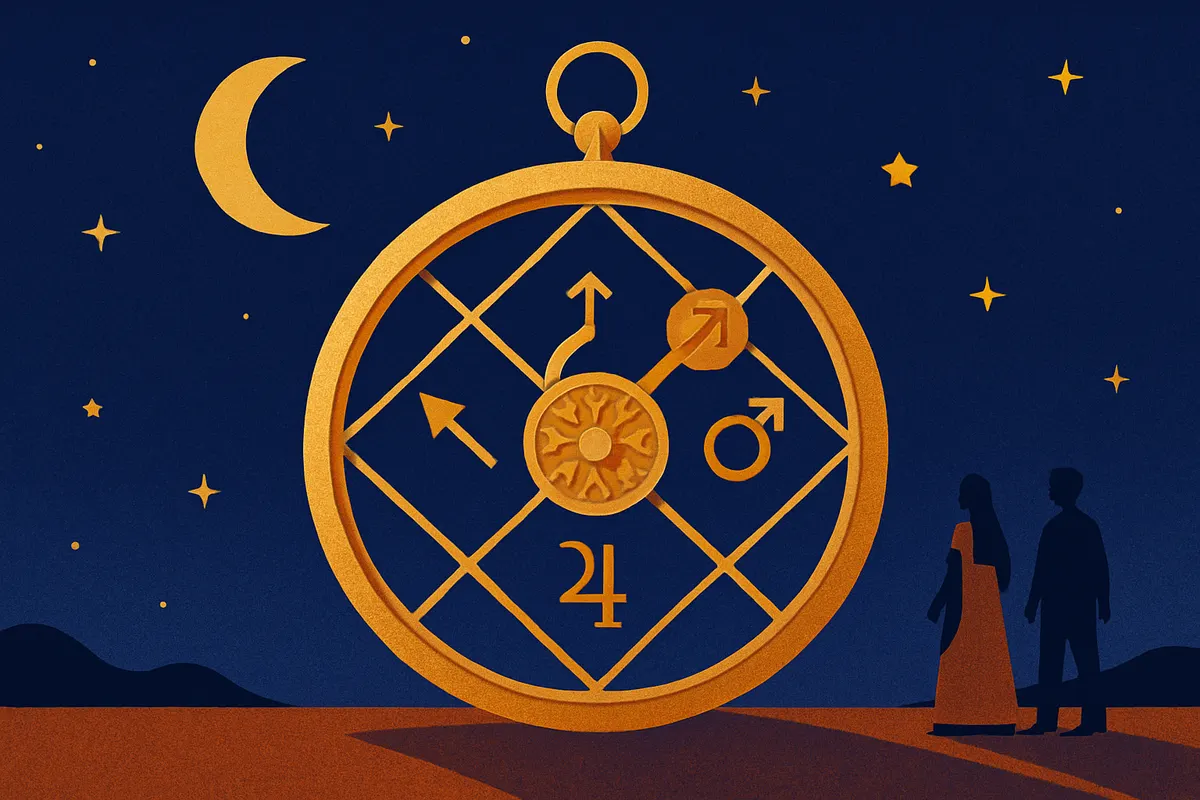
Manglik Dosha cancellation is the classical set of seven conditions in Vedic astrology under which an afflicted Mars is set aside, fully or in part. They include both partners being Manglik, Mars in its own or exalted sign, a Jupiter aspect and a strong Lagna lord. Brihat Parashara Hora Shastra, Mansagari and Jataka Parijata list them alongside the rule itself. The definition sits at Manglik.
Searchers also write Manglik dosh parihar or "Mangal Dosha cancel" (मांगलिक दोष परिहार). A cancellation changes how heavily the placement is read; the placement itself stays in the chart. It is not a puja or a remedy, and it is not a reason to skip the wider match. Most families never hear about these conditions because the matchmaker who reports the flag rarely reads past it.
Why does Manglik Dosha have cancellations at all?
It has cancellations because a system that names an affliction without a way to weigh its severity would be a blunt instrument. Manglik Dosha, Mars in the 1st, 2nd, 4th, 7th, 8th or 12th house from the Lagna (with some traditions also checking from the Moon and Venus), describes friction the tradition calls kalaha (quarrel) and vyatha (distress), not a fixed sentence. Reading only the rule and skipping the exceptions is reading half the chapter. How the rule itself is graded house by house is covered in Manglik Dosha: How It Is Judged, House by House.
What are the seven conditions that cancel Manglik Dosha?
Here they are one at a time.
1. Bilateral Manglik (dosha samya). When both partners carry the dosha, several commentaries hold that the two afflictions neutralise each other rather than compound. The reasoning is that comparable heat meeting comparable heat tempers rather than burns. The qualifier that gets lost is that it works most cleanly when the two placements are roughly matched in severity. Two charts that both show Mars debilitated in the 7th and aspected by Saturn may aggravate each other instead.
2. Mars in its own or exalted sign. A Mars in Aries or Scorpio (its own signs) or in Capricorn (its exaltation) is doing its proper work rather than fighting its placement. The classical position is that a dignified Mars channels its heat into ambition and protective drive rather than domestic friction, and this holds whichever of the six houses it occupies.
3. Mars aspected by Jupiter. Jupiter's aspect, counted as the 5th, 7th and 9th from its position, is one of the most consistently cited softeners. A benefic influence on an afflicted Mars is treated like a calming presence in a room with a hot temper: the underlying heat remains, but its expression is materially gentler.
4. Benefic co-tenancy in the Manglik house. If Jupiter or the Moon sits in the same house as the Manglik Mars, not merely aspecting it but physically present, several commentaries treat this as a partial cancellation, on the same logic as the Jupiter aspect.
5. A strong Lagna lord. This condition looks past Mars to the chart's overall structure. A Lagna lord in a kendra (1st, 4th, 7th or 10th) or trikona (1st, 5th or 9th), in its own or a friendly sign, gives the chart capacity to absorb a difficult Mars the way a well-built house absorbs a minor tremor. A debilitated or afflicted Lagna lord means less reserve to draw on.
6. Marriage after the late twenties. A widely repeated classical observation holds that Mars's volatile qualities settle with age, and several commentators, B.V. Raman among them, read a marriage past the late twenties as facing a lighter version of the same affliction. This does not erase the placement. It describes a lessening of emphasis as the person matures.
7. The flag fires only from the Lagna. In the fuller classical treatment, Manglik status is checked from three reference points: the Lagna, the Moon (Chandra Lagna) and Venus. A chart flagged from all three carries the strictest form. A chart flagged only from the Lagna, with the Moon and Venus readings clean, sits at the softest end. This is the distinction a quick matchmaking check that tests only the Lagna most often skips.
How do you check your own case against the seven conditions?
Work through the conditions in this order, since the first are the fastest to establish and the last need the most chart-reading.
- Is Mars in Aries, Scorpio or Capricorn? (Condition 2)
- Does Jupiter aspect Mars, or share its house? (Conditions 3 and 4)
- Is the partner also Manglik, with a comparably placed Mars? (Condition 1)
- Is the Manglik partner marrying after the late twenties? (Condition 6)
- Is the Lagna lord well placed, in a kendra or trikona and a friendly sign? (Condition 5)
- Does the flag fire only from the Lagna, or also from the Moon and Venus? (Condition 7)
If two or more apply, the textual basis to proceed with the match is real. If none apply and Mars is also debilitated in the 7th or 8th house, the textual basis for a slower, more careful conversation is equally real. That is not a rejection, but a fuller look at the rest of the synastry before deciding.
Bring both birth charts, not a summary sheet. The Lagna lord's exact house, Jupiter's exact aspect and Mars's exact degree decide which conditions genuinely apply, and "Mars is somewhere in the seventh" from memory is not precise enough to run the checklist.
What if two cancellation conditions point in different directions?
Then report both and do not collapse them into one answer. The conditions were compiled across centuries of commentary and occasionally pull against each other. A common case: Jupiter aspects the Manglik Mars (condition 3 applies), but Mars is debilitated in Cancer (condition 2 does not).
The Jupiter aspect softens how the affliction expresses itself, so temper and friction are present but manageable. The debilitation, separately, means the drive and courage Mars supplies are thinner. The honest reading is neither "cancelled" nor "not cancelled": the surface is softer than the underlying structure, and both are worth naming to the family.
Which traditional observances go alongside the cancellations?
Where the cancellations do not clearly apply, the tradition pairs the analysis with observances rather than treating the match as closed. These are framed as practice, not guarantee: a Mangal Shanti puja on a Tuesday, sustained recitation of the Hanuman Chalisa, and donations of red lentils or copper on Tuesdays are the most consistently named.
The tree-marriage or pot-marriage ceremony (Kumbh Vivah) sometimes cited in popular conversation is a regional folk custom, not a core provision of Brihat Parashara Hora Shastra. Families may include or skip it according to their own tradition without changing the chart analysis.
How to check whether a cancellation applies to your chart
Start with the Manglik Dosha calculator: enter your birth date, time and place, and if the result is Manglik it lists the cancellations that apply to your chart. Then use the full reading at /kundli/new to see Mars's exact sign, Jupiter's placement and your Lagna lord together, since conditions 5 and 7 need more than the calculator shows.
For the cross-cultural case, where one partner may have no chart at all, see Manglik Dosha in Mixed and Diaspora Marriages. The related Nadi Dosha check, the other heavily weighted line in the Ashtakoot Milan, has its own cancellation conditions worth reading alongside these.
Frequently asked questions
Can Manglik Dosha be cancelled?
Yes. The same classical texts that name the affliction list several conditions under which it is reduced or set aside, including Mars's dignity, a Jupiter aspect, both partners being Manglik and a well-placed Lagna lord. At least one condition applies in a large share of charts that carry the flag, so check before treating it as a closed question.
What cancels Manglik Dosha completely?
No single condition is universally described as a complete cancellation; the tradition treats the seven conditions as cumulative evidence. Two or more applying together, for example Mars exalted in Capricorn and also aspected by Jupiter, give the strongest textual basis for treating the dosha as resolved.
Does marrying another Manglik person cancel the dosha?
Often, yes. Several commentaries describe this as mutual neutralisation, sometimes called dosha samya. The qualifier is that both placements should be comparably severe, because two very differently afflicted Mars placements do not cancel as cleanly and may aggravate each other.
Does Manglik Dosha go away with age?
Its classical weight is described as lightening after the late twenties, on the reasoning that Mars's volatile qualities settle with maturity. The underlying placement in the chart does not change, but its emphasis in a marriage reading does. Treat age as one of seven conditions, not a cure.
Is a Kumbh Vivah (marrying a pot) required to cancel Manglik Dosha?
No. This ceremony is a regional folk practice, not a requirement in Brihat Parashara Hora Shastra. Families may include it as a tradition of their own, but it is not a classical precondition for the dosha to be considered addressed, and skipping it does not change the chart analysis.
What if none of the seven conditions apply to my chart?
That places the chart in a smaller band where the classical texts recommend a more careful, unhurried look at the full synastry: both partners' Ashtakoot score, the 7th-house strength in each chart and the dasha timing. The reading is neither a rejection nor an assumption that everything will be fine.