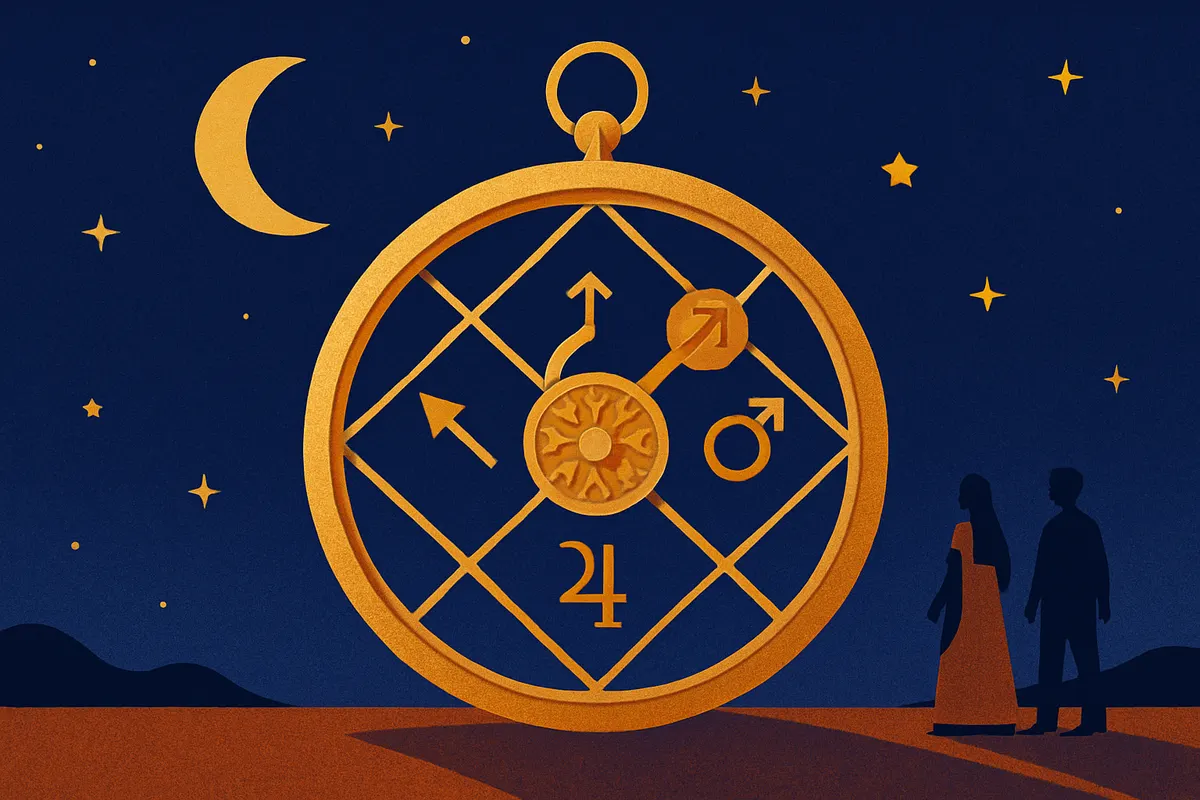
Manglik Dosha is the classical flag raised in Vedic astrology when Mars sits in one of six houses of a birth chart, counted as the 1st, 2nd, 4th, 7th, 8th and 12th from the Lagna. Astrologers judge it by the house Mars holds, its dignity and whether cancellations apply, so it is a graded signal of marital friction, not a verdict. The plain definition is at Manglik.
The condition is also called Mangal Dosha, Kuja Dosha or Bhauma Dosha (मांगलिक दोष), and a person who has it is called Manglik. It is not Kaal Sarpa Dosha, which is a different chart pattern, and it is not a statement about the person's character. The same texts that name the condition also list several conditions that cancel or soften it.
How do astrologers judge Manglik Dosha?
Astrologers judge Manglik Dosha on three questions: which of the six houses holds Mars, how strong and well placed Mars is there, and whether any classical cancellation applies. The label "Manglik" alone answers none of them. It names a chart where Mars, a hot and assertive planet, sits in a house tied to the home, the body or the marriage.
Brihat Parashara Hora Shastra, described on its source page, and later commentators such as B.V. Raman describe the concern plainly: Mars in these positions can add heat to the marital sphere, showing up as sharper early conflict, a strong temperament or a delayed match. The word dosha means a flaw or affliction to be accounted for, in the same way a chart might carry a weak Moon or a combust Mercury.
Which houses make someone Manglik?
The commonly counted houses are the 1st (self and body), 2nd (family and speech), 4th (home and inner peace), 7th (marriage and partnership), 8th (shared longevity and transformation) and 12th (bed and foreign residence), counted from the Lagna.
Schools draw the boundary differently. Some count only five of these six and leave out the 2nd, and the southern Indian tradition also checks Mars from the Moon sign (Chandra Lagna) and from Venus. The free calculator counts the six houses from both the Lagna and the Moon and does not count from Venus. A chart that is Manglik only from the Lagna, with clean readings from the Moon and Venus, sits in a materially milder position than one flagged from all three reference points. Ask which reference point produced the flag before treating "Manglik" as one fixed label.
Is Manglik Dosha as dangerous as people say?
No. The Sanskrit vocabulary the classical sources use is gentler than the modern retelling. The terms are kalaha (quarrel), vyatha (distress) and vichchheda (separation in the sense of distance, not necessarily legal divorce). These describe atmosphere, not outcome. Somewhere between the original chapters and the modern matchmaking app, "adds friction to marriage" became "will end the marriage" or "endangers the spouse's life", a reading the careful commentaries do not support in unmitigated form.
What Manglik Dosha does not mean: a guarantee of divorce, a guarantee of harm to a spouse, or an obligation to perform a tree-marriage or pot-marriage ceremony before a wedding. That remedy is a regional folk practice, not a requirement in the foundational texts. What it plausibly does mean, when unmitigated and heavily placed, is a marriage that needs more conscious handling of temper, timing and space than an unafflicted chart. A couple can act on that information, and it is not a reason to end a match on a single line.
How serious is Manglik Dosha in each house?
The six houses do not carry equal weight, and this grading is what most family conversations skip.
- 7th and 8th houses: the heaviest. Both touch the marriage axis directly. The 7th is the spouse and the partnership itself, and the 8th is the union's longevity and the deeper transformations a marriage undergoes.
- 1st house: temperament. It is read as the native's own quickness to react, physical restlessness and occasional accident-proneness, more about self-management than about the spouse.
- 4th house: the home. It touches domestic peace and the emotional undercurrent of daily life.
- 2nd house: speech and money. It is read through sharper words at the table and more volatility around shared money.
- 12th house: generally the mildest. It touches bedroom life and time spent away from home rather than the relationship's core.
A chart with an unmitigated Mars in the 7th or 8th deserves a genuinely careful look. A chart with Mars in the 12th, in a friendly sign, with no other affliction is often described by the same commentators as barely worth mentioning. A matchmaker who says "Manglik" without naming the house has given a family half of what the classical system provides. Ask "which house, and how is Mars placed there" to restore the graded reading.
When is Manglik Dosha genuinely serious?
It is genuinely serious when several conditions pile up: Mars in the 7th or 8th house, debilitated (its debilitation sign is Cancer; see what Mars debilitated in Cancer means), aspected by Saturn or Rahu, unsupported by any Jupiter aspect, and with no matching mitigation in the partner's chart. That is a stack of conditions, not a single flag, and it is uncommon for all of them to line up.
By contrast, the far more typical case, with Mars in a friendly sign, in a lighter house and receiving a benefic aspect, is exactly what the cancellation rules were written for.
What cancels Manglik Dosha?
The classical cancellations are conditions that offset Mars. The most cited are Mars in its own sign (Aries or Scorpio) or exalted (Capricorn); a strong aspect from Jupiter onto Mars; both partners carrying the dosha, which several commentaries treat as mutual cancellation; a well-placed Lagna lord that lets the chart absorb the affliction; and, in many readings, marriage after the late twenties. The full list is in Manglik Dosha Cancellation: The 7 Classical Conditions.
For couples where one partner has no Vedic chart, or the match spans countries and cultures, see Manglik Dosha in Mixed and Diaspora Marriages.
Is Manglik Dosha the whole matching verdict?
No. Manglik is one check alongside the eight-fold Ashtakoot score, the Nadi Dosha check and the wider synastry of both charts. A strong overall score, a well-placed Venus and Jupiter for the non-Manglik partner and favourable dasha timing at the wedding can matter more to how a marriage unfolds than the Manglik line alone. Ashtakoot Milan: 36 Guna Milan Points Explained shows how the eight kootas fit together.
A family weighing a match should ask for the full picture first: the Ashtakoot score with and without the Nadi line, the strength of both Lagna lords, and whether either 7th house carries other support. A Manglik flag next to an otherwise strong chart reads very differently from one next to a chart already under strain, and only the fuller reading tells you which you have.
How to find out whether you are Manglik
Finding out takes four steps and needs your exact birth details.
- Enter your birth date, time and place in the Manglik Dosha calculator.
- Read which house Mars occupies from your Lagna and from your Moon. A "Yes" means Mars is in one of the listed houses from either.
- Note the house, using the grading above, and Mars's sign: own sign, exalted, debilitated or neutral.
- If you are Manglik, read the cancellations the calculator lists and check them against the cancellation article.
To compare with a partner's chart, use the free 36-point score in Kundli Milan. The full reading at /kundli/new puts your Kundli and Mars into the wider picture, so you are not relying on a relative's half-remembered summary.
Frequently asked questions
What is Manglik Dosha in simple terms?
It is the classical label for a birth chart where Mars sits in one of six houses linked to marriage, home or the body, most often the 1st, 2nd, 4th, 7th, 8th or 12th from the Lagna. It flags potential friction in marriage, not a fixed bad outcome, and several classical conditions can cancel or soften it.
What does Manglik mean for marriage compatibility?
It means the tradition recommends a closer look at how Mars's placement interacts with the rest of both charts: whether Mars is dignified, whether Jupiter aspects it and whether the partner is also Manglik. Manglik status alone does not decide whether a marriage will succeed, and it is only one line of a full match.
Which houses make someone Manglik?
Most commonly the 1st, 2nd, 4th, 7th, 8th and 12th houses from the Lagna. Some schools count only five of these and leave out the 2nd, and others also check the placement from the Moon or Venus. The 7th and 8th houses are treated as the heaviest placements, and the 12th as the mildest.
Can two Manglik people marry each other?
Yes. Several classical commentaries hold that when both partners carry the dosha, the two afflictions neutralise each other rather than compound, sometimes called dosha samya, or parity of affliction. The cancellation works most cleanly when both placements are of comparable severity.
Does Manglik Dosha mean the marriage will fail?
No. The classical terms for the effect, kalaha (quarrel) and vyatha (distress), describe atmosphere and friction, not a guaranteed separation or divorce. Many Manglik charts, especially with common mitigations present, are read as entirely workable, and the texts themselves list the conditions that soften the placement.
At what age does Manglik Dosha stop mattering?
Several traditions hold that its weight lightens noticeably after the late twenties, on the reasoning that Mars's volatile qualities tend to settle with age. This is a lightening of emphasis and not a hard cutoff, and the placement itself does not disappear from the chart.