The Tenth House of the Sky

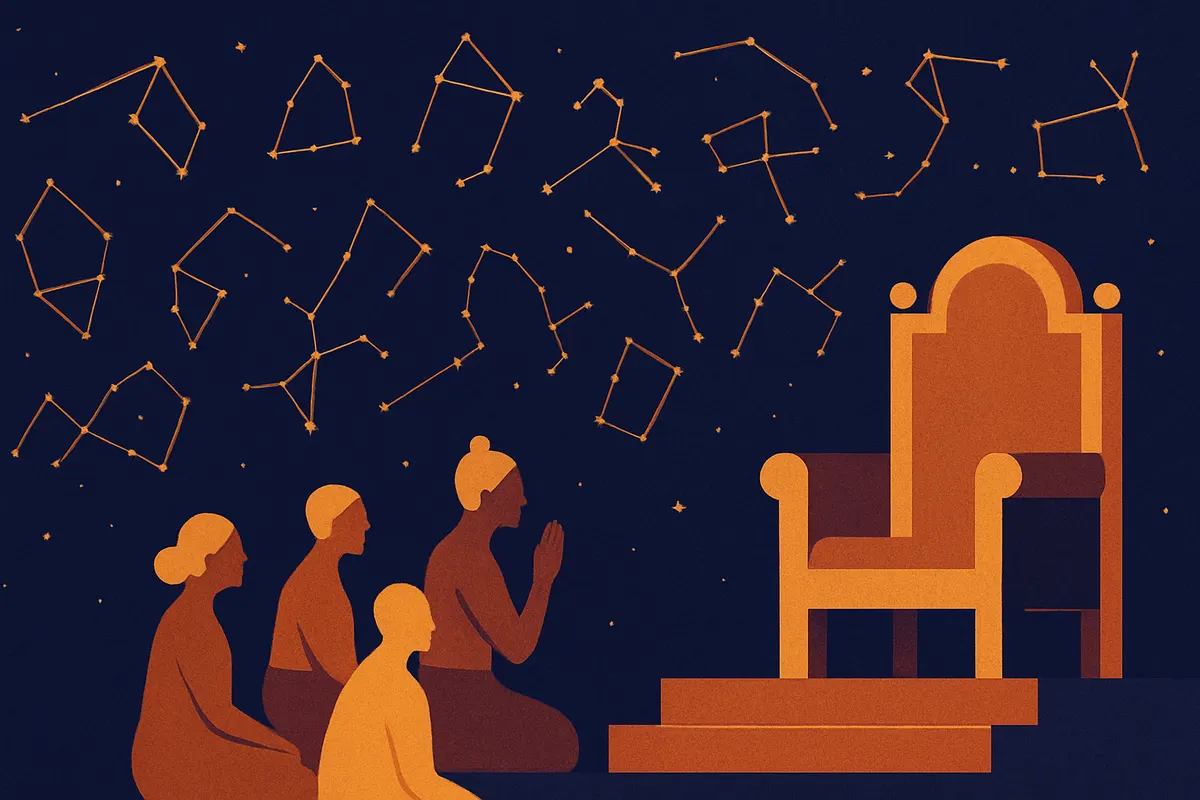
There is a moment in the Taittiriya Brahmana, often quoted in later jyotisha (the science of luminaries) commentary, in which the nakshatras (lunar mansions) are introduced not as simple stellar markers but as seats — asanas — upon which particular devatas (presiding deities) are said to rest. The image is older than any astrological treatise we possess, and it shapes the way Brihat Parashara Hora Shastra, when it later turns to the twenty-seven divisions of the ecliptic, never speaks of a nakshatra as if it were merely an arc of thirteen degrees and twenty minutes. Each division is a residence; each residence has an occupant; each occupant carries a particular inheritance into the chart of any soul born under its watch. When we come to the tenth of these divisions, the asterism known as Magha, we arrive at a residence whose occupant is unlike any other in the wheel. The tenants of Magha are the Pitris, the ancestral fathers, and the seat itself is described in classical sources as a throne — simhasana, the lion-seat — at the foot of which the line of the dead is said to gather.

It is for this reason that Magha cannot be read in the manner one reads, say, Bharani or Hasta. The other nakshatras carry presiding deities who function as discrete forces — Yama at Bharani, Savitar at Hasta, Soma at Mrigashira — and the seeker born under them inherits the texture of that single deity's character. Magha alone is presided over not by an individual god but by a collective, by the Pitris taken as the lineage entire, and this collectivity is not merely an accidental feature of the asterism but the heart of its meaning. When Phaladeepika or Saravali turn to Magha, they do not speak of an isolated planetary signature; they speak of inheritance, of debt, of the weight that the dead carry into the chart of the living, and of the dignity that comes when that weight is honored rather than denied. To read a Magha placement carelessly, as if it were merely the first nakshatra of Simha (Leo) and therefore concerned chiefly with kingship and recognition, is to mistake the shadow on the throne for the throne itself.

This essay therefore approaches Magha through the doorway the classical tradition opens — the doorway of the Pitris and of pitra rina (ancestral debt) — and only through that doorway does it consider the secondary themes of office, royal carriage, and the public dignities that have come, in modern delineation, to dominate the asterism. Brihat Parashara Hora Shastra will be our primary companion, with Phaladeepika by Mantreswara and Saravali by Kalyana Varma at our side where they preserve material that the popular tradition has thinned out.

The Position and the Ruler

Magha occupies the arc from zero to thirteen degrees twenty minutes of Simha (Leo), and its dispositor at the rashi (sign) level is therefore Surya (the Sun), the planet of the Atman, of the soul's central light. Its nakshatra lordship, however — the lord under whose Mahadasha (planetary period of the Vimshottari system) the asterism's signature most strongly expresses itself — belongs to Ketu, the south lunar node, the headless graha (planetary force) whose karaka (significatorship) in the classical sources includes liberation, ancestral karma, sudden gain through unseen sources, and the dissolution of personal ego into something larger than itself. The pairing is unusual and worth lingering over. Surya, the lord of the rashi, signifies the visible throne, the public radiance, the soul as it appears in the world; Ketu, the lord of the asterism, signifies what lies behind the throne, the line of those who sat upon it before, the karma that they have transmitted forward and that the present occupant must, in some measure, settle. Magha is therefore a meeting point — a place where the visible kingship of Surya and the invisible inheritance of Ketu are required to occupy the same seat.

Brihat Parashara, when he sets out the lordships of the Vimshottari Mahadasha system in BPHS chapter 46, does not pause to comment specifically on the metaphysics of Ketu's lordship over Magha, but the implication runs beneath the chapter and surfaces, more explicitly, in Phaladeepika 17.18, where Mantreswara observes that nakshatras ruled by the nodes carry karmic continuities that earlier and later births alike have helped to compose. Saravali, more cryptic in its style, alludes at 8.42 to the nakshatras of the nodes as places where the soul renews acquaintance with conditions previously known. The reader who comes to Magha through these signposts cannot escape the impression that the asterism is concerned, above all, with continuity — with what the soul has carried from before, with what the lineage has transmitted, and with the particular dignity that comes from accepting these inheritances as one's own.

The symbol of Magha given in the classical lists is the throne itself, sometimes elaborated as a royal palanquin or as a chamber containing the seat of office, and the shakti (power) of the nakshatra is named in some sources as tyaga kshepana shakti, the power to leave the body and depart from the conditions of the present life. The combination of throne and departure is, again, characteristic. The throne is not merely a place of arrival; it is a place from which one must, at the appointed hour, also depart, and the dignity proper to it is the dignity of one who can sit upon it without forgetting either of these movements.

The Pitris and the Logic of Pitra Rina

The reader unfamiliar with the classical Indian conception of the Pitris should pause before the term, since the entire weight of Magha turns upon it. The Pitris, in the Vedic and Puranic literature, are not simply deceased relatives in the modern sense. They are the lineage taken as a continuing presence, organized into ranks and residences described in the Garuda Purana and elsewhere, and recognized in the daily and seasonal rites of the Hindu householder through tarpanam (ritual offering of water), shraddha (the rites of remembrance), and the annual observance of pitru paksha (the fortnight of the ancestors that falls in the dark half of Bhadrapada). The continuity envisaged here is real in the classical view; the Pitris are understood to depend, in some measure, on the rites performed by their living descendants, and the descendants are understood to depend, in turn, on the blessings transmitted through that ritual relationship.

Out of this continuity emerges the concept of pitra rina, ancestral debt, named in the classical dharmashastra (treatises on dharma) as one of the three rinas (debts) that every twice-born soul is said to owe at birth — to the rishis (the seers, repaid through study and the transmission of teaching), to the devas (the gods, repaid through yajna or ritual offering), and to the Pitris (repaid through the begetting and sustaining of progeny and through the observance of ancestral rites). When jyotisha turns to Magha, it does so against the background of this older framework. A strong placement in Magha, particularly of the Lagna (ascendant), the Chandra (Moon), or the Lagnesha (lord of the ascendant), is read in the classical sources as a sign that the soul has come into this birth under the particular care of the Pitris, with both the protections that such care confers and the responsibilities that accompany it.

The protections, as Phaladeepika notes at 11.17 in its general remarks on the Sun's nakshatras and is amplified in the regional commentaries on Saravali chapter 13, include a certain native standing that the Magha-born often carry without being taught — a sense of bearing, an instinct for occasions of state, a comfort in formal settings that others find awkward. The responsibilities are subtler. The Magha-born is felt, in the classical reading, to be one who must in some measure represent the lineage; the family's name, its accumulated dharma, its unresolved business, all of this is felt to gather at the Magha placement as if at a doorway. There are charts in which the Magha placement of the Moon coincides with a family pattern of strong ancestral observance, and there are charts in which the same placement coincides with a family in which such observance has lapsed and a generational debt has accumulated. The classical tradition reads both situations through the same lens.

The framing matters because it shapes the kind of advice the classical authors give. Where pitra rina is felt to be active — where the Magha placement is afflicted by malefics, particularly by Shani (Saturn) or by the natural lord Ketu in difficult houses, or where the ninth house (the house of dharma and of paternal lineage) is itself weak — the classical recommendation is not despair but observance. The remedies that the tradition has accumulated for the strengthening of the Pitris are precisely the remedies that, in classical jyotisha, are applied to such charts: tarpanam offered on the new moon (amavasya), the careful keeping of pitru paksha, the recitation of the Pitri Stotra, the practice of dana (charitable giving) in the names of those whose names one knows in the lineage and as a general offering for those whose names have been lost. We will return to these remedies in the closing section. What matters here is that the framing of pitra rina is not punitive but relational — it positions the Magha-born as one who has the standing to carry the lineage forward, and the practices it recommends are practices of honor rather than expiation.

The Four Padas of Magha

The classical division of each nakshatra into four padas (quarters of three degrees twenty minutes each) is, in the Parashari system, more than an academic refinement. Each pada corresponds to a navamsha (one-ninth division of the rashi), and the navamsha falls in turn under the lordship of one of the twelve rashis taken in fixed sequence, so that the pada locates the soul not only in the asterism but in a sub-domain whose rashi-lord further inflects the reading. Magha's four padas, beginning at zero degrees of Simha, fall in the navamshas of Mesha (Aries), Vrishabha (Taurus), Mithuna (Gemini), and Karka (Cancer) — that is, in the navamshas of the first four rashis of the zodiac, taken in their natural order from the fiery Mesha onward. The classical reading of these four padas is therefore the reading of four distinct expressions of the Magha signature, each shaped by the rashi-lord of its navamsha.

The first pada, falling in the Mesha navamsha and therefore under the secondary influence of Mangala (Mars), is read in the classical tradition as the pada of the warrior-king. The Magha-born of this pada carries the throne with a martial bearing; the responsibility to the lineage is felt as a duty to be defended, the family name as something to be borne forward through trials of strength rather than through the cultivation of leisure. Phaladeepika does not name this pada explicitly but in its general remarks on the Sun-Mars combination at 14.21 captures something of the temperament — pride, courage, a directness that occasionally crosses into impatience, and a deep loyalty to those whom the native recognizes as belonging to their circle of obligation. The remedy for the excesses of this pada, when they appear, is the careful direction of the martial energy toward the actual purposes of the lineage rather than toward unrelated quarrels.

The second pada falls in the Vrishabha navamsha, under the secondary influence of Shukra (Venus), and the reading shifts noticeably. Here the throne is felt as a place of cultivation rather than of conquest; the Magha-born of this pada often shows a marked sense for the aesthetic dimensions of office — for the ceremonies, the household, the inherited objects, the formal courtesies that surround a position of rank. The classical sources read this pada favorably for charts in which the family has cultural rather than military prestige, and the corresponding gifts often include a fine voice, a feeling for the arts of hospitality, and an instinct for the kinds of public occasions in which dignity is performed rather than asserted.

The third pada falls in the Mithuna navamsha, under the secondary influence of Budha (Mercury), and produces a Magha-born whose relation to the throne is mediated by speech, learning, and the careful documentation of the family record. There is a scholarly inflection here; the lineage is honored through the keeping of its papers, the preservation of its texts, the patient explanation of its practices to those who do not understand them. The classical tradition does not name this pada among the most outwardly successful of the four, but it is often the pada under which the actual transmission of the lineage occurs — the careful teaching of the rites, the writing down of the names, the quiet labor by which an ancestral inheritance is kept rather than allowed to fade.

The fourth pada falls in the Karka navamsha, under the secondary influence of Chandra (the Moon), and is the most inward of the four. The throne is felt here as a domestic seat, a place at the center of the household where the family gathers, and the Magha-born of this pada often expresses the asterism's signature through the holding together of relations within the immediate family rather than through any public dignity. There is a tenderness here that the more outward padas can lack, and a certain susceptibility to the moods of those one cares for. Where the chart is well-formed, this pada produces the figure who is, without office, the recognized head of the family — the one to whom the others come for counsel, before whom the household arranges its movements, and through whose presence the lineage is most concretely felt.

Magha in the Moon, the Lagna, and the Tenth

It will help, before turning to the question of remedies, to consider briefly what classical authors say of Magha in the three placements that most decisively shape a chart — the Chandra (the Moon, which gives the Janma Nakshatra and is the principal indicator of mental and emotional life), the Lagna (the ascendant, which gives the bodily orientation and the outward life), and the tenth house from either, which carries the karma of public function.

Magha in the Chandra is the signature one most often hears spoken of, since in the Vimshottari system the Chandra's nakshatra at birth determines the sequence of Mahadashas the soul will experience, and a Magha Chandra opens the life under the Mahadasha of Ketu — a period whose classical reading is unlike that of any other opening Mahadasha. Saravali at 8.42 reads early Ketu Mahadasha as a period of unusual sensitivity to the unseen, of dreams that carry a particular weight, of a quietness that the immediate family may not always understand. The Magha-Moon native is described in Phaladeepika 11.17 as carrying an inward dignity from childhood, an early sense of the seriousness of life, and a comfort with older people that the other children of the household may lack. The first task of the Magha-Moon native, classical sources suggest, is to come to peace with this inheritance — neither to flee from the seriousness it brings nor to allow the seriousness to harden into solemnity.

Magha in the Lagna inflects the body and bearing. Brihat Parashara, when he discusses the influence of the nakshatras on physical form in the relevant scattered passages, does not give Magha a separate adhyaya, but the medieval commentators agree that the Magha-Lagna native often shows a markedly upright posture, a slightly elevated chest, a way of carrying the head that betrays no awareness of being observed. This is not vanity in the classical reading but the bodily echo of the asterism's seat-imagery; the Magha-born walks as if a throne were never entirely far away. Where the Surya is also strong in the chart, the bearing is unmistakable; where the Surya is weak or afflicted, the bearing remains but is accompanied by an inner uncertainty that the native learns, with time, to read and to compensate for.

Magha in the tenth from either Lagna or Chandra is the placement that most often draws the Magha-born into formal positions of office — into the carrying of titles, into the inheritance of family enterprises, into roles in which the public function of the lineage is at stake. Phaladeepika's general remarks on the tenth house at 6.50 do not name Magha specifically, but the classical principle that the asterism on the tenth house cusp colors the karma of public life applies straightforwardly here. The Magha-tenth native does not always succeed in conventional terms, but the work they do is felt by those around them to belong to a longer line; their public actions tend to be read by others as continuations rather than innovations, and this is true whether the surrounding tradition is one of governance, of scholarship, of priestly observance, or of family enterprise.

The Classical Question of Affliction

Before we turn to the remedies, a word is necessary on how the classical tradition reads the afflicted Magha. The afflictions to consider are several. The first and most direct is the conjunction or close aspect of Mangala or Shani upon the Magha placement; both planets, while not natural enemies of Surya in every situation, can introduce an element of harshness that pulls the asterism's dignified signature toward pride or toward isolation. The second is the affliction of Surya himself in the chart, since the rashi-lord's condition shapes the expression of the asterism that lies within his sign; a Surya in debility, combust, or hemmed between malefics tends to dim the Magha-born's confidence even where the placement itself is otherwise well-formed. The third, and the most subtle, is the affliction of the ninth house, the bhagya bhava (house of fortune and dharma), since the ninth house in classical jyotisha carries paternal lineage and the inheritance of merit, and an afflicted ninth in a Magha-marked chart often correlates with the felt presence of pitra rina described above.

Brihat Parashara, in his treatment of the various dosha (planetary afflictions) configurations across adhyayas 26 and following, offers the principle that affliction of a nakshatra ruled by a node calls for remedial measures of an unusually careful kind, since the nodes do not respond to the strengthening procedures applied to the seven graha proper but require, instead, the cultivation of practices that address the karmic continuities the nodes embody. This is the classical justification for treating Magha-related afflictions with rites of ancestral observance rather than only with the gemstone or mantra remedies suitable to other graha. The reasoning is not that the conventional remedies fail; it is that they address only one layer of what the affliction expresses. The Magha-born whose chart shows pitra rina active will benefit from a Surya-strengthening practice, certainly, but the deeper work belongs to the relationship with the lineage itself, and this work is what the classical authors emphasize.

It must be added, in deference to the realities of contemporary life, that astrological observations about the lineage are not predictions of the future shape of one's family relations and are not substitutes for the kinds of conversations and decisions that families must have through ordinary channels. The classical tradition is generous in its readings precisely because it understands the chart to be one window among several, and the discernment of how to act on what one sees there belongs to the seeker rather than to the text. Where any matter touched on in this essay raises specific health, financial, or legal questions, please consult a qualified medical professional, a SEBI-registered investment adviser, or a qualified advocate as appropriate. For any specific health concern, please consult a qualified medical professional. The astrology offers a frame; the practical decisions belong to other counselors entirely.

Traditional Remedies for the Magha Signature

The remedies the classical tradition has gathered around Magha are notable for their specificity to the asterism's ancestral character. Where a generic Surya remedy might be recommended for any chart in which the Sun is weak, the remedies for an active Magha signature gather around the practices of pitri observance, and a brief survey will show how unusually well-formed this remedial tradition is.

The most widely attested practice is the offering of tarpanam on amavasya (the new moon), the day on which the Pitris are classically said to be most accessible. The tarpanam is performed with water and, where the practitioner has been taught the rite, with darbha grass and til (sesame seeds), facing south, and is offered in the names of the known ancestors of the lineage with a closing offering for those whose names have been forgotten. The practice is simple, the materials are inexpensive, and the effect, the classical authors agree, is cumulative rather than immediate. A Magha-born who establishes the practice across a full year of new moons is said, in the classical reading, to find that the inward weight of the lineage begins to settle into a quieter, steadier presence.

The fortnight of pitru paksha, falling in the dark half of Bhadrapada (typically September in the contemporary calendar), is the great annual observance for the lineage and is recommended without reservation for any chart in which Magha is prominent. The full performance of the rites belongs to those who have been taught them, but even an attenuated observance — the lighting of a lamp on the relevant tithi (lunar day), the recitation of the Pitri Stotra, the offering of food to a Brahmin or to a hungry person in the names of the ancestors, the careful keeping of mauna (silence) for some hours of the day — carries weight in the classical view. Mantreswara's general remarks on annual observances suggest that the regular performance of pitru paksha alters, over years, the texture of the seeker's relationship to the family pattern.

The recitation of the Pitri Gayatri — devatabhyah pitribhyash cha mahayogibhya eva cha, namah svadhayai svahayai nityameva namo namah — is a brief practice that classical sources recommend for daily use by those whose Magha signature is strong. The mantra honors the devas, the Pitris, and the great yogis together, and the daily attention it requires is the kind of small, regular discipline that the tradition trusts more than it trusts grand single observances. For Magha placements where Ketu is also notably afflicted in the chart, the recitation of the Ketu beeja mantra — om straam streem straum sah ketave namah — for one full mala (rosary of one hundred and eight repetitions) on Tuesdays and Saturdays is added, with the understanding that Ketu, being a node rather than a graha proper, is honored through inward attention rather than through the wearing of stones.

The dana (charitable giving) recommended for the strengthening of the Magha signature is specific. Phaladeepika and the regional commentaries together recommend the giving of food and clothing to elderly persons, particularly to those without surviving family of their own, on amavasya and on the days of the full moon (purnima). The principle is simple: the gift offered to one whose lineage no longer holds them returns, in the classical view, to the giver's lineage as merit. Donations to institutions that maintain the rites of the unclaimed dead — crematoria, cemeteries, traditional pitri-tirthas (sacred sites of the ancestors such as Gaya) — are similarly recommended, and the visit, if it can be made, to Gaya itself for the performance of pinda dana is held by classical sources to be the most consequential single observance available to a Magha-born.

The gemstone tradition for Magha is less elaborate than for some other asterisms, since the asterism's nakshatra-lord Ketu is not assigned a primary gemstone in the classical lists; the cat's eye (lehsunia or vaidurya) recommended for Ketu is worn only on competent astrological recommendation and only when the chart's other indications support it. For the rashi-lord Surya, the ruby (manikya) is the classical recommendation, set in gold, worn on the ring finger of the right hand, on a Sunday morning at sunrise after the appropriate purification. The ruby is not a remedy for pitra rina as such; it is a strengthening of the rashi-lord under whose visible aspect the Magha signature must, in this life, be carried. Where finances do not support a high-quality ruby, the classical tradition is content with the offering of a red flower at sunrise to Surya and the recitation of the Aditya Hridayam, which serves the same purpose at no cost. This is a general reflection drawn from the classical tradition, not investment advice; gemstone purchases of any significance should be made with the counsel of those qualified to evaluate the stones.

The practice of mauna for some part of the day, particularly on Sundays, is a final and frequently overlooked remedy. The Magha-born often carries an unusual receptivity to the inward voice of the lineage, and a regular practice of silence — even an hour each Sunday morning — allows that receptivity to find its natural rhythm rather than being crowded out by the noise of contemporary life. Saravali's remarks on the cultivation of inwardness in nakshatras of the nodes suggest that mauna, simple as it sounds, is among the most powerful of the practices available to those whose chart turns upon the asterisms of Ketu and Rahu.

A Final Word

The Magha-born who reads these lines is invited to read them, above all, as a description of an inheritance that is already theirs. The throne is in the chart not as an aspiration but as a placement; the lineage is present not as a project but as a fact; the practices recommended above are not new acquisitions but the recovery of patterns that the tradition has held for a very long time and that the present life has been given the standing to take up again. The classical authors, when they wrote about Magha, did not write as if the asterism could be activated or unlocked through some technique; they wrote as if the asterism were a residence into which the soul had been received at birth, and as if the work of life consisted in learning, slowly, how to inhabit such a residence with grace.

Brihat Parashara Hora Shastra, Phaladeepika, and Saravali — read in any reliable edition with a chart open beside the page — will continue to speak more fully and more particularly than any single essay can. The verses on Magha are scattered across these texts, and the recovery of the asterism's full signature is the work of a patient reading rather than of a single sitting. What is offered here is a doorway. The throne, the ancestors, the weight of lineage, the practices that classical jyotisha gathered around them — these are the elements that, in the classical view, belong to the asterism's name. To read Magha in this light is to receive the chart not as a verdict but as a continuation, and to understand the dignity that the classical tradition saw in the soul whose first lunar mansion is the seat at the foot of which the long line of the dead has gathered.

Related cornerstones

If this reading was useful, the following cornerstones address related dimensions of the same broader tradition: