Why is Ashwini the first nakshatra?
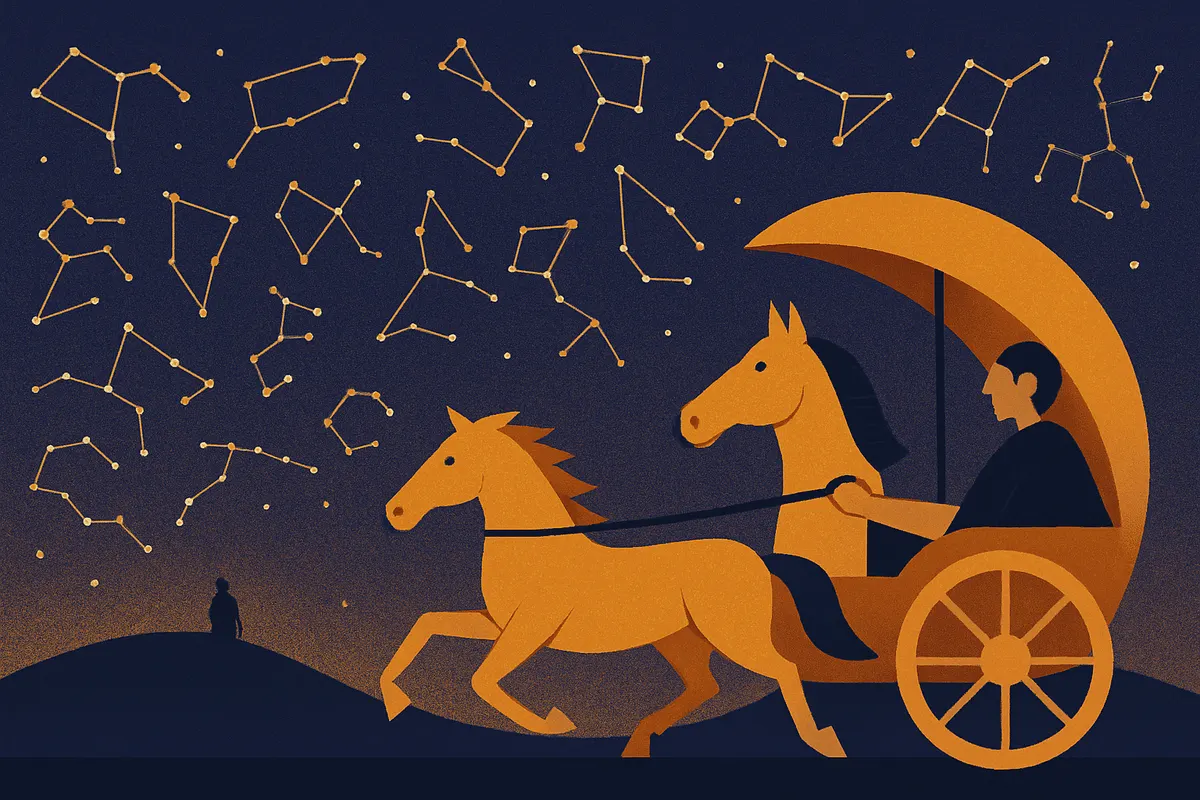
Ashwini is the first nakshatra because the count of the 27 mansions begins at 0°00' Aries, and the classical texts that enumerate them place Ashwini at the head of the count; the placement is not incidental. It sits at the meeting point of Revati's soft closing of the previous cycle and Aries' first fiery ignition — a threshold the tradition treats as more than an ordinal convenience. The two deities presiding over it, the Ashvini Kumaras, appear throughout the Rig Veda riding a golden chariot through the dawn sky to reach those in distress: restoring sight to the blind sage Rijrashva, replacing a warrior's severed leg with one of iron, returning the aged sage Chyavana to youthful vigor. To place these two healer-gods at the very opening of the zodiacal wheel is, in the tradition's own logic, to declare something about beginnings themselves — that they arrive with the urgency of a physician reaching the wounded, and with the swiftness of a horse before sunrise. The next mansion, Bharani, takes up the slower work of carrying forward what Ashwini begins.
Who are the Ashvin twins, the deity of Ashwini?
The Ashvini Kumaras, or Ashvin twins, are the twin physician-gods of the Rig Veda and the presiding deities of Ashwini; reading the mansion without them in mind misses its whole flavor. The twins are among the most frequently invoked deities in the Rig Veda, described as youthful, golden, inseparable, and perpetually in motion toward wherever suffering calls them. Classical commentators describe the Ashwini-born as handsome, well-formed, quick of mind, devoted to their parents, and inclined to take up difficult work without long deliberation — traits read as direct inflections of the Ashvin character rather than a free-standing list. The horse symbol deepens this rather than complicating it: in the Vedic imagination the horse is the vehicle of swift, consecrated purpose, and the Ashwini-born is rarely satisfied with a small, enclosed life. There is a recurring restlessness in the classical description — a constitutional pull toward motion whenever there is ground to cover or a need to be met.
Who is the ruling lord of Ashwini Nakshatra?
Ketu, the headless southern lunar node, is the ruling lord of Ashwini, and it is the single most consequential fact about the mansion for a practicing reading. Ketu is associated with the residue of past karma rather than present appetite, with sudden intuitive recognition rather than slow accumulation, and with a pull toward eventual detachment. Placing Ketu at the threshold of the zodiac, ruling its very first mansion, signals that beginnings in this tradition are not treated as innocent — the native arrives already carrying momentum from elsewhere, and the characteristic Ashwini urgency is read as that momentum seeking expression. This is also why the classical description of Ashwini natives often pairs seemingly opposite traits: quickness with sudden dissatisfaction, bold initiative with periodic withdrawal, sociability with a real need for solitude. Ketu additionally lends a gift for sudden insight — the Ashvin physicians heal by remedies that arrive fully formed rather than through slow analysis — and a matching hazard: an Ashwini native who has not learned to slow down and verify intuition against careful checking will sometimes act on a conclusion before it has been tested.
Ashwini Nakshatra padas: signs and meanings
Each Nakshatra divides into four padas (quarters) of 3°20' each, and Ashwini's four padas fall respectively in the Aries, Taurus, Gemini and Cancer navamsha. The first pada (Aries navamsha) is the most uncompromisingly fiery — driven, eager to lead, drawn to physical or competitive fields, sometimes better at decisive intervention than patient follow-through. The second pada (Taurus navamsha) softens the fire into steadier restorative work — gardening, music, the patient repair of homes and possessions, or bodywork such as massage and physical therapy. The third pada (Gemini navamsha) channels Ashwini's speed through language and exchange, producing writers, teachers and communicators whose hazard is that fluency can outrun depth of thought. The fourth pada (Cancer navamsha) turns the healing impulse toward emotional attunement, favoring the care of children, the elderly, or anyone whose suffering is as much felt as physical.
Ashwini Nakshatra characteristics: what do the classical texts say?
Classical portraiture of the Ashwini native, drawn from sources including Phaladeepika and Saravali, converges on a consistent picture: handsome or well-proportioned in appearance, intelligent and lively in disposition, devoted to truth, drawn to occupations involving speed of decision, medicine, or the management of animals and vehicles. The same sources are equally frank about the shadow side — impatience with slow processes, occasional pride, restlessness that leaves projects unfinished, and emotional volatility that can surprise those who mistook surface confidence for the whole personality. None of this is described as fixed; the consistent classical position is that an Ashwini native who consciously balances their natural speed with patience and reflection tends toward considerable accomplishment.
The vocational signature the texts associate with Ashwini remains recognizable today. Medicine in every form — physician, surgeon, nurse, Ayurvedic practitioner, emergency responder — is the central classical calling, extending naturally to the management and operation of vehicles of every kind, from driver to pilot to mechanic, and to work that is fundamentally about arriving where help is needed: the firefighter, the rescue worker, the relief coordinator. The unifying thread across all of these is the readiness to move the moment motion is required.
Which body part does Ashwini govern?
The classical body-part association for Ashwini is the head, and Ayurvedic tradition reads this as the seat of the senses and active intelligence — an association read as conferring, when the placement is well supported, an abundance of cognitive vigor and sensory quickness. The corresponding fragility runs the same direction: a mansion governing the head is understood as correspondingly sensitive to disturbances of it, and the traditional counsel for an Ashwini native emphasizes protecting sleep, managing stress, and avoiding overstimulation. None of this is medical advice in any specific sense — for any persistent concern related to the head or nervous system, consult a qualified medical professional.
Moon in Ashwini Nakshatra: which dasha does it open?
Because Ketu rules Ashwini, any native whose Moon falls in this Nakshatra opens life in a Ketu Mahadasha, seven years long in full (among the shortest of the nine Vimshottari periods, second only to the Sun's six), of which only the balance remains at birth. Classical sources describe this opening dasha as setting a particular tone for the early years: swift transitions, intense early experiences, and a personality that often appears more defined earlier than is typical for children opening in a slower dasha. For a fuller picture of how a starting Nakshatra determines the entire dasha sequence, and how to read the rest of a chart in the order astrologers actually use it, see How to Read a Vedic Astrology Birth Chart. Ketu's own Mahadasha is covered in full in Ketu Mahadasha: 7 Years of Detachment, Loss, and Final Polish.
Ashwini Nakshatra yogas and notable combinations
The classical tradition mentions several combinations in which an Ashwini placement takes on amplified weight. A benefic conjunct the Moon in Ashwini is described by later commentators as producing physical vitality and a naturally healing presence. A Lagna in Ashwini with a strongly placed ruling planet in an angular or trine house is read as producing unusual energy and capacity for sustained achievement — potential rather than a guarantee, since realization always depends on the choices the native makes with it. The interaction between Ashwini and Saturn is treated with particular care: Saturn's slow, constraining nature sits in tension with Ashwini's swiftness, and periods when Saturn aspects or transits this portion of the chart are read not as misfortune but as an education in patience that the unmodified natal placement would not otherwise provide.
Ashwini Nakshatra remedies
For an Ashwini native looking to steady the mansion's natural restlessness, classical practice recommends recitation of the Ashvini Kumara mantras, charitable giving on the days traditionally associated with Ketu, and — after consultation with a knowledgeable practitioner — the cat's-eye gemstone (vaidurya) associated with Ketu. More broadly, the tradition consistently recommends pairing the native's natural speed with a steady daily practice: a fixed hour of exercise, a slow multi-year engagement with a single text, or any sustained rhythm that gives the Ashvin quickness a lasting shape rather than suppressing it.
How do I find out if my Moon is in Ashwini Nakshatra?
- Enter your birth date, time and place in the Nakshatra finder. It returns your Moon sign, nakshatra and pada.
- If the nakshatra shown is Ashwini, your Moon lies within Aries 0°00'–13°20'. The pada is the 3°20' quarter it falls in: pada 1 0°00'–3°20' Aries, pada 2 3°20'–6°40' Aries, pada 3 6°40'–10°00' Aries, pada 4 10°00'–13°20' Aries.
- Open the Dasha calculator to see the Ketu Mahadasha balance at birth, which depends on how far the Moon had already travelled through Ashwini.
Ashwini is the first nakshatra, so a Moon at the very start of Aries begins the whole sequence, and the Ketu Mahadasha balance at birth is close to its full seven years. Positions use the sidereal zodiac with the Lahiri ayanamsa and the Swiss Ephemeris (see /tools). The Moon crosses roughly one nakshatra a day, so an uncertain birth time can move you across a pada or, near an edge, into the neighbouring nakshatra. For the full chart, generate it at /kundli/new.
Frequently asked questions
What is Ashwini Nakshatra?
Ashwini is the first of the 27 nakshatras in Vedic astrology and spans 0°00'–13°20' of Aries. Its ruling planet is Ketu, its presiding deities are the Ashvini Kumaras, the twin physician-gods of the Rig Veda, and its symbol is a horse's head. It marks the start of the zodiacal wheel and of the Vimshottari Dasha order.
Who is the ruling lord of Ashwini Nakshatra?
Ketu, the southern lunar node, is the ruling lord of Ashwini. In the Vimshottari Dasha system, anyone born with the Moon in Ashwini therefore begins life in a Ketu Mahadasha, which lasts seven years in full; the balance left at birth depends on how far the Moon has travelled through the nakshatra. Ketu also rules Magha and Mula.
Is Aswathy the same as Ashwini Nakshatra?
Yes. Aswathy is the Malayalam and South Indian name for the nakshatra called Ashwini in most other regions. Ashvini, Aswini and Asvini are further spellings of the same mansion. All of them refer to the first 13°20' of Aries, ruled by Ketu and presided over by the Ashvini Kumaras.
What are the main traits of Ashwini Nakshatra?
Classical sources describe Ashwini natives as quick-minded, decisive, physically energetic, drawn to medicine or fast-paced work, and inclined to help others in a crisis. The same sources note a shadow side of impatience, pride and restlessness that unfinished projects reveal, and they recommend deliberately balancing natural speed with patience.
What are the symbol and deity of Ashwini Nakshatra?
The symbol of Ashwini is a horse's head, and its presiding deities are the Ashvini Kumaras, the twin physician-gods of the Rig Veda. They are associated with healing, speed and rescue from distress, which is why Ashwini is linked with physicians, first responders and anyone who moves quickly when help is needed.
Which body part does Ashwini Nakshatra govern?
Ashwini governs the head in the classical nakshatra-to-body scheme that Ayurvedic tradition also follows. The association is read as both a gift, cognitive quickness, and a point of sensitivity that benefits from protected sleep and stress management. It is a traditional frame, not medical advice; see a qualified professional for any health concern.