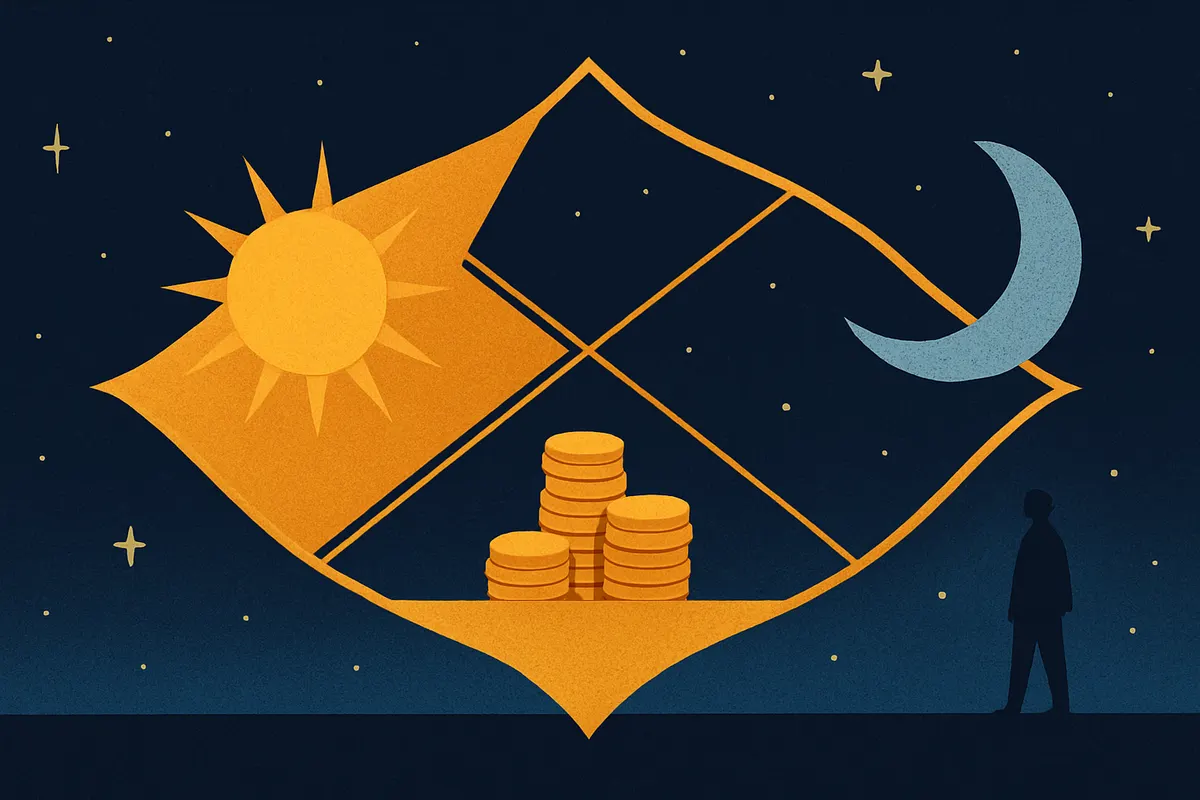
The Hora (D2) chart is the divisional chart that divides each sign into two parts of 15° to show the temperament of a person's wealth. Each half belongs to the Sun or the Moon: the Sun's hora points to wealth earned through personal effort, the Moon's hora to wealth that accumulates or is received. It shows the pattern of wealth, not the amount.
The Hora is also written D-2 or Hora varga (होरा), and it is a different thing from the hora, the planetary hour of the day used to time an event. It is the second of the sixteen vargas set out in Reading the Divisional Charts, and it is a layer inside your birth chart rather than a separate horoscope.
The Hora reduces every sign to two halves, the Sun's and the Moon's, making it the most structurally simple of the sixteen divisional charts.
Even signs (Taurus, Cancer, Virgo, Scorpio, Capricorn, Pisces)
1st half = Moon's hora, 2nd half = Sun's hora
Signs in the chart
Only two: Leo (Sun's hora) and Cancer (Moon's hora)
Tells you
Temperament of wealth, not the amount
What does the Hora chart show?
The Hora shows what kind of wealth flows toward you and from what kind of source, not how much of it there will be. Most people who look up the Hora chart want a single answer: will I have money? The amount of wealth in a life is governed by far more than one divisional chart: the second house and its lord, the eleventh house, Jupiter, Venus, and the timing of dasha cycles and transits. The Hora answers a narrower and genuinely useful question underneath all of that.
How to calculate the D2 (Hora) chart
Each thirty-degree sign divides into two equal halves of 15°, and which planet owns which half depends on whether the sign is odd or even. Charts on this site use the sidereal zodiac with the Lahiri ayanamsha and the Swiss Ephemeris; the method is described under /tools.
Enter your birth date, time and place in the Lagna calculator. It shows your Lagna and every planet as a sign and a degree.
For each planet, note its sign and its degree inside that sign, from 0° to 30°.
Decide whether the sign is odd or even. Odd signs are Aries, Gemini, Leo, Libra, Sagittarius and Aquarius; even signs are Taurus, Cancer, Virgo, Scorpio, Capricorn and Pisces.
Decide whether the degree is in the first half (0° to 14°59′) or the second half (15° to 29°59′).
In an odd sign the first half is the Sun's hora and the second half the Moon's. In an even sign the order reverses: the first half is the Moon's and the second the Sun's.
A worked example. A planet at 22° Taurus. Taurus is an even sign, and 22° is in the second half, so the planet is in the Sun's hora. The same degree in an odd sign behaves the other way: a planet at 22° Aries is in the second half of an odd sign, so it is in the Moon's hora.
The result is a chart with only two signs: Leo, the Sun's own sign, stands for the Sun's hora, and Cancer, the Moon's own sign, stands for the Moon's hora. Every planet lands in one or the other. The classical reading counts how many planets fall in each hora and which specific planets land where.
What do the Sun's hora and the Moon's hora mean?
The Sun's hora describes wealth through self-effort and personal initiative: earned income from salaried work, profit from an actively run business, visible roles in leadership or public office. The classical phrase for this is wealth earned through one's own exertion.
The Moon's hora describes wealth through receptive flow: investments that mature, inheritance, gifts, held family wealth, and public-facing trade that depends on the public's continued patronage, such as hospitality, retail, food and drink. The classical phrase for this is wealth received through tradition or lineage.
A chart with most planets in the Sun's hora points toward a life where wealth arrives mainly through effort. Most planets in the Moon's hora points toward wealth that arrives mainly through tending and accumulation. An even split points toward drawing on both sources, with dasha timing determining which predominates when.
What does each Hora signature look like in practice?
Each signature has a recognisable financial life, and neither is better than the other.
Dominant hora
Typical financial life
Sun's hora
Salaried professional with visible standing; entrepreneur whose business depends on their own continued involvement; self-employed professional whose income scales with personal output
Moon's hora
Investor whose wealth comes from maturing holdings; inheritor of family wealth; proprietor of a public-facing business that runs on customer flow rather than the owner's daily exertion
They are different temperaments, and the practical question is whether a native's actual working life matches their natal signature. A strong Moon's-hora native stuck in a purely salaried role often reports a low-grade chronic friction between temperament and daily arrangement; the classical (and practically sound) recommendation is to build a receptive-flow income stream, such as rental property, a portfolio or a side enterprise, alongside the salaried work. A strong Sun's-hora native living entirely off inherited or rentier wealth often reports the opposite friction: a felt need to earn something through direct effort even when necessity has been met.
What do the planets mean in each hora?
Each planet brings its own flavour depending on which hora it occupies.
Planet
In the Sun's hora
In the Moon's hora
Sun
Doubled solar signature: leadership, government, medicine, high-visibility work
Public-facing leadership, roles combining authority and care
Real estate, sports-related business, public-facing physical work
Mercury
Writing, teaching, consulting earned through personal exertion
Publishing, media, trade earned through public flow
Jupiter
Wealth through dharmic teaching requiring personal effort
Wealth through institutions whose value flows from patronage
Venus
Artistic or relational work earned through creativity
Luxury business, hospitality, wealth through partnership
Saturn
Wealth through long disciplined service, rewarded late
Wealth through patient asset accumulation
Which house should the hora lord sit in?
Check where the lord of your dominant hora sits in your main chart: the Sun for a Sun-dominant hora, the Moon for a Moon-dominant one. Its house in the rashi colours the wealth signature.
Hora lord's house in the rashi
Wealth signature
1st
Tied to personal identity and visible self-presentation
2nd
Flows directly into accumulated assets and family wealth
4th
Through home, real estate and the maternal lineage
5th
Through creative work, speculation and children-related matters
7th
Through partnership, marriage and business associations
9th
Through dharma, teaching, foreign travel or paternal inheritance
10th
Through career, public position and professional achievement
11th
Through gains, friendships and elder siblings
An afflicted hora lord (combust, debilitated, or in the 6th, 8th or 12th house without redemptive aspects) produces a wealth signature that arrives with more friction, worth managing consciously rather than treating as fixed. The houses themselves are covered in Second House: Wealth and Speech and Eleventh House: Gains and Elder Siblings.
Why is the Hora the wealth chart?
Wealth, in classical thinking, has a fundamental two-sidedness: it is earned through effort or received through accumulation, and no third source exists in that accounting. The Hora's two-sign division maps directly onto that duality, which is the classical reasoning for why this chart, rather than another, is read for wealth. It also means the Hora can be read in relative isolation for a quick temperament check, unlike most divisional charts, which need the rashi to mean much on their own.
What can the Hora chart not tell you?
The Hora does not tell you how much you will earn, and more planets in the Sun's hora does not mean more wealth: it means a different temperament of wealth. The amount depends on the second house, the eleventh house, Jupiter, Venus and dasha timing; the combinations classical texts call wealth yogas are covered in Dhana Yogas. The Moon's hora does not mean laziness either: receptive flow still requires real work, only work that takes the form of tending rather than direct exertion. This is a general reflection on wealth patterns, not investment or financial advice.
The Hora is also not used for non-wealth questions in classical practice. Marriage is read through the Navamsa (see Navamsa (D9) Chart), career through the Dasamsa; stretching the Hora beyond wealth produces unreliable readings.
How to see your own Hora and hora lord
Which hora dominates your chart depends on the exact degree of each planet at your birth, so a planet near 15° of a sign is worth checking twice against your birth time. Start with the Lagna calculator for degrees and follow the five steps above. The full reading at /kundli/new calculates your Hora chart next to your main chart, so you can see your wealth temperament beside your actual second and eleventh house indications rather than guessing from a planet count alone.
The Hora chart shows the temperament of a person's wealth: whether it flows mainly through personal effort (the Sun's hora) or through receptive accumulation such as investments, inheritance and public patronage (the Moon's hora). It does not show the amount of wealth, which depends on the second and eleventh houses, Jupiter, Venus and dasha timing.
How is the D2 (Hora) chart calculated?
Each 30° sign splits into two halves of 15°. In odd signs (Aries, Gemini, Leo, Libra, Sagittarius, Aquarius) the first half is the Sun's hora and the second half is the Moon's. In even signs (Taurus, Cancer, Virgo, Scorpio, Capricorn, Pisces) the order reverses, so every planet falls in either the Sun's or the Moon's hora.
Does having more planets in the Sun's hora mean I will be wealthier?
No. A dominant Sun's hora describes a wealth temperament built on effort, not a guaranteed amount. Someone with every planet in the Sun's hora can be wealthy, average or struggling, because the amount depends on the second house, the eleventh house, Jupiter, Venus and the dasha running at the time.
Is the Moon's hora a sign of easy money or laziness?
No. The Moon's hora describes wealth that comes through tending and receptive accumulation: managing investments, holding inherited assets, or running a business that depends on customer flow. That still involves real and sustained work, only not direct exertion in exchange for each hour. It describes how wealth arrives, not how hard a person works.
Can the Hora chart predict marriage or career?
No. Classical practice reserves the Hora for wealth. Marriage is read through the Navamsa (D9) and career through the Dasamsa (D10), and using the Hora for those questions goes beyond its classical scope. If you want a career reading, the divisional chart built for that question gives a sharper answer than stretching the Hora.
What if my work does not match my dominant hora?
A mismatch, such as a Moon's-hora native in a purely salaried role, often produces a low-grade friction between temperament and arrangement. The practical response is to build the other stream deliberately: a Moon's-hora native adds a receptive-flow asset such as property or investments, and a Sun's-hora native living off inherited wealth benefits from a deliberate personal-effort project.