What does the 2nd house represent?
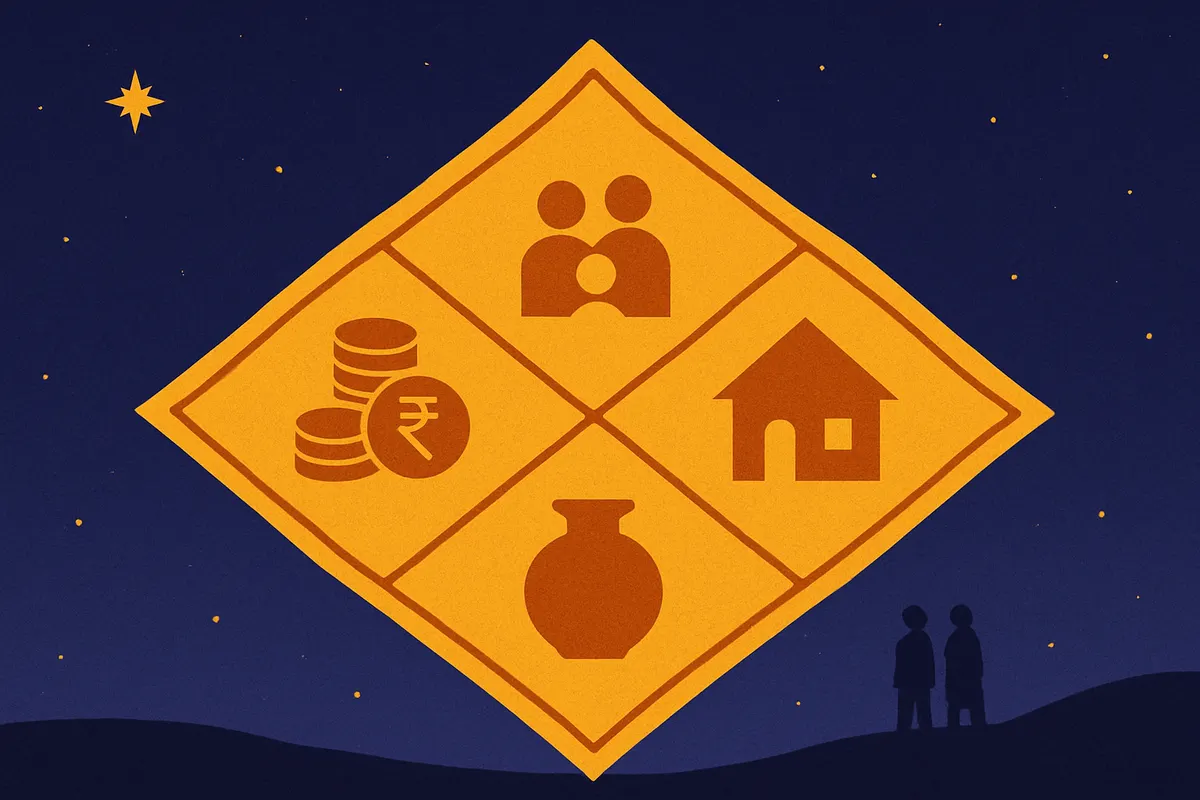
Brihat Parashara Hora Shastra, the foundational classical text of Vedic astrology, lists the second house's significations in a single unbroken sequence: wealth, family, food, speech, the right eye, early education, and fortitude. The classical authors do not rank these — they treat wealth and speech as equally real facets of the same underlying thing, which is accumulation.
This is why reducing the second house to "will I be rich" misses most of what the classical tradition is actually describing. The wealth of Dhana Bhava is never solitary. It sits beside family and speech in the same textual breath, because the wealth this house shows is the wealth a household pools together, spoken about and shared at a common table — not simply a number in an account.
Why is speech counted as wealth in the 2nd house?
The most distinctive signification of the second house, and the one newcomers to the subject find strangest, is speech. Classical authors treat cultivated speech (vak) as itself a form of accumulated treasure, arguably the form most distinctive to a human life — a person can lose every possession and remain wealthy in the speech that has been slowly built across a lifetime of attention. Saravali, the classical compendium of Kalyana Varma, observes that a second house carrying a well-placed Jupiter and Venus together produces speech that functions as an ornament to whatever it touches.
The presiding figure behind this signification is Saraswati, goddess of speech and learning, whose presence is felt in the second house even where she is not named. When benefics occupy or aspect the second house, classical sources describe speech that is sweet and well-received; when malefics dominate the house without relief, they describe speech that arrives with effort, or that tends toward harshness and error. The lord of the second house carries these qualities wherever it is placed — a second lord that lands in the ninth tends to turn cultivated speech toward teaching, while the same lord in the eighth tends toward reserve, or toward subjects others would not raise.
What is Kutumba Bhava, the family in the 2nd house?
Kutumba Bhava, the second house read as family, means specifically the family one is born into — parents, elder relatives, the household of childhood — and not the family created through marriage (the seventh house) or through children (the fifth house). This distinction matters, because the second house is telling a different, earlier story: the strength or affliction of Dhana Bhava says a great deal about the prosperity and harmony of the household a person grew up inside, since that formative environment goes on to shape how comfortably wealth, food, and speech are handled in adult life.
A second house afflicted by Mars, especially under an aspect from Saturn, often points to a childhood household where the table was a place of tension rather than nourishment. A second house carrying a strong Jupiter with the Moon's aspect more often points to a household of unhurried meals and affectionate speech. Saravali's image for a well-placed second-house lord is a tree whose roots drink deeply — the grandparents and the line before them are the roots, the parents the trunk, and the present native the newest growth, inheriting speech, food, and shelter from those who came before and capable of passing them forward in turn.
What do food, the right eye and a sense of value mean in the 2nd house?
The remaining significations of Dhana Bhava look scattered until their common thread appears: each concerns the soul's interface with the tangible, accumulable world. Food is the most immediate — a second house favourably placed with Jupiter tends to show a household where nourishment is steady rather than anxiously counted, and where guests are received generously even in lean periods.
The right eye is a subtler signification, tied in classical anatomy to the outward, waking, day-facing self (the left eye, by contrast, belongs to the twelfth house's inward-facing significations). A second house weakened by the Sun's classical enemies, particularly a close Saturn conjunction, is sometimes read as a caution to take ordinary care of the eyes through a working life — an astrological hint, not a diagnosis; for any specific concern, a qualified medical professional is the right person to see.
The last of these tactile significations is a natural sense for what holds value across time — historically read through the knowledge of metals and gems, since the classical economy stored wealth in gold, silver, and copper. In modern terms this reads as an instinctive feel for durable value rather than passing price. This is a general reflection on temperament, not investment advice; a SEBI-registered investment adviser is the right source for any specific financial decision.
Planets in the 2nd house
The planet that touches the 2nd house decides which of its faces comes forward. A 2nd house strongly touched by Jupiter tends to show accumulated learning and cultivated speech; the same house held by Venus tends to show a generously kept table and a love of fine possessions; the same house afflicted by Mars without redemption tends to show sharp words and contested inheritance. The house itself does not change — only which of its many faces comes forward. The Sun's placement in this house is covered separately in Sun in the 2nd House.
What are Dhana Yoga and Saraswati Yoga?
Several classical yogas (planetary combinations) draw their force from the second house. Dhana Yoga proper (see Dhana Yogas: The Four-House Wealth Rule) forms when the lords of the second and eleventh houses — the two houses of accumulation and gains — enter into mutual relationship with the lords of the Lagna, the fifth, or the ninth house. When this combination forms cleanly, wealth tends to build steadily through honoured channels rather than arrive as a single windfall, and the strongest versions of this yoga involve Jupiter directly.
Saraswati Yoga forms when Jupiter, Venus and Mercury occupy kendra or trikona houses (the wider classical definition also allows the second house), with Jupiter itself well placed. Named for the goddess of speech, it ties the second house's speech significations to its wealth significations directly: the native's income comes through cultivated expression — teaching, writing, considered counsel — rather than through the second house's food or family channels.
Not every second-house combination is favourable. Daridra Yoga, one of the classical tradition's difficult combinations, arises when an afflicted second-house lord sits in one of the dusthana houses (the sixth, eighth, or twelfth) while the wealth karakas Jupiter and Venus are themselves under malefic aspect. Classical authors do not pass over this in silence, but they also do not stop at naming it — remedies follow directly, discussed below.
Why is the 2nd house called a maraka sthana?
It would be evasive to describe the second house without mentioning its maraka (death-timing) classification, which unsettles many people on first hearing it. The second and seventh houses are both called maraka sthanas in classical texts, and the reasoning for the second is precise rather than ominous: counted inclusively, the second house is the eighth house — the house of endings — from the seventh house of partnership. That structural relationship is what earns it the label, not any claim about a particular native's lifespan.
Classical commentators are careful about when this maraka quality actually activates: chiefly during the dasha (planetary period) of an afflicted second-house lord, and typically alongside several other converging indications of a body's natural span reaching its end. Absent those conditions, the maraka signature of the second house tends to show up in far milder form — the closing of a financial chapter, the passing of an elder relative, the end of a long-running disagreement that finally gives way to quiet. Reading the second house as "the place of completions" is more accurate, and more useful, than reading it as a verdict.
What are the remedies for an afflicted 2nd house?
When the second house shows significant affliction, classical sources recommend a modest, consistent set of practices rather than any single fix. The first is dana (charitable giving) directed specifically at food — offering a meal to someone in need is said to strengthen the second house's food signification, since the tradition treats the karma of nourishment as travelling in both directions.
The second is deliberate cultivation of speech itself: the recitation of texts associated with Lakshmi or Saraswati, depending on whether the affliction concerns wealth or speech more directly, functions less as a magical fix than as a daily training of the speech faculty, the way scales train a musician's hand. The third is the wearing of a gemstone tied to the second-house lord, which classical sources treat with real caution — the size and choice of stone should follow a careful assessment of that lord's dignity, and a poorly-chosen stone for a malefic lord can amplify the wrong qualities rather than correct them. The fourth and gentlest remedy is simply tending the family table: eating with parents and siblings when possible, listening more attentively to elders' speech, and observing the small daily courtesies that hold a household together — none of it requiring wealth, all of it addressing the house directly.
How to find your 2nd house
- Enter your birth date, exact time and place in the Lagna calculator. The Lagna changes sign about every two hours, so a rough time can give the wrong set of houses.
- Take the Lagna sign as your 1st house. The calculator uses whole-sign houses, so each following sign is the next house.
- Count one sign on from the Lagna: that sign is your 2nd house. For a Virgo Lagna it is Libra, ruled by Venus.
- The ruler of that sign is your 2nd lord. Find its row in the calculator's planet table to see which house it occupies.
- Any planet whose row shows house 2 sits in your 2nd house. Jupiter, Venus or Mars in that row sets the pattern described in the planets section.
The calculator uses the sidereal Lahiri ayanamsha and the Swiss Ephemeris, as described on the free calculators page.
Which planets and lord shape your 2nd house?
Your 2nd house is set by three things: the sign that falls on it, where its lord has landed, and whether Jupiter, Venus or Mars dominates its expression. The full reading at /kundli/new calculates all three, so you can see which of Dhana Bhava's faces (wealth, speech, family or all three) is strongest in your case.
Frequently asked questions
What does the 2nd house mean in Vedic astrology?
The 2nd house, Dhana Bhava, governs accumulated wealth, the family a person is born into, speech, food and the right eye. Classical texts treat these as facets of a single underlying idea: the slow accumulation of what sustains a life, whether material, verbal or relational.
Is the 2nd house only about money?
No. Wealth is one of several significations the 2nd house carries, alongside speech, the birth family, food and early education. A strong 2nd house can show up mainly as cultivated speech or a well-provisioned household rather than a large bank balance, since classical authors treat these as equally real forms of accumulation.
What is Dhana Yoga?
Dhana Yoga is a classical wealth combination that forms when the lords of the 2nd and 11th houses relate to the lords of the Lagna, the 5th or the 9th. When it forms cleanly, wealth tends to accumulate steadily through respected channels across a long period rather than through a single windfall.
Why is the 2nd house called a maraka house?
The 2nd house is classified as maraka (death-timing) because, counted inclusively, it is the 8th house, the house of endings, from the 7th house. The label describes that structural relationship, not a claim about a lifespan, and it activates chiefly during an afflicted 2nd lord's dasha, usually as the end of a chapter.
Does the 2nd house show my spouse's family or my own?
Your own. The 2nd house's family signification, Kutumba Bhava, refers to the family you are born into, meaning parents, elder relatives and the childhood household. The family created through marriage is read from the 7th house, and the family created through children from the 5th house.
What if my 2nd house lord is weak or afflicted?
Classical texts answer a weak 2nd lord with remedies rather than resignation: charitable giving focused on food, daily cultivation of speech through recitation, a carefully chosen gemstone only after the lord's dignity is assessed, and deliberate tending of family meals and elder relationships. None of these is presented as a guarantee.