What are the main traits of Shravana Nakshatra?
People with the Moon in Shravana share a recognizable pattern: their primary way of engaging the world is listening, and not only in ordinary conversation. They are the ones who notice what a speaker almost said, who sense a colleague's unstated reluctance before it is voiced, whose friends find themselves confiding things they hadn't quite admitted to themselves yet. This receptivity has a real cost that popular astrology writing tends to skip over. Shravana natives are, by the mansion's own signature, porous — the line between what is happening inside them and what is happening around them runs thinner than average, and the developmental task across adult life is building enough inner discrimination to keep that line legible.
Why is the Moon the ruling lord of Shravana, inside Capricorn?
The Moon rules Shravana, the twenty-second nakshatra, where the lord cycle from Ashwini returns to the Moon, and the Moon is the planet of feeling, memory, and receptive registration. The mansion sits in the central body of Capricorn, Saturn's cardinal earth sign of structure and institution-building. On paper the pairing looks paradoxical: an emotionally porous ruler inside a sign built for discipline. The classical reconciliation is that Saturn's structure does not suppress the Moon's sensitivity here; it gives the sensitivity its container. Outwardly composed and reliable in the Capricorn manner, a Shravana native carries genuine lunar depth inside — Saturn supplies the frame within which that depth can be received without flooding the person carrying it.
Who is Vishnu, the deity of Shravana Nakshatra?
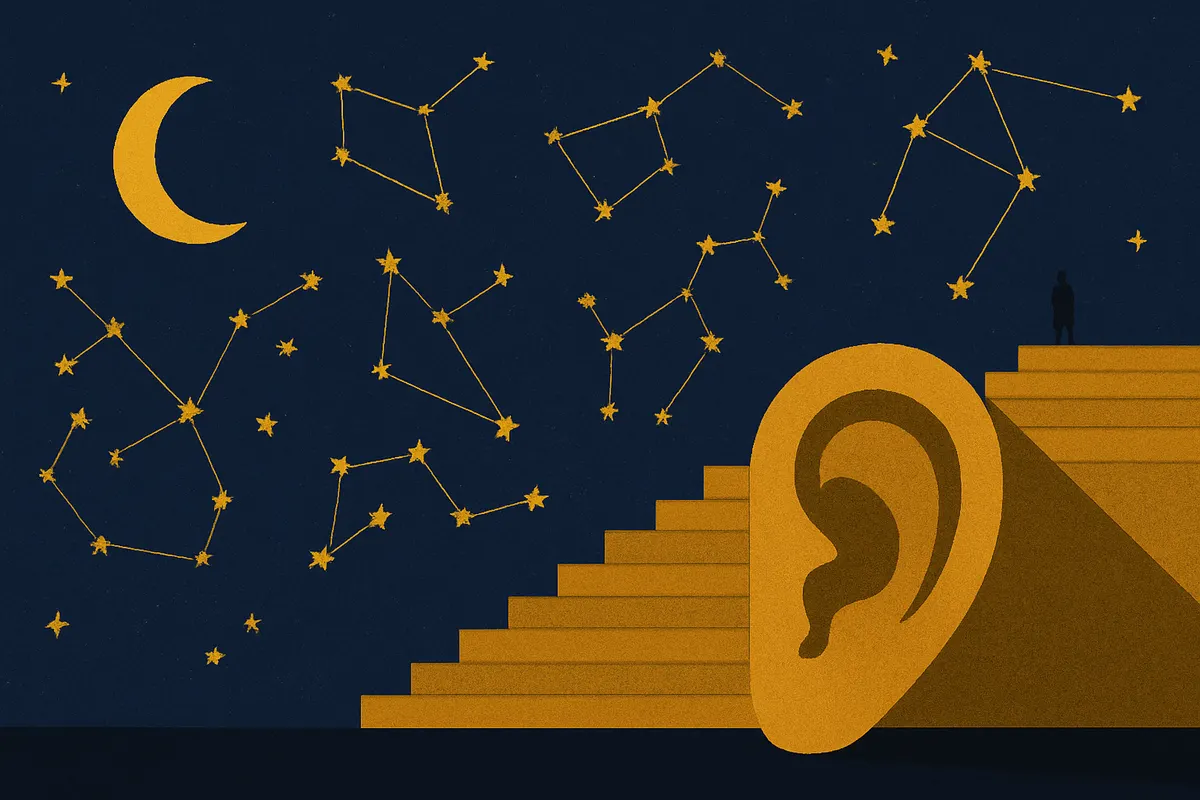
The presiding deity, Vishnu, is the preserver among the classical trinity — the principle that holds what has been created so it can continue rather than dissolve. The image most associated with him here is the tri-vikrama, the three strides by which Vishnu, in his dwarf incarnation, spanned the three worlds. Read onto this mansion, the three steps become a structure for the listening itself: inward listening (what is arising inside the native), social listening (what people around them are actually saying), and generational listening (what has been carried forward from earlier voices). A Shravana native who develops all three becomes, over time, a kind of institutional or family memory — the person others rely on to hold what would otherwise be lost.
What do the classical texts say about Shravana Nakshatra?
Brihat Parashara Hora Shastra assigns Shravana the qualities chara (mobile) and deva (elevated, refined) — a temperament the tradition reads as both attentive and dignified. Phaladeepika describes a Moon in Shravana as inclining toward sensitivity, learning, and the careful study of received tradition, and singles out callings built on the preservation and transmission of material: the archivist, the editor, the long-tenured scholar. Saravali emphasizes the gradual, cumulative nature of the mansion's gift — years of careful listening slowly filling a vessel that eventually becomes, in turn, a source others draw from.
Commentators writing in this tradition also note a real risk: a native who has not consciously built the inner discrimination between their own signal and the world's inflow can end up organizing their inner life around whichever voice around them happens to be loudest. This is not a character flaw so much as an unmanaged version of the mansion's actual gift.
What are the four padas of Shravana Nakshatra?
Shravana's four padas all sit inside Capricorn, but each carries a different navamsa sub-lord.
The first pada (Aries navamsa, 10°00'–13°20' Capricorn) is sub-ruled by Mars and produces the most active listener of the four — someone who acts decisively on what they hear rather than only absorbing it, at the risk of speaking too quickly on incomplete information. The second pada (Taurus navamsa, 13°20'–16°40') is sub-ruled by Venus and produces the most aesthetically attuned listener — editors, curators, and translators whose ear is for beauty as much as content. The third pada (Gemini navamsa, 16°40'–20°00') is sub-ruled by Mercury and favors the writers and long-form interviewers who translate what they hear into language others can use. The fourth pada (Cancer navamsa, 20°00'–23°20') is sub-ruled by the Moon itself — the most porously receptive of the four, common among therapists and long-tenured pastoral figures, and the one for whom the boundary-setting work discussed above is most demanding and most rewarding when done well.
What is the Moon Mahadasha like for a Shravana Moon?
Because the Moon rules this nakshatra, its ten-year Mahadasha tends to be the chapter in which a Shravana native's receptive faculty is exercised most fully — both its gift and its characteristic strain. Classical texts hold that a nakshatra-lord's mahadasha presses hardest on whatever the nakshatra itself signifies, and here that is the preservative, listening role. Natives often describe this decade as the one in which their careful listening became visibly their actual work: a counseling practice consolidating, an editorial role maturing, a contemplative discipline bearing its first sustained fruit. Where the natal Moon is under real strain — closely conjunct malefics, poorly placed — the same period can bring the receptivity as overwhelm rather than gift, and classical remedy recommends the standard Moon practices (Monday observance, offerings of milk and white flowers) alongside deliberately protected solitude.
What parts of the body does Shravana Nakshatra govern?
Shravana's classical body association is the ears, extending to the inner-ear structures responsible for balance — a fitting seat for a mansion whose signature is literally hearing. The constitution is read as Kapha-dominant with a Vata secondary, predisposing toward light, easily disturbed sleep and heightened sensitivity to noise. The classical recommendation is acoustic hygiene: protected sleep, deliberate periods of quiet, and caution against chronically loud environments. These are offered as preventive habits, not medical advice — for any persistent concern, consult a qualified medical professional.
What careers suit Shravana Nakshatra, and what is empathic overload?
Shravana's career signature is unmistakable: librarian, long-tenured editor, careful counselor, institutional memory-keeper, long-form interviewer — any role where the value created is the patient holding of what others say and would otherwise lose. A modern reading adds a caution that the classical sources anticipate without naming: Shravana natives can be at real risk of empathic overload, the cumulative exhaustion of carrying others' material without adequate replenishment. The corrective the classical and modern material converge on is twofold — seeking roles where the listening itself is structurally valued rather than silently exploited, and building an identity that is not entirely organized around being the one who listens.
How does Shravana Nakshatra affect relationships and marriage?
In relationships, Shravana natives often present a distinctive competence — sensing a partner's feeling before the partner has fully registered it themselves — paired with a quieter inner life that is rarely as openly shared. Many learned early that attentive listening was the currency that secured connection, and organized their adult relational lives around offering that listening while keeping their own interior in reserve. The developmental task is reopening that reserve deliberately: finding a partner who listens back and treats the native's attentiveness as a gift requiring reciprocity, not a service to be quietly received.
For the Manglik question, Shravana natives whose Mars falls in the first, fourth, seventh, eighth, or twelfth house carry the standard Manglik signature; because Shravana sits in Saturn-ruled Capricorn rather than a Mars sign, no special intensification applies, though chart-matching before marriage remains advisable, particularly for natives of the more porous fourth pada.
How does Shravana relate to Uttara Ashadha and Dhanishta?
Shravana follows Uttara Ashadha, the mansion of late, unconquered conviction, and precedes Dhanishta, the mansion of rhythm, wealth, and public recognition. Read in sequence, the three mansions trace a plausible arc: the slow-ripening conviction of Uttara Ashadha, consolidated through Shravana's patient listening and preservation, made audible and recognized in Dhanishta's more public rhythm. A native whose Moon sits in Shravana is, in this reading, the quiet middle term — the one who has to actually hold and digest what the previous mansion's conviction produced before the next mansion's recognition can follow.
This sequencing is worth knowing mainly as a corrective to an easy misreading. It is tempting to treat Shravana's receptive, listening quality as a purely passive stage between two more active mansions. The classical material does not support that reading. The Moon Mahadasha that a Shravana native runs, whether at birth or later in life, is typically the period doing the most consequential work of the three — the quiet accumulation without which the surrounding mansions' more visible qualities would have nothing solid to stand on.
How do I know if my Moon is in Shravana Nakshatra?
Your Moon is in Shravana if it is between 10°00' and 23°20' of Capricorn on the sidereal zodiac. The Nakshatra Finder gives the nakshatra and pada from your birth date, time and place, using the Lahiri ayanamsa like the other tools at /tools.
The fourth pada, 20°00'–23°20' in the Cancer navamsa, is the one this article describes as most porously receptive, so it is worth knowing which pada you have. The dasha then starts with the Moon, ten years less the portion already run. The rest of the timeline is at /kundli/new.
Frequently asked questions
What is Shravana Nakshatra?
Shravana is the twenty-second of the 27 nakshatras in Vedic astrology, meaning "hearing", and it spans 10°00' to 23°20' of Capricorn. It is ruled by the Moon and presided over by Vishnu, the preserver, with an ear or three footprints as its symbol.
Who is the ruling planet of Shravana Nakshatra?
The Moon is the ruling planet of Shravana. A person with the Moon placed here begins life in a ten-year Moon Mahadasha, often described as the period when the receptive, listening capacity comes fully into use, together with its characteristic strain.
Which zodiac sign is Shravana Nakshatra in?
Capricorn only. Shravana occupies 10°00' to 23°20' of that sign, and its four padas fall in the Aries, Taurus, Gemini and Cancer navamsa. None is vargottama, because that would need the Capricorn navamsa, which no Shravana pada carries. So every Shravana Moon is a Capricorn Moon.
What are the personality traits of Shravana Nakshatra natives?
Shravana natives are described as attentive listeners, learned and sensitive, and inclined toward careers built on preserving and transmitting received knowledge. The mansion's central challenge is telling genuine inner signal apart from the steady inflow of what they absorb from other people.
What careers suit Shravana Nakshatra natives?
Careers built on careful listening and the preservation of material suit this nakshatra well: editing, counselling, archival and library work, long-form interviewing and teaching. Roles that demand constant unstructured availability tend to produce the empathic exhaustion the mansion is prone to.
Why is Shravana associated with the ear?
Classical texts assign the ears and the inner-ear balance system to this nakshatra, matching its core theme of receptive hearing. The association is read as both a gift, an acute capacity to listen, and a point of sensitivity that benefits from protected rest and quiet.