What does Dhanishta Nakshatra mean?
Dhanishta means "most prolific" or "wealthiest," and the classical signature backs that up: a genuinely social, organising temperament that turns scattered group effort into productive rhythm. Mars supplies decisive action; the Eight Vasus — the elemental gods who hold water flowing, wind moving, fire burning, and the pole star fixed — supply the theme of foundational maintenance. Put together, Dhanishta natives are the ones who keep a household's calendar, an institution's operations, or a band's timing running, often without getting much credit for the fact that nothing would hold together without them. In the wheel, Dhanishta follows Shravana and is followed by Shatabhisha.
What do the classical texts say about Dhanishta Nakshatra?
Brihat Parashara Hora Shastra attributes to Dhanishta natives capability in collective enterprises, a natural instinct for rhythm and timing, and a gift for accumulating durable wealth through diligent, sustained work rather than speculation. A useful image for this pattern is the orchard-keeper: the native doesn't plant the orchard from scratch every season, but maintains the rhythms by which an existing orchard keeps bearing fruit year after year — what modern work would call operations rather than founding. Popular astrology sometimes overstates the wealth angle; the classical texts are explicit that the underlying rhythm-keeping gift is morally neutral, and what it produces depends on the field it's applied to, not the placement itself.
Who are the Eight Vasus, the deities of Dhanishta Nakshatra?
The Vasus are the elemental custodians of the Vedic pantheon — Apa (water), Anila (wind), Anala (fire), Pratyusha (dawn), Prabhasa (light), Dyu (sky), Prithvi (earth), and Dhruva (the pole star) — each responsible for the continuous rhythm of one foundational dimension of the world. For a Dhanishta native, this is the structural teaching of the nakshatra: the contribution asked of them is maintaining foundational rhythms, whether that's a household calendar, an operations function, or the steady pulse under a piece of music. It's a contribution the surrounding world tends to take for granted — until the native who was quietly providing it is no longer there.
What are the four padas of Dhanishta Nakshatra?
Dhanishta's four padas fall in the Leo, Virgo, Libra and Scorpio navamsa, the first two inside Capricorn and the last two inside Aquarius. Pada 1 (Capricorn 23°20'–26°40', Leo navamsa) is the visible-leader pada — confident, decisive presence, often the public face of an organisation. Pada 2 (26°40'–30°00', Virgo navamsa) is the analytic organiser — meticulous, detail-focused, the operations director or careful record-keeper. Pada 3 (Aquarius 0°00'–3°20', Libra navamsa) is the relational organiser, applying Mars's drive to building professional networks and community events. Pada 4 (3°20'–6°40', Scorpio navamsa) doubles the Mars signature and produces the most intense expression — activists and founders willing to keep going when competitors have given up, with the integration task of channelling that heat through Aquarian group-orientation rather than burning out alone.
What parts of the body does Dhanishta Nakshatra govern?
Classical sources place the back and ankles under Dhanishta's care, extended to the rhythmic functions of the body more broadly — pulse, breath, and the daily digestive cycle that keeps the body in a steady state. That fits the nakshatra's name and signature: the back is the structural support that lets the body keep going through the day's demands, and the ankles are the joints that transmit the body's rhythmic motion to the ground.
In the dosha typology, Dhanishta reads as predominantly pitta with a notable vata secondary — pitta from Mars's fire and the heat that constant productive action generates, vata from the mansion's mobile quality and, for natives whose portion falls in Aquarius, that sign's air element. The combination produces a constitution built for sustained activity but prone to overheating and nervous depletion when the activity isn't balanced by real rest. The practical recommendation is a genuinely off day once a week — no organising, no operations work — alongside cooling practices in the evening and consistent hydration. For any specific or persistent health concern, consult a qualified medical professional; this is a self-awareness frame, not a diagnosis.
What is the Mars Mahadasha like for a Dhanishta Moon?
Mars rules Dhanishta, the twenty-third nakshatra, where the Ashwini-based lord cycle reaches Mars, and its 7-year Mahadasha tends to bring sharply increased activity for these natives — new ventures launched, organisations founded, an operations role suddenly becoming visible as the centre of the working life. Where natal Mars is afflicted, the same energy can strain body and relationships if it isn't balanced with real rest. The most reliable sub-periods for bringing the nakshatra's organising signature forward are Mars-Saturn (drive held within institutional discipline) and Mars-Jupiter (operational skill expanded into a wisdom frame). For how the Mars period unfolds independent of nakshatra, see Mars Mahadasha: 7 Years of Drive and Confrontation.
What careers suit Dhanishta Nakshatra?
The callings that suit Dhanishta are the ones built around patient maintenance of productive rhythms: operations directors, project managers, entrepreneurs whose business depends on steady weekly fulfilment cycles, wedding and event planners, musicians who hold down the rhythm section, and — for pada 4 natives specifically, where Mars doubles up — organisers and activists willing to sustain a long campaign after everyone else has lost momentum. The specific occupational risk for this nakshatra is what's sometimes called operational invisibility — chronic frustration from doing essential work that an institution doesn't formally recognise, because the work is keeping things running rather than producing something visibly novel. This tends to bite when peers in more visible creative roles start getting recognised for work that depends on the Dhanishta native's invisible maintenance. The fix is twofold: seek roles where the operational contribution is genuinely compensated and resourced, not silently relied on, and build a sense of identity that doesn't require external credit to feel real.
How does Dhanishta Nakshatra affect marriage and Manglik status?
Dhanishta natives tend to bring an active, practical making-it-work orientation into partnership — building the shared calendar, handling the household logistics, making the relationship function in concrete, visible ways. The risk, when unintegrated, is drifting into an operational-mode-only relationship where the rhythms are kept but the slower emotional conversation gets quietly skipped. Because Mars rules this nakshatra, and its fourth pada sits in Mars's own Scorpio navamsa, Manglik considerations deserve particular attention during marriage discussions for natives of this mansion, especially in the fourth pada.
What happens in Sade Sati for a Dhanishta Moon?
Because Dhanishta straddles two signs, its Sade Sati pattern splits by pada. Padas 1–2 (Capricorn Moon) run Saturn through Sagittarius, Capricorn and Aquarius; padas 3–4 (Aquarius Moon) run it through Capricorn, Aquarius and Pisces. In both cases, the transit tends to test the sustainability of the rhythms a native has been keeping — what's genuinely workable consolidates, and what was being held together by sheer effort beyond the body's capacity tends to surface, often through health pressure or the dropping of a commitment carried past the point of usefulness. For how Sade Sati's three phases generally unfold, see Sade Sati: The Three Phases Explained.
What are the traditional remedies for Dhanishta Nakshatra?
The classical remedy literature for Dhanishta concentrates on three areas, and all three are worth treating as ordinary maintenance rather than emergency fixes. First, protect a genuinely restful day each week — no organising, no Mars-driven productivity — and pair it with a cooling oil massage on Tuesdays, Mars's day. Second, if a Mars transit or dasha period is running hot, the classical practices are reciting the Hanuman Chalisa on Tuesdays and chanting Mars's bija mantra, om angarakaya namah, 108 times. Third, direct some of the native's organising gift outward through charity aimed at institutions built on the same steady, decades-long rhythm the nakshatra itself represents — cooperatives, mutual-aid networks, long-running cultural organisations — rather than one-off donations. The person who has spent a career quietly supporting others' visible work tends to find that supporting an institution's invisible operations, in turn, strengthens exactly the capacity the nakshatra gave them.
How do I know if my Moon is in Dhanishta Nakshatra?
Dhanishta covers 23°20' of Capricorn through 6°40' of Aquarius. If your Moon lies in that span, the Nakshatra Finder will show the nakshatra and pada from your birth date, time and place (sidereal zodiac, Lahiri ayanamsa, as in all of /tools).
The pada settles your Moon sign: Capricorn for padas 1 and 2, Aquarius for 3 and 4, which also shifts Sade Sati. The first dasha is Mars, seven years at full length. Enter the same details at /kundli/new to see how much of it remained at birth.
Frequently asked questions
What is Dhanishta Nakshatra?
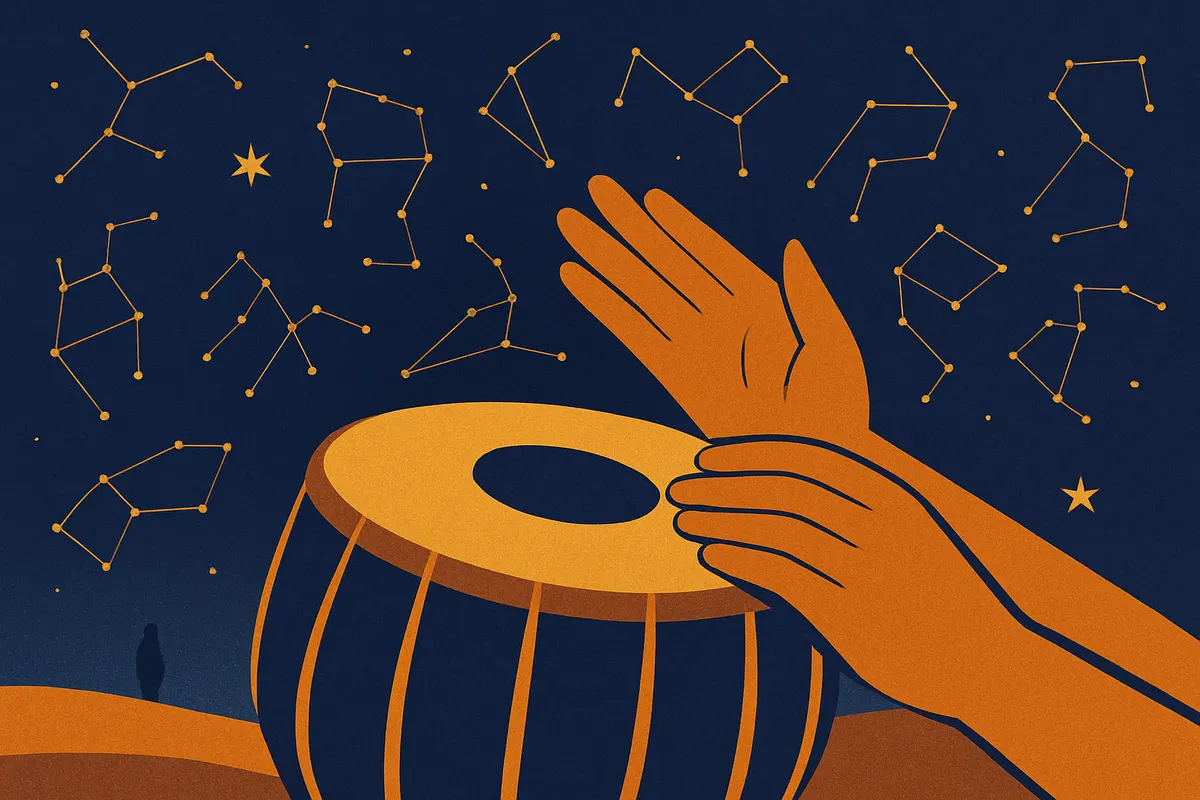
Dhanishta is the twenty-third of the 27 nakshatras in Vedic astrology, spanning 23°20' of Capricorn to 6°40' of Aquarius. It is ruled by Mars, presided over by the Eight Vasus and symbolised by a drum. Its name is read as "most prolific" or "wealthiest".
Who is the ruling planet of Dhanishta Nakshatra?
Mars is the ruling planet of Dhanishta in the Vimshottari Dasha system. Anyone born with the Moon here opens life in a 7-year Mars Mahadasha, which is tied with Ketu's seven years as the second-shortest of the nine planetary periods, after the Sun's six.
Which zodiac sign is Dhanishta Nakshatra in?
Two signs. Padas 1 and 2 lie in the last 6°40' of Capricorn and padas 3 and 4 lie in the first 6°40' of Aquarius, so the Moon sign is Capricorn or Aquarius depending on the pada. This is why the Sade Sati path splits within one nakshatra.
What traits are associated with Dhanishta Nakshatra?
A gift for organising groups, for rhythm and timing, musical or otherwise, and for accumulating wealth through steady, diligent work. The classical texts add that the rhythm-keeping gift is morally neutral, so what it produces depends on the field it is applied to.
Is Dhanishta a good placement for musicians?
Classically, yes: the drum symbol and the Vasus' link to foundational rhythm connect Dhanishta to musical timing, especially percussion and ensemble roles. It shows up just as often in non-musical work where the same gift keeps a calendar, a supply chain or a team's cadence, and it works alongside the wider chart.
How does Dhanishta compare to Shravana, the nakshatra before it?
Shravana is Moon-ruled and centred on listening and receptive learning. Dhanishta follows it and shifts from receiving to organising, from taking in what a group needs to actively building and maintaining the structure that meets it. Both sit in Capricorn at least in part, but Shravana lies wholly within that sign.