A Note Before You Read

If your phone has been quietly heavy for a few days because someone — an astrologer at a wedding, a cousin who reads charts for fun, a YouTube short that the algorithm chose for you at midnight — told you that your chart carries Kaal Sarpa Dosha, I want you to put the phone down for a moment and read this slowly. The word "dosha" (literally, "fault" or "blemish") and the imagery of being caught between the two ends of a cosmic serpent have a way of making any reasonable adult feel cursed before they have had their morning chai.

Here is the straight version. Kaal Sarpa is a real configuration in a Vedic chart. It is also, by a wide margin, the most over-marketed condition in modern Indian astrology. The texts that genuinely matter — Brihat Parashara Hora Shastra (the foundational treatise of Vedic astrology, abbreviated BPHS), Phaladeepika of Mantreshwara, Saravali of Kalyana Varma — either do not name Kaal Sarpa Dosha at all by that exact phrase, or treat the underlying placement of the lunar nodes with far more nuance than the WhatsApp version allows. Most of what you have heard about it in the last decade has been amplified by online quick-readings, paid puja services, and the kind of fear-first marketing that thrives on anxious search queries.

I will walk you through what the configuration actually is, what the classical lineage truly says, where the modern panic came from, the narrow band of charts where it deserves real attention, and the much wider band where you can take a breath. I will not invent statistics. I will not pretend a chart placement guarantees a life outcome. I will not tell you to spend a single rupee on a remedy you do not understand. By the end you should be able to look at your own Kundli (birth chart) and your relatives at the next family lunch and say, with some confidence, what the flag does and does not mean.

What Kaal Sarpa Dosha Actually Is

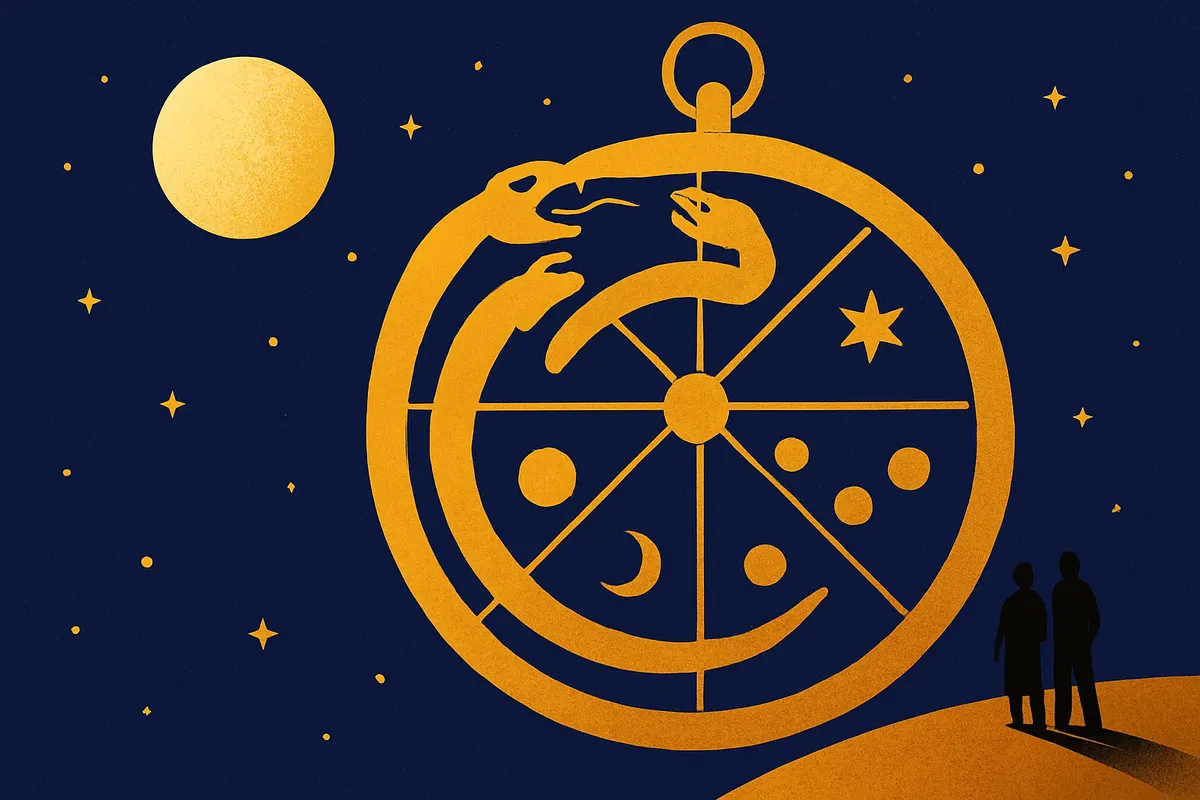
The configuration is geometric. Rahu and Ketu — the two lunar nodes, called the north and south nodes of the Moon, treated in Vedic astrology as the head and tail of a celestial serpent (Sarpa) — sit on opposite ends of a 180-degree axis at every moment. They are always exactly opposite each other in the chart. The question is what falls between them.

Kaal Sarpa Dosha, in the modern formulation that nearly all astrologers use today, is said to occur when all seven of the visible planets — Sun (Surya), Moon (Chandra), Mars (Mangal), Mercury (Budha), Jupiter (Guru), Venus (Shukra), and Saturn (Shani) — are caught on one side of the Rahu–Ketu axis. The serpent's mouth is Rahu; its tail is Ketu; and the planets are figuratively swallowed between them. The name "Kaal Sarpa" itself means "the Serpent of Time" — Kaal pointing to time and to the destructive aspect of time, Sarpa to the snake. It is an evocative image. The practical question is whether the image deserves the weight popular culture has given it.

There are sub-classifications you will see online and in some modern compilations — twelve named varieties, one for each axis on which Rahu and Ketu can sit. The most commonly cited are Anant Kaal Sarpa (Rahu in 1st, Ketu in 7th), Kulik (Rahu in 2nd, Ketu in 8th), Vasuki (Rahu in 3rd, Ketu in 9th), and so on through Shankhpal, Padma, Mahapadma, Takshak, Karkotak, Shankhachood, Ghaatak, Vishdhar, and Sheshnag. Each is given a flavor in the modern literature — Anant is said to disturb general life and self-image, Padma to disturb education and progeny, Vishdhar to bring sudden travel and instability, and so on. These twelve-fold descriptions are largely a twentieth-century compilation. They are not present in the form we now read them in BPHS, Phaladeepika, or Saravali. They are real in the sense that practitioners use them; they are not classical in the sense of being traceable to the foundational texts.

There is also a distinction between Kaal Sarpa Yoga and Kaal Sarpa Dosha that the marketing rarely respects. A "yoga" in Vedic astrology is a combination — neutral language, often even auspicious. A "dosha" is a flaw. Several modern Vedic writers, including some serious commentators in the lineage of B.V. Raman, treat the configuration as a yoga first — meaning a particular concentration of nodal energy that can produce both intensity and accomplishment — and only as a dosha when other afflictions stack on top of it. The conversion of "Kaal Sarpa Yoga" into "Kaal Sarpa Dosha" in the popular conversation is itself a piece of the inflation we are tracing.

A further subtlety: most modern astrologers also distinguish between Purna (complete) and Aanshik (partial) Kaal Sarpa. Purna requires all seven planets strictly within the Rahu–Ketu arc, with not a single planet — not even by one degree — escaping outside the axis. Aanshik allows some planetary degrees to spill out of the arc, which is much more common and considerably milder in interpretation. Many charts that get labelled Kaal Sarpa in a casual reading are actually Aanshik, where one planet is at, say, 27 degrees of a sign while Rahu is at 25 — technically outside the arc, technically not Kaal Sarpa at all in its strict form.

What the Classical Texts Actually Say

This is the part where the WhatsApp version and the textual record part company. Let me lay it out plainly.

Brihat Parashara Hora Shastra — the most important text in the Parashari tradition that almost every modern Vedic astrologer cites — has extensive chapters on Rahu and Ketu, on their effects in each house, on their dasha periods (the planetary major cycles in the Vimshottari Dasha system), and on yogas formed with them. It does not contain a chapter titled "Kaal Sarpa Dosha" in its received form. References to Rahu and Ketu surrounding all the planets exist, but the dramatic, life-defining curse interpretation is not how Sage Parashara, as the text is attributed, frames it. BPHS treats the nodes as agents of karma and intensity — which they are — without compressing all that nuance into a single flag.

Phaladeepika by Mantreshwara — a roughly fifteenth-century text widely respected — discusses Rahu and Ketu in detail across its chapters on planetary effects (Phaladeepika 5.31 onwards in standard editions, where the malefic and benefic effects of the nodes are treated). It does not name Kaal Sarpa Dosha. The configuration of all planets between the nodes simply is not a category Mantreshwara isolates and warns against in the way modern compilations suggest.

Saravali by Kalyana Varma, an even older text often cited as authoritative on yogas, contains hundreds of yoga descriptions. The dramatic, life-cursing version of Kaal Sarpa as a stand-alone yoga is not among the well-known ones it lists, though related nodal yogas are.

The earliest serious appearances of "Kaal Sarpa Yoga" as a named category come from later regional commentaries and a strand of folk astrology, particularly from western India and some Maharashtrian and Gujarati sources, which entered the modern conversation in the twentieth century. B.V. Raman, the modern Vedic writer whose work most contemporary practitioners read, is comparatively measured on the topic. He acknowledges the configuration, notes that the chart's overall strength, dasha sequence, and other yogas almost always override the bare nodal placement, and warns explicitly against treating it as a stand-alone verdict.

So when an astrologer leans heavily on a "Kaal Sarpa Dosha" diagnosis without showing you the same care for your Lagna lord (the planet ruling your rising sign), your Mahadasha sequence (your major planetary periods), your house lords, and your other yogas — they are working from popular tradition, not from the classical texts they are usually claiming as their source.

Where the Modern Panic Came From

It is worth understanding why this configuration, of all the dozens of yogas in the classical literature, became the one that fills television slots and search engines. Three forces stack up.

The aesthetic. "All planets caught between the serpent" is a vivid, cinematic image. It paints itself. The pop-cultural vocabulary of Indian astrology in the last forty years has favored images that work as a thumbnail — Manglik (the Mars affliction, with its red, hot, marriage-disturbing flavor), Shani Sade Sati (the seven-and-a-half-year Saturn transit), Pitra Dosha (ancestral karma), Kaal Sarpa. The yogas that do not photograph well — Gajakesari, Adhi Yoga, Pancha Mahapurusha — are equally classical and arguably more determinative for life outcome, but they get a fraction of the attention because they do not scare anyone.

The economics. A diagnosis that requires expensive remedial pujas, particularly the Kaal Sarpa Shanti puja at certain temples — Trimbakeshwar in Maharashtra most prominently — generates pilgrimage traffic, ritual fees, and packages that combine travel, lodging, and ceremony. None of this makes the configuration imaginary. But it does mean that the institutions with the most reach to amplify the diagnosis also have a structural reason to keep it loud. This is not a unique pathology of astrology; the same dynamic exists in many therapeutic and ritual ecosystems globally. It is just worth naming honestly.

The internet's incentive curve. Search queries like "do I have Kaal Sarpa Dosha" generate orders of magnitude more clicks than "what is my Mahadasha lord doing in my 10th house." The free chart calculators that spread first across Indian astrology websites in the 2010s heavily flagged Kaal Sarpa precisely because that flag drove engagement. Once the digital muscle memory was built, a generation of users started arriving at any astrological reading already worried about the serpent. The diagnosis stopped being something an astrologer found in your chart and became something you walked in expecting to be told.

None of this argues that the configuration is meaningless. It does argue that the volume and tone of the modern conversation is calibrated for engagement, not for accuracy.

What the Configuration Genuinely Indicates

Step back from the fear language. Rahu and Ketu, classically and across every serious Vedic source, are agents of karma — the unfinished work the soul is here to engage with. Rahu pulls toward intensification, ambition, foreign experience, the unconventional, and obsessive desire. Ketu pulls toward dissolution, detachment, spiritual seeking, and sudden release. They are the chart's growth engine and its stripping mechanism, working as a pair.

When all seven visible planets sit between the nodes, what the configuration genuinely indicates — across the careful modern Vedic readings I respect, including B.V. Raman's casebooks and the more measured contemporary writers — is a chart where the nodal axis is unusually emphasized. The life tends to carry these features in some combination:

The person often experiences the unusual rather than the predictable. Career paths zigzag. Relationships have a fated, intense quality even when they are stable. There is frequently a strong pull toward something — a vocation, a travel, a partner, a question — that does not look like the obvious choice from the outside. Effort feels uneven; periods of grinding flat output are punctuated by sudden expansions or sudden dissolutions tied to the dasha activation of Rahu or Ketu. Many people with this configuration report a sense, even in their twenties, that life is "trying to teach them something specific." That is the karmic axis talking.

This is not the language of a curse. It is the language of an emphatic life. Several extraordinarily accomplished people in modern Indian and global public life are repeatedly cited in astrology circles as having Kaal Sarpa configurations — businesspeople, leaders, artists, sportspersons. I will not name specific public figures because the chart-times for many of them are uncertain and the gossip is unhelpful, but the general pattern in the better-documented cases is consistent: the configuration shows up disproportionately in people who did unusual things. Not in people whose lives were destroyed.

That should reframe the question. The right question is not "do I have Kaal Sarpa Dosha." The right question is "if my chart has the nodal axis emphasized, how do the other features of my chart shape that emphasis — and what is my dasha sequence going to ask of me over the coming years?"

The Narrow Set of Cases That Warrant Attention

Now the careful part. The classical and modern commentators who take the configuration seriously do so under specific conditions that almost never appear in the casual diagnosis. I want to be honest with you: there is a real, narrow band of charts where the nodal emphasis combines with other afflictions in a way that does deserve a longer, more thoughtful reading. Here is what that band looks like.

Rahu or Ketu placed in a dushtana house with no benefic relief. The 6th, 8th, and 12th houses (the dushtana — "difficult" — houses) are classically associated with conflict, transformation, and dissolution. When Rahu sits in the 8th — the house of longevity and sudden events — and is unaspected by Jupiter (Guru), the natural benefic, and the chart's overall Lagna lord is also weak, the Kaal Sarpa flag becomes one part of a stack that genuinely warrants reflection.

Mahadasha or Antardasha of Rahu or Ketu coinciding with a chart-wide stress signature. In the Vimshottari Dasha system, Rahu's major period lasts eighteen years and Ketu's seven. When a person with a strong Kaal Sarpa configuration enters a Rahu Mahadasha or Ketu Mahadasha, the nodal themes of the chart amplify. If at the same time Saturn is transiting one's natal Moon in the seven-and-a-half-year cycle called Sade Sati, and the Lagna lord is debilitated, the period can carry real weight. This is rarely about Kaal Sarpa alone; it is about the convergence.

Strict Purna Kaal Sarpa with no planet outside the axis at all, combined with weak Jupiter. Jupiter is the chart's natural softening, expanding, wisdom-bringing planet. A complete Kaal Sarpa where Jupiter is debilitated (in Capricorn / Makara) or combust (very close to the Sun) or in a dushtana house with no remedial dignities — that is a configuration where the absorbing function of the chart is compromised. The classics treat this seriously not because Kaal Sarpa is itself a verdict, but because the chart's own counterweight is missing.

The chart shows other strong indicators of nodal disruption. This is the one most laypeople miss. If a chart already carries Pitra Dosha (an ancestral karmic flag traced to Sun afflictions), or strong Grahan Yoga (eclipse yoga, where the Sun or Moon is conjunct Rahu or Ketu within a few degrees), or a heavily afflicted 4th house — and Kaal Sarpa is also present — then the configuration is one symptom of a broader pattern, not the diagnosis itself. The reading should focus on the broader pattern.

Specific examples from the careful tradition. B.V. Raman, in his casebooks, discusses cases where charts with all planets between the nodes coincided with marked life upheavals — but always notes the dasha context and the position of the Lagna lord. He does not, in any reading I can point to, treat Kaal Sarpa as a stand-alone explanation for life difficulty. The honest modern Vedic position, as I read it, is: when the configuration appears alongside other clear weaknesses, take it seriously as one strand. When it appears in an otherwise strong chart, it is more accurately read as a karmic emphasis than as a curse.

If you fall into this narrow band, the conversation worth having with a careful astrologer is not "how do I get rid of Kaal Sarpa." It is "what is my chart asking me to integrate, and how do my dasha periods over the next decade structure that integration?"

The Much Wider Set of Cases Where You Can Exhale

Now the honest other side. For most readers who have been told they carry Kaal Sarpa Dosha and have been quietly worried for weeks, the careful answer looks something like this.

Aanshik Kaal Sarpa with even one planet decisively outside the axis is materially milder. If Mercury is at 28 degrees of Sagittarius and Rahu is at 25 degrees of Sagittarius, that planet has escaped the arc. The strict Purna form does not apply. Several modern Vedic commentators consider Aanshik with multiple outside planets effectively non-operative as a stand-alone dosha.

A strong Lagna lord almost always neutralizes the configuration. If the planet ruling your rising sign is in its own sign, exalted, in a kendra (angular house — 1, 4, 7, 10) or trikona (trinal house — 1, 5, 9), and free of severe affliction, the chart's primary engine is robust. The nodes can do what they will at the periphery; the core of the life carries forward. This is one of the most consistent observations across the modern tradition.

A well-placed Jupiter softens the entire pattern. Jupiter aspecting the Lagna, or sitting in a kendra, or in its own sign (Sagittarius / Dhanu, Pisces / Meena) or exalted (Cancer / Karka), is the chart's protective dignity. With a strong Jupiter, even a strict Kaal Sarpa is read by careful astrologers as a karmic intensifier rather than a damaging dosha. Phaladeepika's chapters on Jupiter's protective effects are explicit on this point.

Strong Pancha Mahapurusha or other classical yogas in the chart. If you have Ruchaka Yoga (Mars in own or exaltation in a kendra), Bhadra Yoga (Mercury similarly placed), Hamsa, Malavya, or Shasha Yoga — the five great-person yogas of the classical tradition — those are powerful structural strengths. Their presence reorders any Kaal Sarpa reading. The dosha narrative becomes, at most, one footnote against a chart with strong scaffolding.

A clean, well-placed Moon. The Moon (Chandra) is the chart's emotional and mental anchor. A well-placed Moon — in own sign Cancer (Karka), or exalted in Taurus (Vrishabha), or in a kendra with benefic aspects, and clear of conjunction with Rahu or Ketu — gives the person psychological resilience that absorbs nodal volatility well. Many of the people with Kaal Sarpa configurations who go on to lead distinctive, productive lives have a strong Moon doing quiet structural work.

If two or three of these conditions describe your chart — and for the great majority of readers, at least one of them does — the rational, classically grounded response to a Kaal Sarpa flag is not panic. It is a longer, more careful conversation about your dasha sequence and your overall chart strength. The flag is informational. It is not a verdict.

Practical Steps This Week

If you have been carrying this question and want to move from a vague worry to a clear position, do these things, in this order, this week. The point is to argue from the chart, not from the rumor that reached you.

1. Get your Kundli with exact birth time. Check the time on your hospital record or your mother's memory of the morning. To the minute if you can; within fifteen minutes is workable. Without the time, the Lagna and house placements are estimates, and so is everything else. If you have an old paper janma-patrika the family pandit prepared, dig it out and verify the birth-time field.

2. Verify whether your configuration is Purna or Aanshik. Look at the exact degrees of Rahu, Ketu, and each of the seven visible planets. Is every one of the seven planets strictly within the arc from Rahu to Ketu? Or is at least one planet — even by one degree — outside? If outside, you are looking at Aanshik, which is materially milder. Most casual readings collapse this distinction. Do not let yours.

3. Identify your Lagna lord and its strength. Find the planet that rules your rising sign. Where is it? In its own sign? Exalted? In a kendra or trikona? Aspected by Jupiter? If you can answer "yes" to two or more of these for your Lagna lord, your chart's engine is structurally strong, and any Kaal Sarpa flag should be read against that strength rather than in isolation.

4. Check the position of Jupiter. Jupiter's role in your chart is the single most important counterweight to nodal disruption. Note its sign, house, and aspects. A well-placed Jupiter changes any Kaal Sarpa reading in your favor. A debilitated or afflicted Jupiter is the one finding that, alongside a strict Kaal Sarpa, deserves a longer conversation.

5. Map your current and next Mahadasha. Are you currently in a Rahu or Ketu Mahadasha, or about to enter one in the next five years? If yes, the nodal themes of your chart are activated or about to be. That is not a reason to fear the period; it is a reason to read it carefully and structure your major decisions around its rhythms. If you are in, say, a Jupiter or Venus Mahadasha and far from a nodal period, the Kaal Sarpa flag is even less weighty in your immediate life.

6. Make a list, on paper, of the actual concerns that brought you to the question. Are you worried about your career? Your marriage? Your health? Your finances? The Kaal Sarpa diagnosis is a generic flag; your concrete worry is specific. Run the chart against the specific concern. Ask: which house governs this concern, who is its lord, where is its lord placed, what aspects fall on it, what dasha currently activates it? That analysis will tell you a hundred times more than the headline diagnosis.

7. If you decide on remedies, choose ones that you understand and that fit your tradition. The classical and folk repertoire includes daily recitation of Maha Mrityunjaya Mantra (an ancient Sanskrit verse to Lord Shiva from the Rig Veda 7.59.12, used in the tradition for protection and longevity), Rudrabhishek (a worship of Shiva involving milk, water, and Vedic mantras), donation of black sesame on Saturdays, the Naga Panchami observances on the fifth day of the bright fortnight of Shravana, and at the higher-investment end, the Kaal Sarpa Shanti puja at Trimbakeshwar or other recognised shrines. Pick what you understand. Skip what feels coerced. A remedy that you do because you genuinely intend it does the calming, conscious work it is meant to do; a remedy that you do because someone scared you into it does very little.

8. If the chart genuinely sits in the worst-case stack, consult a careful astrologer — and then a counselor. If your reading shows strict Purna Kaal Sarpa, weak Lagna lord, debilitated Jupiter, an active Rahu or Ketu Mahadasha, and a real life concern in the area the configuration touches, that is the band where a longer, careful astrological reading from a measured practitioner makes sense. Pair it, if a real life decision is on the table, with a counselor or therapist who can help you navigate the period in practical terms. The chart describes the weather. You still have to walk through it. For any decisions touching long-term financial commitments during a heavy nodal period, this is a general reflection, not investment advice — consult a SEBI-registered investment adviser before any specific decision. For any health-adjacent worries you have stacked on top of the diagnosis, please consult a qualified medical professional.

Reading the Configuration in a Family Chart Context

A specific case worth naming, because it produces a particular kind of family conversation, is the Kaal Sarpa diagnosis arriving on a child's chart rather than the native's own. A parent has the family pandit cast the child's horoscope; the pandit names Kaal Sarpa; the parent goes home with a diagnosis they did not ask for and a child who is now, in the parent's mind, marked.

The textual reading is the same regardless of whose chart carries the configuration. The same questions apply: is it strict Purna or partial; how is the Lagna lord placed; is Jupiter strong or compromised; what dasha sequence is on the horizon. The popular conversation around children's charts, however, tends to skip the textual analysis and go directly to remedy — extensive Trimbakeshwar pujas before the child is old enough to understand them, gemstones placed on the body without the child's consent, anxious parental tracking of every developmental milestone for evidence of the dosha's effect.

A more measured reading is to take the diagnosis seriously as one input among many in a long parental relationship, not as a defining label that the parent carries on the child's behalf. The configuration, if real, will express across the child's life in patterns the chart can name; those patterns, when they appear, can be supported in age-appropriate ways at the time. The texts do not require pre-emptive remediation of an infant. They describe a configuration whose work happens across decades, and they expect that work to be supported by the native themselves once the native is old enough to participate in it.

The other configuration worth naming is when both parents carry Kaal Sarpa and the child does not. The popular conversation sometimes reads this as transmission averted; the textual reading is more modest. The parents' configuration is theirs to work with; the child's chart is the child's chart, and the parents' Kaal Sarpa does not bind the child's life in any direct textual sense. The household's relationship with the configuration may shape the child's emotional climate — parents preoccupied with their own dosha tend to project that preoccupation onto family life — but that is a parenting question, not an astrological one.

Final Note

You came to this article with the word Kaal Sarpa weighing on you. I hope you are leaving with a sharper question and a quieter chest. Kaal Sarpa Dosha, in the form most people encounter it, is not a verdict. The configuration is real; the cinematic interpretation that the modern conversation has built around it is mostly inflation. The classical sources that the loud version claims as its textual ground are, when you read them carefully, much more measured.

If your chart genuinely carries the worst-case stack — strict Purna placement, weak Lagna lord, compromised Jupiter, active nodal dasha, and other corroborating afflictions — you have classical, textual, careful grounds to look hard at the period ahead and to plan your large decisions with awareness. Most readers do not carry that stack. They carry a flag that, when read against the rest of their chart, is best understood as karmic emphasis — a life that asks for unusual choices and rewards them — rather than as a curse to be paid off.

Pull up your Kundli this weekend. Check whether the configuration is strict or partial. Locate your Lagna lord and your Jupiter. Map your Mahadasha. Then, if a question about your career or marriage or move or wedding has been waiting on this answer, take it up again with the chart rather than with the rumor. Whatever you decide, decide it because the chart said so — and because you understood what it actually said.

Related cornerstones

If this reading was useful, the following cornerstones address related dimensions of the same broader tradition: