A Note Before We Begin
Among the divisional charts that the older Indian classical tradition treats with sustained attention, the Drekkāṇa — the third-divisional chart, the D3 in modern shorthand — occupies a particular place that the casual reader of contemporary Vedic astrology often does not register. The drekkāṇa is not as widely consulted in popular practice as the navāṃśa (D9), nor as visibly important as the daśāṃśa (D10) for career questions. But the older texts — Brihat Parashara Hora Shastra in particular, with its dedicated Drekkāṇa Adhyāya — treat the drekkāṇa as a chart of unique character, providing readings that the rashi alone cannot access and that complement the navāṃśa's soul-and-marriage reading with a register the navāṃśa does not itself touch.
The classical sources are precise about the drekkāṇa's primary significations. It is the chart consulted for sibling matters — not the eldest siblings, who fall under the eleventh house's jyeṣṭha signification, but the broader sibling field whose third-house affinities the drekkāṇa reads with particular depth. It is the chart consulted for parakrama — the courage-as-action that the third house signifies in the rashi, refined and clarified by the third-divisional reading. It is the chart consulted, in many classical applications, for matters of physical effort, hand-based skill, short journeys, the immediate neighbourhood, and the personal initiative by which the day's work is carried forward. And it is the chart, uniquely among the divisional charts, that Parāśara endows with thirty-six specific iconographic depictions — the drekkāṇa-rūpas — each providing a symbolic image whose interpretation the older astrological tradition has refined across centuries of practice.
This article is for the seeker who has begun to encounter the drekkāṇa in their own chart consultation — perhaps because the question of sibling relationships pointed them toward the D3, perhaps because the parakrama assessment of the lifetime brought the third-divisional chart into focus, perhaps because their astrologer mentioned a particular drekkāṇa-rūpa image and the seeker wants to understand what that image means. We will move slowly, beginning with what the chart is in plain language, then turning to the sub-rulership pattern, the 36 iconographic significations, the sibling and parakrama readings, the practical casting procedure, and the common misreadings the popular literature is prone to. Read this with both your rashi and your drekkāṇa charts open if you have them.
What the Drekkāṇa Actually Is — In Plain Language
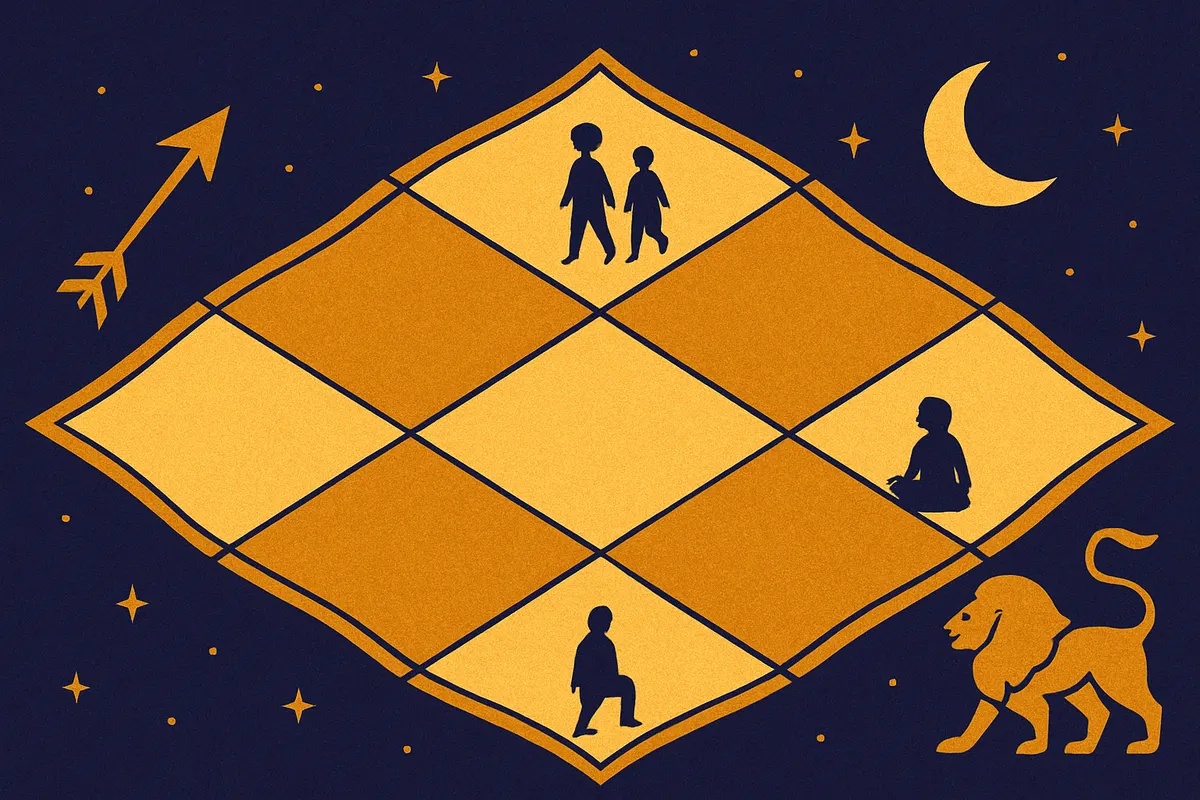
The drekkāṇa is constructed by dividing each rashi sign of thirty degrees into three equal parts of ten degrees each. The first ten degrees of any sign constitute the first drekkāṇa of that sign; the next ten degrees constitute the second drekkāṇa; the closing ten degrees constitute the third drekkāṇa. Across the twelve signs of the zodiac, this produces a total of thirty-six drekkāṇas — the foundational unit on which the chart's specific iconographic and sub-rulership readings are built.
The drekkāṇa of a planet is determined by the precise zodiacal degree of that planet at the moment of the chart's casting. A planet at four degrees of Mesha falls in the first drekkāṇa of Mesha; a planet at fifteen degrees of Mesha falls in the second drekkāṇa; a planet at twenty-five degrees of Mesha falls in the third drekkāṇa. To construct the full drekkāṇa chart, one assigns each planet to its corresponding drekkāṇa sign according to the classical sub-rulership pattern, and one assigns the lagna of the drekkāṇa chart to the drekkāṇa sign occupied by the rashi lagna's exact rising degree.
The classical sub-rulership pattern, which the older texts treat as foundational, assigns the three drekkāṇas of any sign to specific signs in a structured progression. The first drekkāṇa of any sign is ruled by the sign itself — that is, the lord of the rashi sign also rules the first drekkāṇa. The second drekkāṇa of any sign is ruled by the lord of the fifth sign from the rashi sign, counted in the natural zodiacal order. The third drekkāṇa of any sign is ruled by the lord of the ninth sign from the rashi sign, again counted in the natural zodiacal order.
This 1-5-9 pattern, which the older sources call the Parāśarī drekkāṇa assignment to distinguish it from the alternative Parivṛtti drekkāṇa assignment that some commentators use, has the structural consequence that the three drekkāṇas of any sign are aligned with the three signs of the same elemental triplicity. For Mesha (a fire sign), the first drekkāṇa is Mesha itself, the second is Siṃha (the fifth sign from Mesha, also a fire sign), and the third is Dhanus (the ninth sign from Mesha, also a fire sign). The three fire signs — Mesha, Siṃha, Dhanus — together rule the three drekkāṇas of every fire sign. The same elemental coherence holds for the earth, air, and water triplicities.
The Triplicity Coherence and Why It Matters
The elemental coherence of the drekkāṇa sub-rulerships is not an accident, and the older texts read it as one of the drekkāṇa's most important structural features. A planet placed in the first drekkāṇa of any sign occupies the drekkāṇa of the sign itself — the most direct expression of the rashi sign's nature. A planet in the second drekkāṇa occupies the drekkāṇa of the same triplicity sign that is fifth from the rashi sign — the fifth-house trikoṇa refinement of the rashi nature, often associated with the dharmic-creative dimension of the sign. A planet in the third drekkāṇa occupies the drekkāṇa of the same triplicity sign that is ninth from the rashi sign — the ninth-house trikoṇa refinement, often associated with the teacher-and-fortune dimension of the sign.
This means that the drekkāṇa chart, in addition to giving the seeker information about siblings and parakrama, also gives the practitioner a refined reading of the trikoṇa (trinal) significations of any planet placed in any sign. A planet in the first drekkāṇa expresses the rashi nature directly; a planet in the second expresses the Lakṣmī-trikoṇa (the fifth-house dharma-and-creativity dimension) of the rashi nature; a planet in the third expresses the Sarasvatī-trikoṇa (the ninth-house dharma-and-teaching dimension) of the rashi nature. The integration of these three different refinements is one of the distinctive interpretive contributions the drekkāṇa chart makes to the practising astrologer's reading.
The 36 Iconographic Drekkāṇas of Parāśara
The Drekkāṇa Adhyāya of Brihat Parashara Hora Shastra gives, with unusual concreteness for a classical jyotiṣa text, a specific iconographic image — a rūpa — for each of the thirty-six drekkāṇas. The images are striking in their visual particularity, and the older astrological tradition has refined the interpretation of these images across centuries of practice. Each image carries specific significations that modulate the reading of any planet placed in the corresponding drekkāṇa, and the careful practitioner consults the rūpa alongside the sub-rulership and the broader chart context.
The three drekkāṇas of Mesha, by way of illustration, give us a representative pattern. The first drekkāṇa of Mesha is depicted as a dark-coloured man with red eyes, holding an axe and protecting his body — the Mars-natured warrior in his most direct form. The second drekkāṇa of Mesha is depicted as a woman of red complexion holding a vessel, a horse-rider, dressed in red garments, with the hunger and thirst of one engaged in intense activity — the Sun-influenced Mars expression of Siṃha's rulership of the second drekkāṇa. The third drekkāṇa of Mesha is depicted as a wise yellowish-brown person, skilled in arts, of cruel nature, holding a staff — the Jupiter-influenced Mars expression of Dhanus's rulership of the third drekkāṇa.
These images are not decorative. They give the practitioner a specific interpretive tool. A planet in the first drekkāṇa of Mesha takes on the warrior-with-axe quality — the planet's matters are likely to be expressed in a register of direct martial protection of one's own. A planet in the second takes on the woman-with-vessel quality — the matters carry the engaged but specific activity of the Sun-Mars combination. A planet in the third takes on the wise-arts-practitioner quality — the matters carry the Jupiter-Mars dharma-applied-to-craft signature. The careful reader integrates the rūpa with the planet's nature, dignity, aspects, and daśā timing.
The thirty-six rūpas across all twelve signs together constitute one of the most distinctive interpretive systems in the classical jyotiṣa tradition. The full enumeration is too long for this article, but any standard published commentary on the Drekkāṇa Adhyāya will give the seeker the complete list, and the careful study of these images alongside one's own chart's drekkāṇa placements is a classical practice that the older sources treat as an integral part of serious chart consultation.
A few additional examples will give the reader the texture of the rūpa system. The first drekkāṇa of Karka — the second water sign — is depicted as an elephant with a horse-like face, holding leaves in its trunk, having come out of a forest — the watery Cancer expression amplified by the elemental coherence of the first drekkāṇa's self-rulership. The second drekkāṇa of Karka, ruled by Vṛścika as the fifth from Karka, shows a woman holding a Pāla tree and wandering through the forest in search of a husband, decorated with serpent ornaments — the Mars-influenced Karka expression intensified by the Scorpio sub-rulership. The third drekkāṇa of Karka, ruled by Mīna as the ninth from Karka, depicts a man with serpent-like ornaments, on a boat, pursuing a wife the seas have separated him from — the Jupiter-influenced Karka expression with the dharmic seeking of the ninth-house trikoṇa refinement.
The first drekkāṇa of Tulā shows a man holding a balance and weights, going to the marketplace in cleansing garments — the direct expression of Tulā's sign nature. The second drekkāṇa of Tulā shows an eagle-headed man with hunger and thirst, contemplating his wife and children at home — the Mercury-Saturn-touched expression of Kumbha as the fifth from Tulā. The third drekkāṇa of Tulā shows a man in golden armour, holding bow and quiver, in pursuit of cattle in the forest — the Mercury-touched expression of Mithuna as the ninth from Tulā.
The first drekkāṇa of Makara shows a hairy-bodied man, hog-faced, having yoked himself to a buffalo, with crocodile and shark ornaments — the direct earthy patient Saturn-Mars expression of Makara's sign nature. The second drekkāṇa of Makara shows a woman holding a flower, of dark complexion, skilled in arts, with the eyes of a hunter — the Venus-influenced expression of Vṛṣabha as the fifth from Makara. The third drekkāṇa of Makara shows a man with a hairy chest, in a cloth of various colours, holding pottery and bow — the Mercury-influenced expression of Kanyā as the ninth from Makara.
These images, though strikingly visual, are not arbitrary. The careful classical commentator reads each rūpa as a distilled symbolic representation of the planet's expressive qualities when placed in the corresponding drekkāṇa. The animal forms, the implements, the postures, and the social roles in the images all carry specific interpretive significations the older tradition has refined across centuries. The seeker who studies the full Drekkāṇa Adhyāya in any reliable English translation will find the system rewarding — it provides interpretive specificity that the abstract rashi reading alone does not access.
Why Sibling Affairs Read More Clearly in the Drekkāṇa
The third house of the rashi chart gives the practising astrologer a general reading of the sibling field, but the older sources are explicit that the deeper sibling reading — particularly for younger siblings, for the texture of the relationships, for the timing of sibling-related events — proceeds from the drekkāṇa. The reasoning is structural. The drekkāṇa is the third-divisional chart, and the third house's significations are accordingly amplified in the D3. The third house of the drekkāṇa chart, the third lord of the drekkāṇa chart, the placement of Mars (the kāraka for siblings) in the drekkāṇa — all of these together give the practitioner a refined reading that the rashi alone cannot provide.
The classical reading proceeds in layers. The third house of the rashi gives the broad sibling field — the existence, approximate number, and general relational texture of the siblings the lifetime is built around. The third house of the drekkāṇa refines this reading, showing the specific relational character, the durability of the sibling bonds, and the long-arc trajectory of the relationships across the decades. Mars's placement in the drekkāṇa gives the kāraka-level reading — the sibling's character, the kind of parakrama the sibling carries, and the way the sibling's life will likely unfold.
For natives whose third house in the rashi looks one way but whose third house in the drekkāṇa looks differently, the older sources counsel reading both together rather than choosing one. A native with an apparently strong rashi third but a weakened drekkāṇa third will often experience sibling relationships that seemed strong on the surface but proved more difficult to maintain across the decades. A native with an apparently challenged rashi third but a strengthened drekkāṇa third will often discover, with time, that the sibling relationships develop into a depth and durability that the rashi alone did not promise.
Reading Courage and Parakrama Through the D3
The parakrama signification of the third house — the courage-as-action, the personal initiative, the willingness to take the next step — also reads more clearly through the drekkāṇa than through the rashi alone. The third house of the drekkāṇa chart, considered together with the placement of Mars in the drekkāṇa and the lord of the third drekkāṇa itself, gives the practitioner a refined assessment of the native's capacity for sustained personal effort.
A native with a well-disposed third house in the drekkāṇa — with benefics tenanting the third or aspecting it favourably, with the third lord in a strong placement, with Mars (the kāraka) in good dignity — typically carries the parakrama faculty as a constitutional feature of how they engage with the world. They are the ones who, in any difficult moment, are quietly the first to move, and whose movement carries the surrounding people forward without theatrical announcement.
A native whose drekkāṇa third is more challenged carries a different relationship to parakrama. The faculty has to be developed deliberately rather than relied on as a constitutional given, and the classical counsel is that the upachaya designation of the third house (which applies to the drekkāṇa third just as it applies to the rashi third) means that this disciplined development is itself a viable lifetime path. The patient practice of small forward motions, the disciplined hand-skill cultivation, the steady engagement with the daily tasks that the moment is asking for — all of these strengthen the parakrama faculty across the decades, and the drekkāṇa third's upachaya signature ensures that the discipline pays off.
The Lagna Lord's Placement in the D3
The lagna lord of the rashi chart, when placed in the drekkāṇa, gives the practitioner an additional important reading. This placement modulates how the third-divisional significations actually deliver across the lifetime — whether the sibling and parakrama matters come through the rashi reading clearly, with modifications, or with substantial redirection.
When the rashi lagna lord sits in a kendra (first, fourth, seventh, or tenth) of the drekkāṇa, the third-divisional reading tends to deliver in alignment with the lagna's primary themes. The siblings' lives integrate well with the native's own life arc; the parakrama faculty is reliably available for the major decisions of the lifetime; the third-divisional matters reinforce the rashi's primary readings rather than complicating them.
When the rashi lagna lord sits in a trikoṇa (fifth or ninth) of the drekkāṇa, the third-divisional reading delivers with additional dharmic or fortune-related amplification. Siblings often play roles in the native's dharmic life — supporting the spiritual practice, sharing the dharmic vocation, providing the ninth-house-style fortune that the trinal placement signals.
When the rashi lagna lord sits in a dusthāna (sixth, eighth, twelfth) of the drekkāṇa, the third-divisional reading is read with more careful attention to the modulations the dusthāna introduces. Sibling relationships may carry difficulty, distance, or the specific dusthāna significations of the placement house. The classical practitioner reads the placement with care, noting the daśā periods during which the dusthāna-related significations are likely to come most fully forward.
When the rashi lagna lord is vargottama in the drekkāṇa — that is, occupies the same sign in the rashi and in the drekkāṇa — the alignment between the outer and the third-divisional expression is at its most structurally integrated, and the rashi reading delivers with particular reliability.
Mars in the Drekkāṇa: The Kāraka Reading
Mars is the natural kāraka (significator) for siblings, for parakrama, and for the third-house affairs that the drekkāṇa refines. His placement in the drekkāṇa therefore carries particular weight, and the classical practitioner consults Mars's drekkāṇa position closely whenever the chart's reading turns to the matters Mars naturally signifies.
A Mars in his own sign in the drekkāṇa (in Mesha or Vṛścika) gives a notably strong kāraka reading: the sibling field is supported, the parakrama faculty is constitutionally robust, and the matters Mars governs in the rashi are likely to deliver with structural integrity. A Mars in his sign of exaltation in the drekkāṇa (Makara) gives an even stronger reading — though the Capricorn dignity adds the patient long-arc Saturn quality to the Mars expression, and the practitioner reads accordingly.
A Mars debilitated in the drekkāṇa (in Karka) carries the standard debility caveats. The kāraka reading is weakened, and the matters Mars signifies — siblings, parakrama, hand skill — may show the strain. The classical recommendation is sustained Mars upāsanā throughout the relevant daśā periods, the disciplined practice of parakrama-strengthening daily routines, and the conscious working with the third-house faculties that the rashi reading still allows access to.
A Mars in kendra or trikoṇa houses of the drekkāṇa — in the first, fourth, seventh, tenth, fifth, or ninth — generally supports the kāraka significations. Siblings tend to play significant roles in the native's life; the parakrama faculty is readily available; the third-divisional matters reinforce the rashi reading. A Mars in dusthāna houses (sixth, eighth, twelfth) of the drekkāṇa warrants the more careful reading the dusthāna placement always asks for, with attention to aspects, conjunctions, and daśā timing.
The D3 in Daśā Timing
The Vimśottarī mahādaśās of the planet ruling the third drekkāṇa of the rashi chart, of planets sitting in the rashi third, and of planets prominent in the drekkāṇa chart all bring the third-divisional significations to the foreground of the native's experience. The classical practitioner reads these daśā periods with careful attention to the drekkāṇa-level reading rather than to the rashi alone.
A native whose drekkāṇa third is well-disposed will typically experience the relevant daśā as the chapter in which sibling relationships deepen, parakrama gifts come into mature form, and hand-skill or short-journey related significations bear durable fruit. A native whose drekkāṇa third is more challenged will typically experience the daśā as the chapter in which sibling relationships are tested, the parakrama faculty is asked to develop in difficult conditions, and the disciplined practices the upachaya designation rewards become particularly central to the native's daily life.
The antardaśās within these mahādaśās modulate the picture further. A Mars antardaśā within a third-related mahādaśā often intensifies the parakrama significations. A Mercury antardaśā often brings the communicative and skill-acquisition dimension forward. A Saturn antardaśā tends to slow and deepen the upachaya development, often producing the delayed but durable strengthening that the older sources treat as the third-house signature gift.
Casting and Reading Your D3: A Practical Walkthrough
For the seeker who wants to engage with their own drekkāṇa beyond the consultation room, the basic casting procedure is approachable.
First, obtain the precise zodiacal degree of each of your planets and your lagna in the rashi chart. The drekkāṇa changes every ten degrees, so the precision required is less stringent than for the navāṃśa, but birth time accuracy still matters for borderline placements.
Second, for each planet and the lagna, identify the drekkāṇa it occupies by determining which ten-degree segment of the rashi sign the degree falls into. For the first drekkāṇa (0–10°), the sub-rulership equals the rashi sign itself. For the second drekkāṇa (10°–20°), the sub-rulership equals the fifth sign from the rashi. For the third drekkāṇa (20°–30°), the sub-rulership equals the ninth sign from the rashi.
Third, construct the drekkāṇa chart by placing each planet in the drekkāṇa sub-rulership sign, and placing the drekkāṇa lagna in the drekkāṇa sign that the rashi lagna's degree falls into. The resulting chart is your drekkāṇa.
Fourth, read the drekkāṇa with attention to: the drekkāṇa lagna itself; the placement of the rashi lagna lord in the drekkāṇa; the third house and third lord of the drekkāṇa (for siblings and parakrama); Mars's placement in the drekkāṇa (for the kāraka reading); the iconographic rūpa of any prominent drekkāṇa placement (consulted from the published Drekkāṇa Adhyāya commentary); and the integration of the drekkāṇa reading with the broader rashi context.
Fifth, integrate the drekkāṇa reading with the rashi rather than treating them as separate charts. The classical practice is always integrative — the rashi gives the broad reading, the drekkāṇa refines it, and the practitioner reads them together to arrive at the chart's actual teaching on the matters the drekkāṇa most fully addresses.
Common Misreadings of the Drekkāṇa
There are a few patterns worth flagging because each can lead the seeker to a flatter understanding than the chart actually supports.
The first misreading is the treatment of the drekkāṇa as a chart only for siblings. The drekkāṇa certainly gives the deepest reading on siblings the chart system makes available, but its scope extends to parakrama generally, to the trikoṇa-refined readings of any planet, to the iconographic significations of the rūpas, and to the broader third-divisional reading of any matter the rashi shows. Reading the drekkāṇa only for siblings flattens the chart's actual range.
The second misreading is the mechanical application of the rūpa significations without integration into the broader reading. The thirty-six iconographic images are powerful interpretive tools, but they are read in dialogue with planet nature, dignity, aspects, sub-rulership, and daśā timing. A planet in the warrior-with-axe drekkāṇa of Mesha does not always express that image directly — the planet's nature, the lagna's reading, and the broader chart context modulate the rūpa significantly.
The third misreading is the confusion of the Parāśarī and Parivṛtti drekkāṇa systems. The standard system used in the classical tradition is the 1-5-9 Parāśarī assignment described in this article. The Parivṛtti system (which assigns the three drekkāṇas of a sign to that sign and the next two signs in zodiacal order) is used in some specific regional traditions and for some specific applications, but is not the standard for general chart reading. The seeker who finds their two readings disagreeing should verify which system is being used.
The fourth misreading is the over-reliance on the drekkāṇa alone for sibling questions. The drekkāṇa gives the refined reading, but the rashi third house, the eleventh house (for elder siblings), the relevant kāraka placements, and the daśā timing all need to be read together. The reader who consults only the drekkāṇa and ignores the broader chart system will produce confident but partial readings.
The fifth misreading is the assumption that the rūpa images are merely poetic. The thirty-six iconographic depictions are not decorative literary flourishes the classical commentators added to give colour to an otherwise dry technical chapter. They are interpretive primitives — distilled symbolic forms that carry specific significations the older tradition has refined and tested across centuries. The reader who treats the rūpas as poetic illustrations rather than as interpretive tools loses access to one of the most distinctive contributions the Drekkāṇa Adhyāya makes to the classical jyotiṣa system.
The sixth misreading is the confusion between the planetary sub-rulership and the iconographic rūpa. These are two different layers of the drekkāṇa reading. The sub-rulership tells the practitioner which sign rules the drekkāṇa (the 1-5-9 pattern); the rūpa gives the iconographic image associated with that drekkāṇa in BPHS. Both are read together, with the sub-rulership giving the structural placement and the rūpa giving the symbolic texture, but they are not the same thing and should not be confused.
Closing
The teaching of the drekkāṇa, when it is heard at depth, is the teaching of the third-divisional refinement — the chart that gives the practitioner a closer reading on siblings, parakrama, hand skill, short journeys, and the iconographic rūpas that Parāśara recorded with such care in the Drekkāṇa Adhyāya. The 1-5-9 sub-rulership pattern aligns the three drekkāṇas of any sign with the three trikoṇa signs of the same elemental triplicity, and the resulting structural coherence allows the practising astrologer to read each drekkāṇa placement as the trikoṇa-refinement of the rashi sign's nature. The integration of the drekkāṇa with the rashi is the older texts' consistent counsel, and the careful study of the thirty-six rūpas alongside one's own chart's drekkāṇa placements is a classical practice the seeker can undertake patiently across the years.
For the seeker engaging with their own drekkāṇa for the first time, the practical counsel is to begin with one or two prominent placements rather than attempting the full reading at once. Find the drekkāṇa of your lagna; consult the corresponding rūpa; sit with the image and notice what the symbol evokes about your own constitution. Then move to the drekkāṇa of your Moon; consult that rūpa; reflect on what the image suggests about your inner emotional life. The classical practice rewards this slow patient engagement more than it rewards the rapid scan that the modern app-based reading sometimes encourages.
The deeper teaching, when the drekkāṇa is studied at length, is the older tradition's commitment to the integration of the abstract and the iconographic. The rashi reading proceeds in abstract structural terms — signs, houses, lords, aspects, dignities. The drekkāṇa reading complements this with specific symbolic images that engage the seeker's imaginative faculty, and the integration of the abstract structural reading with the iconographic symbolic reading produces an interpretation that neither register alone could provide. May the seeker who begins to study the drekkāṇa find in its images the kind of interpretive specificity the Drekkāṇa Adhyāya was composed to make available, and may the integration of the rashi and the drekkāṇa deepen across the years of patient practice that any classical jyotiṣa engagement requires. The third-divisional chart, when it is read with the slow attention the older texts intend, becomes one of the steady companions of the practising astrologer's daily work, and one of the more rewarding chapters of the chart system the seeker can study patiently across the long arc of their own jyotiṣa learning.
Related cornerstones
If this reading was useful, the following cornerstones address related dimensions of the same broader tradition:
- The Bhāṃśa (D27): Strength, Vitality, and the Classical Reading of Bala
- The Chaturvimśāṃśa (D24): Education, Learning, and the Classical Reading of Scholarly Attainment
- The Daśāṃśa (D-10) and the Diaspora Career: Reading Vocational Trajectory Across Continents
- The Dasamsa (D-10): How Classical Astrologers Read Career