A Note Before We Begin
Among the remedial practices the older Indian astrological tradition has refined across centuries, the yantra — the sacred geometric diagram — occupies a distinctive place. Where the mantra works through sound and the gemstone works through material substance, the yantra works through geometry — the precise arrangement of lines, triangles, circles, lotus-petals, and bīja syllables that together constitute a visual instrument the seeker uses as the focus of devotional attention and remedial practice. The classical sources treat the yantra with sustained reverence, both as a category of remedial instrument in its own right and as one of the three principal modes (yantra, mantra, tantra) through which the older tradition organises the practising seeker's daily discipline.
The Sanskrit term yantra itself carries the literal sense of instrument or device. The verbal root yam- means to control, to restrain, to hold in proper alignment, and the yantra is etymologically the device by which the practitioner brings something into proper alignment. In the astrological context, the yantra is the geometric instrument by which the seeker brings the planetary energies — the grahas — into alignment with their own life. The classical texts elaborate the construction and use of yantras with the same precision they apply to the construction of mantras: the geometric form, the bīja syllables inscribed within it, the materials on which it is drawn, the consecration ritual that activates it, the daily upāsanā by which its alignment is renewed.
This article is for the seeker who has begun to encounter the yantra tradition in their own remedial consultation — perhaps because their astrologer has recommended a specific yantra for a specific planetary configuration, perhaps because the seeker has seen yantras in temples or households and wishes to understand the classical reading of what these geometric instruments actually are, perhaps because the broader question of remedial practice has brought yantra into focus. We will move slowly, beginning with the structural logic of the yantra as a category of remedial instrument, then turning to the principal yantras of the classical astrological tradition — the Navagraha Yantra, the planet-specific yantras, the Śrī Yantra in its astrological dimension — and the practical questions of construction, consecration, and daily use that the older sources elaborate.
What a Yantra Is, in Plain Language
A yantra is a geometric diagram constructed according to specific classical rules, intended to function as an instrument of devotional and remedial practice. The diagram typically consists of an outer enclosing form (often a square or bhūpura representing the four directions), one or more inner geometric figures (triangles pointing upward and downward, circles, hexagrams, or other classical forms), and a central point (the bindu) representing the seat of the deity or planetary energy the yantra invokes. Bīja syllables — the seed-mantras of the relevant deity — are inscribed at specific points within the geometric figure, completing the alignment between the visual form and the sonic invocation.
The classical theory of how the yantra works is consistent across the older sources. The geometric form is treated not as a mere visual aid but as a structural representation of the deity's or planet's actual presence. The triangles, the circles, the lotus-petals, and the bīja syllables together constitute, in the older theological reading, the deity's yantra-deha — the geometric body of the deity, available for invocation through the constructed form. When the seeker engages with the yantra through devotional attention, recitation of the corresponding mantra, and the proper consecration ritual, the geometric form becomes the seat of the deity's actual presence in the seeker's daily life.
The astrological yantras, specifically, are the yantras dedicated to the nine grahas — the seven traditional planets and the two lunar nodes — and to the broader configurations the older astrological tradition uses for remedial purposes. These yantras are constructed according to the specific geometric rules the older texts give for each graha, with the bīja syllables of each graha inscribed at the appropriate positions, and they function as the geometric instruments by which the seeker brings the corresponding planetary energy into balanced alignment with their chart.
The Navagraha Yantra: The Foundational Astrological Yantra
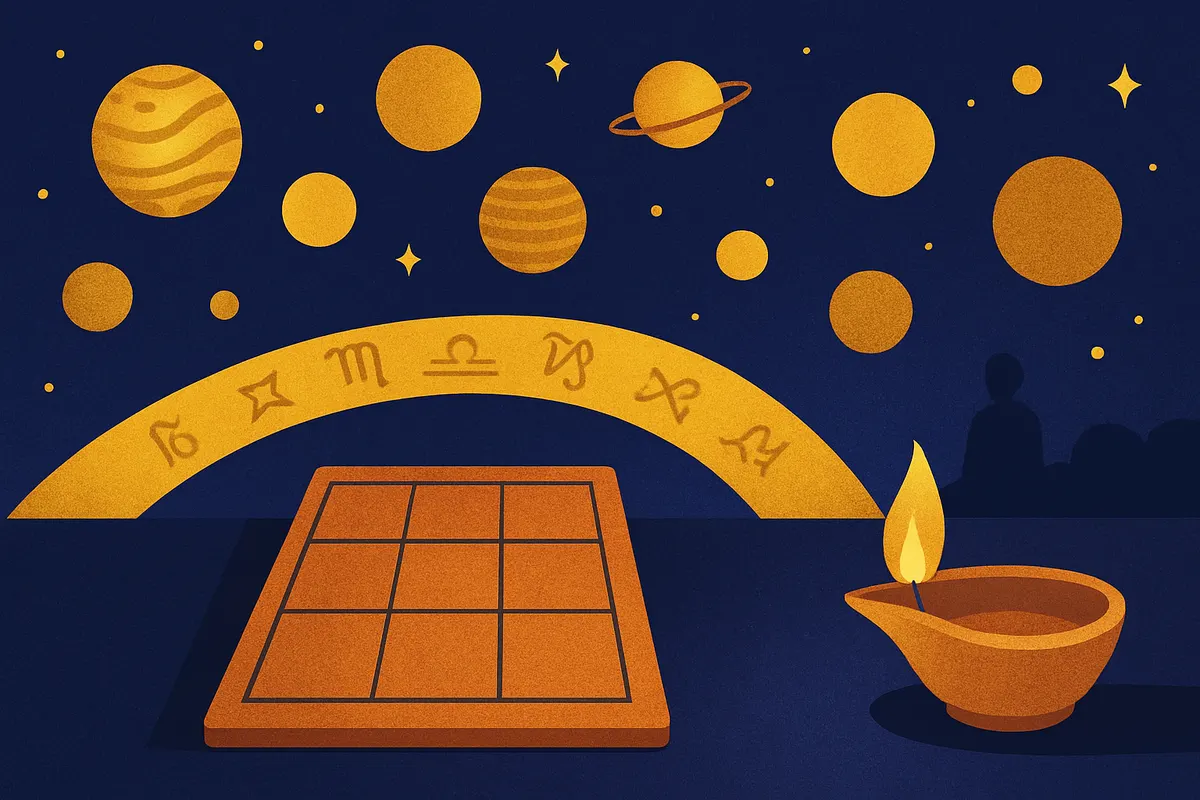
The Navagraha Yantra — the yantra of the nine planets — is the foundational astrological yantra and the one most commonly used in classical remedial practice. The geometric form consists of nine compartments arranged in a three-by-three grid, with each compartment dedicated to one of the nine grahas. The arrangement of the nine compartments follows a specific classical order that the older texts elaborate, with the Sun typically placed in the centre and the other eight planets distributed around it according to their classical relationships.
The bīja syllables of each of the nine grahas are inscribed in the corresponding compartment, and the yantra is consecrated through the recitation of the Navagraha mantra and the appropriate offerings. Once consecrated, the yantra is treated as a working instrument of remedial practice: the seeker engages with it daily through devotional attention, mantra recitation, and the maintenance disciplines (cleansing, offering of flowers, lighting of lamps) that the classical tradition elaborates.
The advantage of the Navagraha Yantra over the planet-specific yantras is that it addresses all nine grahas together. Most charts carry some configuration that involves multiple planets — a difficult Saturn aspecting a weakened Moon, a combust Mercury together with an afflicted Venus — and the Navagraha Yantra allows the seeker to address the entire planetary network through a single instrument rather than maintaining separate yantras for each graha. The classical recommendation is that the Navagraha Yantra be the foundational yantra of any household's remedial practice, with planet-specific yantras added when a particular planet's configuration requires concentrated attention.
The Planet-Specific Yantras
For natives whose chart carries a particular planet in significantly afflicted condition — a debilitated Sun, a combust Mercury, a Mars under heavy malefic aspect — the classical tradition recommends the use of the planet-specific yantra in addition to the general Navagraha Yantra. Each of the nine grahas has its own dedicated yantra, with the geometric form, the bīja syllable, and the consecration ritual specific to that graha.
The Sūrya Yantra — the yantra of the Sun — typically takes the form of a six-pointed star (a hexagram of two interpenetrating triangles) within a square enclosure, with the bīja syllable hrāṃ or raṃ inscribed at the central point. The Sun's yantra is recommended for natives whose Sun is debilitated in Libra, severely afflicted by Saturn or Rāhu, or in difficult relationship with the lagna lord. The classical practice is to engage with the Sūrya Yantra on Sundays, with the recitation of the Sūrya mantra and the offering of red flowers.
The Candra Yantra — the yantra of the Moon — typically takes the form of a circle (representing the moon's full disc) within a square enclosure, with the bīja syllable śrāṃ or somaṃ inscribed at the central point. The Moon's yantra is recommended for natives with afflicted Moon configurations — Kemadruma Yoga unmodified by cancelling conditions, the Moon in close affliction by Saturn or Rāhu, or the Moon in dusthāna houses without redemptive aspects. The classical practice is to engage with the Candra Yantra on Mondays, particularly during the bright fortnight, with the offering of white flowers.
The Maṅgala Yantra — the yantra of Mars — takes a triangular form within a square enclosure, with the bīja syllable aṃ inscribed at the central point. The Mars yantra is recommended for natives with the Manglik configuration, a debilitated or afflicted Mars, or significant Mars-related career difficulties. The classical practice involves Tuesday observance with red flowers and red sandalwood paste.
The Budha Yantra of Mercury, the Bṛhaspati Yantra of Jupiter, the Śukra Yantra of Venus, the Śani Yantra of Saturn, the Rāhu Yantra, and the Ketu Yantra each follow analogous structural principles, with the geometric form, bīja syllable, weekday observance, and offerings specific to the graha in question. The classical sources elaborate the construction and use of each in detail, and the seeker engaging with any planet-specific yantra should consult a reliable classical source for the precise specifications.
The Śrī Yantra and the Broader Tantric Tradition
Beyond the specifically astrological yantras, the classical tradition treats the Śrī Yantra — the yantra of the goddess Tripurasundarī — as the foundational yantra of the broader tantric remedial system. The Śrī Yantra is more elaborate than the planetary yantras: nine interpenetrating triangles (four pointing upward, five pointing downward, representing the Śiva and Śakti principles) form the inner figure, surrounded by concentric lotus-petal rings and the outer bhūpura. The classical theological reading treats the Śrī Yantra as the geometric body of the goddess herself, the most refined of all yantras, and the instrument through which the seeker brings the broadest cosmic alignment into their daily life.
For the astrological practitioner, the Śrī Yantra serves as the foundational frame within which the planet-specific and Navagraha yantras operate. The Tripurasundarī goddess is, in the Śrī Vidyā tradition, the parā śakti — the supreme creative power — whose alignment with the seeker's life provides the broader matrix through which the more specific planetary alignments can be brought into balance. Many classical practitioners maintain the Śrī Yantra as the household's central yantra, with the Navagraha Yantra and the planet-specific yantras supplementing rather than replacing it.
The construction of the Śrī Yantra is technically demanding, requiring precise geometric proportions that the older texts elaborate with care. Improperly constructed Śrī Yantras — common in mass-produced commercial reproductions — are treated by the classical sources as inadequate for serious devotional or remedial use. The seeker engaging with the Śrī Yantra should obtain it from a properly trained craftsperson, or have it consecrated by a qualified practitioner before serious use, or follow the classical guidelines for its proper construction and use.
Construction and Materials: What the Classical Sources Specify
The classical tradition is precise about the materials and methods by which yantras should be constructed. The choice of material, the method of inscription, the timing of construction, and the consecration ritual all affect the yantra's efficacy as a remedial instrument, and the older sources elaborate these specifications with care.
The most traditional materials for yantra construction are copper, silver, gold, and bhūrja-patra (birch bark). Copper is the most commonly recommended material for general household use, particularly for the Navagraha Yantra and the planet-specific yantras of the seven traditional planets. Silver is recommended particularly for yantras associated with the Moon and Venus. Gold is recommended for yantras associated with the Sun and Jupiter, and for the central installation of the Śrī Yantra in households of sufficient means. Bhūrja-patra, the traditional birch bark, is used for portable and personal yantras that the seeker carries on their person or keeps within a small reliquary.
The method of inscription should follow classical specifications. Engraving with appropriate metallic instruments is the traditional standard for metal yantras; ink prepared from specific natural substances is used for bhūrja-patra and paper yantras. Mass-produced printed yantras, common in modern commercial markets, are treated by the older sources as adequate for general devotional purposes but as inferior to properly inscribed traditional yantras for serious remedial work. The seeker engaging in significant remedial practice should obtain yantras inscribed according to classical specifications, even if the cost and effort are greater.
The timing of construction matters as well. Yantras intended for specific grahas should ideally be constructed on the corresponding weekday — Sunday for the Sun, Monday for the Moon, and so on — and within auspicious muhūrtas (time windows) calculated by the classical muhūrta tradition. The Śrī Yantra is typically constructed on Friday (the day of Venus, who is closely associated with the goddess) or during specific lunar configurations the older texts identify as particularly auspicious for the goddess's installation.
Consecration: The Prāṇa-pratiṣṭhā Ritual
A constructed yantra is not, in the classical reading, automatically a working remedial instrument. It must first be consecrated through the prāṇa-pratiṣṭhā ritual — the ritual of installing the deity's life-breath in the geometric form. Without this consecration, the yantra remains merely a constructed diagram, and its efficacy as a remedial instrument is significantly limited.
The prāṇa-pratiṣṭhā ritual is performed by a qualified priest or by the seeker themselves following classical guidelines. The ritual involves the recitation of specific mantras (the prāṇa-pratiṣṭhā mantras given in the older Tantric texts), the offering of specific substances (water, milk, honey, ghee, flowers, incense, lamp), and the ritual installation of the deity's presence in each of the geometric components of the yantra. The consecration is typically performed at an auspicious muhūrta, often coinciding with the deity's specific weekday or with a lunar configuration the older texts identify as supportive.
Following the consecration, the yantra is treated as a living installation of the deity, with the daily devotional practices that the classical tradition elaborates: regular cleansing of the yantra's surface, offering of fresh flowers and incense, lighting of lamps before it, and the recitation of the corresponding mantras with sustained attention. These daily practices are not optional ornaments to the yantra's installation; they are the disciplines by which the yantra's efficacy as a remedial instrument is maintained over time.
Daily Practice: How the Seeker Engages With the Yantra
The classical tradition is precise about the daily disciplines through which the seeker engages with an installed yantra. The morning practice typically begins with the cleansing of the yantra's surface, the offering of fresh water and flowers, and the lighting of an oil lamp or incense before it. The recitation of the corresponding mantras — the Navagraha mantra for the Navagraha Yantra, the planet-specific mantras for the planet-specific yantras — follows, with the recommended number of repetitions varying by classical source but typically falling between one hundred and one thousand and eight repetitions per day.
The evening practice mirrors the morning, with the renewal of the offerings and a brief recitation. Some classical traditions add a third daily engagement at midday, particularly for the Sūrya Yantra whose solar associations make the noon hour particularly appropriate.
The seeker's posture and attention during the daily practice matter significantly. The classical recommendation is to sit facing the yantra at a comfortable distance (typically two to three feet), with the body in the meditation posture (sukha-āsana or padma-āsana depending on the seeker's flexibility), with the gaze focused softly on the central bindu of the yantra. The mantra recitation proceeds while this focused attention is maintained, and the seeker enters into the yantra-bhāvanā — the contemplative absorption in the yantra's form — that the classical tradition treats as the substantive content of the practice.
The duration of the daily practice varies by the seeker's circumstances and the severity of the chart configuration the yantra is addressing. For general household yantras, twenty to thirty minutes daily is the classical recommendation. For yantras addressing severe configurations, longer daily practice (one to two hours) is recommended for an extended period (forty days, three months, or a year, depending on the classical source). The careful seeker establishes a sustainable daily rhythm and maintains it patiently over the months and years.
Yantras and the Daśā Sequence
The classical practitioner often coordinates the use of specific yantras with the Vimśottarī daśā sequence the seeker is currently passing through. The mahādaśā of a planet whose chart configuration is challenging is the period during which the corresponding planet-specific yantra is most actively recommended; the antardaśā periods within the mahādaśā provide further refinement of timing.
A native passing through a difficult Saturn mahādaśā, particularly with Saturn afflicted in the natal chart, is typically recommended the Śani Yantra with sustained Saturday observance throughout the nineteen years of the period. A native in a Rāhu mahādaśā with afflicted Rāhu placement is recommended the Rāhu Yantra, with the specific weekday and offering observances the classical tradition elaborates. The pattern extends across the grahas: the daśā timing identifies which planet's yantra deserves the seeker's primary attention, and the daily practice with that yantra runs alongside the broader Navagraha Yantra and household yantra installations.
The classical caveat is that yantra practice is not a substitute for the broader remedial system the older sources elaborate. Mantra recitation, dāna (charitable giving), the disciplined observance of fast days, the vrata observances tied to specific weekdays and graha-relations — all of these together constitute the remedial system, and the yantra is one instrument among several rather than a self-sufficient solution. The seeker engaging seriously with yantra practice is also engaging with the broader remedial discipline.
The Iconographic Symbolism of Yantra Geometry
Beyond the mechanical specifications of construction and use, the older Indian classical tradition reads the geometric components of yantras as a developed iconographic system whose symbols carry specific significations the practising seeker is asked to attend to in their daily practice.
The bindu — the central point — is the seat of the deity's presence, the parā śakti in the Śrī Yantra's case, the specific graha's essence in the planet-specific yantras. The classical tradition reads the bindu as the unmanifest source from which the manifest geometric form emerges, the still centre around which the deity's energy unfolds. The seeker's gaze in daily practice is typically focused on the bindu, with the surrounding geometry held in peripheral awareness.
The triangles — trikoṇa — appear in many yantras in two principal directions. The upward-pointing triangle represents the masculine principle (Śiva, fire, ascending consciousness), and the downward-pointing triangle represents the feminine principle (Śakti, water, descending grace). The interpenetration of upward and downward triangles, as in the Śrī Yantra's nine triangles, represents the dynamic union of these principles that constitutes the manifest cosmos. For astrological yantras, the triangles often correspond to the elemental and energetic qualities of the graha the yantra represents.
The lotus-petal rings — kamala-dala — surrounding the inner figure represent the unfolding of the deity's presence into the cosmos. The classical tradition associates specific numbers of petals with specific levels of cosmic manifestation: eight petals for the directional powers, sixteen for the lunar phases, twenty-four for the cycles of the year, one thousand for the fully unfolded cosmos in some elaborated yantras.
The square enclosure — bhūpura — represents the four directions and the manifest world within which the yantra is installed. The four gates of the bhūpura (positioned at the cardinal directions) represent the points of access through which the seeker enters the yantra's geometric space, and the consecration ritual typically includes specific offerings at each of the four gates.
The bīja syllables inscribed at specific points within the geometry are the sonic complement to the visual form. Each bīja is the seed-syllable of the corresponding deity or graha, and its inscription within the yantra completes the integration of visual and sonic invocation that the classical tradition treats as essential to the yantra's working efficacy.
Some yantras include additional iconographic elements that the careful classical commentator reads with attention. Specific mātṛkā alphabets — the Sanskrit syllabary arranged in particular orderings — are inscribed in some yantras as a complete sonic invocation of the deity through every possible vibration. Specific cakra arrangements — concentric rings or interlocking figures — appear in some yantras as representations of the deity's progressive manifestation through cosmic levels. The seeker engaging with a complex yantra should consult a qualified classical commentator to understand the specific iconographic significations of all the elements present, because the meaning of any single element is modulated by its relationships to the others within the same geometric whole.
The classical tradition treats the integrated reading of yantra iconography as itself a form of contemplative practice. The seeker who has engaged with their household yantra for many years often finds that the iconographic symbolism becomes increasingly transparent to inner experience — the bindu's stillness becomes recognisable as a quality of consciousness rather than merely a visual point, the triangles' interpenetration becomes felt as a dynamic within the seeker's own being, the lotus-petals' unfolding becomes experienced as the unfolding of devotional response within the seeker. This deepening of the iconographic reading across years is itself the substantive content of yantra practice in its mature form, and the older sources treat it as the natural fruition of patient daily engagement with the geometric instrument.
Common Misreadings of the Yantra Tradition
There are several patterns the practising astrologer encounters in casual approaches to yantra practice, and they are worth flagging because each can lead the seeker to a flatter understanding than the classical tradition supports.
The first misreading is the treatment of yantras as decorative objects. Many modern households display yantras — particularly the Śrī Yantra — as wall decorations, without the consecration ritual or daily devotional practice the classical tradition treats as essential. Such installations are not, in the older reading, working remedial instruments; they are decorative reproductions of geometric forms that, properly installed, would carry remedial efficacy. The seeker engaging seriously with yantra practice should distinguish between decoration and installed practice.
The second misreading is the over-reliance on commercial mass-produced yantras. The classical tradition is precise about construction materials, methods, timing, and consecration, and mass-produced yantras typically do not satisfy these specifications. They function adequately for general devotional purposes but are inadequate substitutes for properly constructed and consecrated traditional yantras when the seeker's chart configuration is significant.
The third misreading is the assumption that yantra practice produces rapid results. The classical tradition treats yantra practice as a long-arc discipline whose effects compound over months and years rather than days and weeks. The seeker who expects immediate visible change after a few days of practice has misread the tradition's actual time-horizon, and the disappointment that follows often produces premature abandonment of practices that would have borne fruit had they been continued patiently.
The fourth misreading is the confusion of yantras with talismans or amulets in the popular Western sense. Yantras are devotional and meditative instruments first; their remedial function operates through the seeker's own engaged practice, not through any automatic mystical operation independent of the seeker's attention. A yantra worn around the neck without the corresponding daily practice is not, in the classical reading, performing the work the older tradition expects of it.
The fifth misreading is the use of yantras as a shortcut around the more demanding remedial disciplines. Some seekers, encountering a chart configuration that the older tradition would normally address through sustained mantra practice, dāna, vrata observance, and chart consultation with a qualified astrologer, will purchase a yantra and treat it as the entire remedial response. The classical tradition does not support this shortcut. The yantra is one component of the integrated remedial system; it works best within the broader discipline rather than as a substitute for it.
The sixth misreading is the assumption that any yantra is appropriate for any seeker. Specific chart configurations call for specific yantras, and the seeker should consult a qualified classical practitioner before installing a serious yantra in their household. A misaligned yantra — one whose specific energies do not match the seeker's chart configuration — is not necessarily harmful, but it is also not particularly helpful, and the seeker who installs yantras based on popular advice rather than chart-specific consultation often acquires installations that produce no significant remedial effect.
Closing
The teaching of the yantra tradition, when it is heard at depth, is the teaching of geometry as the visual register of the graha energies that the seeker's chart maps. The geometric form, the bīja syllables, the consecration ritual, and the daily devotional practice together constitute the working remedial instrument the classical tradition has refined across centuries. The Navagraha Yantra gives the seeker access to the integrated planetary network; the planet-specific yantras concentrate attention on individual grahas whose configurations require dedicated work; the Śrī Yantra provides the broader cosmic frame within which the more specific planetary alignments operate.
For the seeker beginning yantra practice, the practical counsel is to begin with the Navagraha Yantra, properly constructed and consecrated, with sustained daily engagement over months and years. The planet-specific yantras can be added as the chart's configurations and the seeker's daśā timing make particular planets central. The Śrī Yantra, when added, becomes the household's central installation. The integration is patient, the practice is daily, and the results compound across the long arc that any cultivated remedial discipline requires. May the seeker engaging with the yantra tradition find in its geometric forms the alignment the older sources promise it can support, and may the daily practice with the consecrated yantra become one of the steady disciplines of the cultivated devotional life.
The deeper teaching, when the yantra tradition is approached patiently over years, is that the geometric form is the visual register of an alignment that the seeker is being asked to develop within themselves. The bindu, the central point of any yantra, corresponds to the still centre within the seeker that the daily devotional practice is gradually bringing into alignment with the deity's presence. The triangles, the lotus-petals, the bhūpura enclosure, the bīja syllables — all of these together form an external diagram of the inner alignment the seeker is being asked to cultivate. The yantra in the household becomes, over time, a mirror of the yantra the seeker is patiently constructing within themselves through the daily devotional discipline.
This deeper reading is what justifies the older tradition's sustained reverence for the yantra as a remedial instrument. The geometric form addresses not only the graha energies in the seeker's chart but also the seeker's own developmental work of bringing their interior life into alignment with the cosmic order the grahas represent. The chart's difficulties, in this deeper reading, are themselves the occasion for the inner alignment-work that the yantra supports, and the yantra practice becomes part of the broader spiritual discipline within which the chart is engaged with rather than merely a remedial response to chart-level difficulties.
For the seeker willing to take up the yantra tradition with this depth of engagement, the practical counsel is unambiguous: begin with proper construction and consecration, maintain daily practice with patient attention, integrate yantra practice with the broader remedial system the older tradition elaborates, and trust that the long-arc cultivation will, over months and years, produce the alignment the geometric form represents. The yantra installed in the household, attended to faithfully, becomes one of the steadiest companions of the cultivated devotional life, and the integration of yantra practice with the broader chart-engagement work that the older tradition supports remains one of the most rewarding chapters of the classical remedial system the seeker can engage with patiently across the long arc of their own spiritual life.
Related cornerstones
If this reading was useful, the following cornerstones address related dimensions of the same broader tradition: