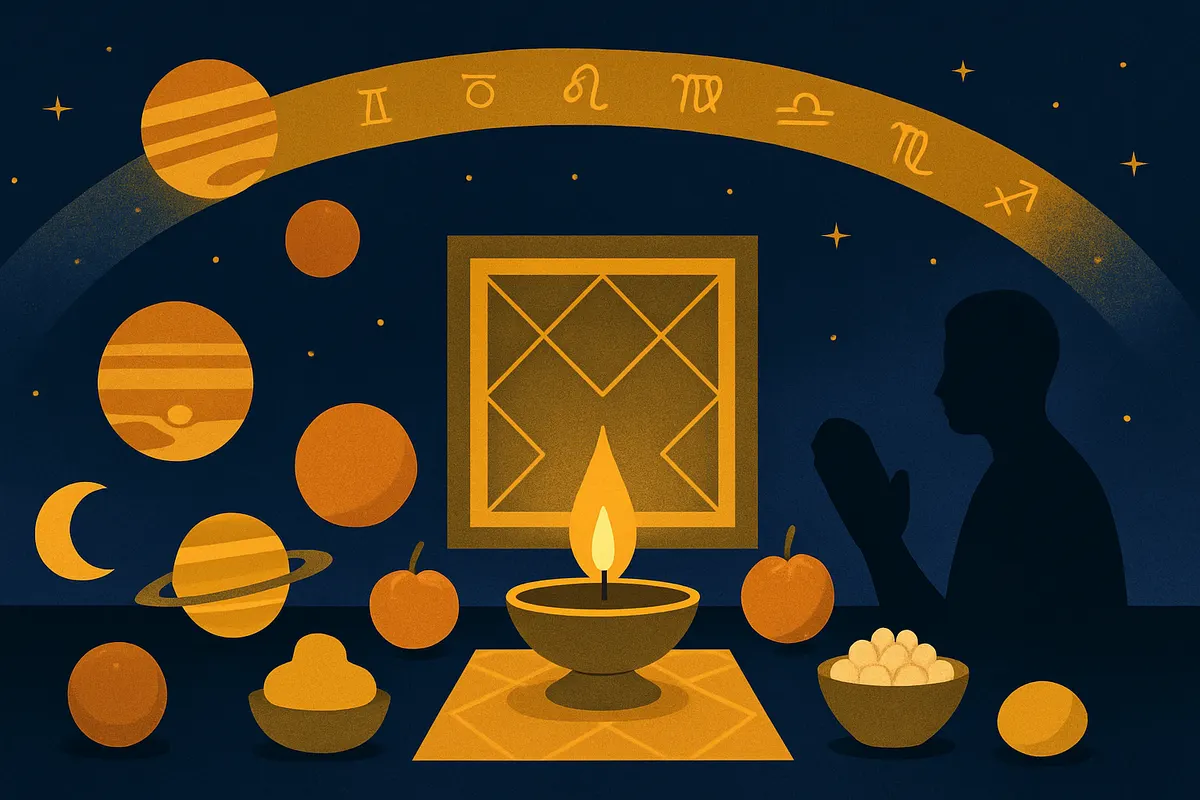
Mantra remedy is a traditional Vedic astrology remedy (upaya) in which a short seed-syllable (beej) mantra assigned to a graha is recited on that planet's weekday as a steady devotional discipline. Each of the nine grahas has its own beej mantra, weekday and offering. The tradition frames it as practice that steadies a person's relationship with a difficult placement, not as a mechanical fix.
Mantra recitation is also called graha mantra or navagraha mantra japa (मंत्र जप). It is not the same as a stotra (a longer devotional hymn), a yantra (a diagram) or a vrata (a vow with fasting), although the remedies are commonly practised together.
Each graha's mantra is paired with a specific weekday and offering; the classical tradition treats consistency of practice as more important than any single ritual.
Mantra remedies by graha at a glance
Graha
Beej mantra
Day
Traditional offering
Surya (Sun)
Om Hraam Hreem Hraum Sah Suryaaya Namah
Sunday
Water offered at sunrise
Chandra (Moon)
Om Shraam Shreem Shraum Sah Chandraaya Namah
Monday
White rice or white flowers
Mangala (Mars)
Om Kraam Kreem Kraum Sah Bhaumaaya Namah
Tuesday
Red flowers, red lentils
Budha (Mercury)
Om Braam Breem Braum Sah Budhaaya Namah
Wednesday
Green cloth or leaves
Brihaspati (Jupiter)
Om Graam Greem Graum Sah Gurave Namah
Thursday
Yellow turmeric or flowers
Shukra (Venus)
Om Draam Dreem Draum Sah Shukraaya Namah
Friday
White sweets, fragrant flowers
Shani (Saturn)
Om Praam Preem Praum Sah Shanaye Namah
Saturday
Black sesame, mustard oil
Rahu
Om Bhraam Bhreem Bhraum Sah Rahave Namah
Saturday (with Shani)
Dark cloth, mustard oil
Ketu
Om Sraam Sreem Sraum Sah Ketave Namah
Tuesday or Saturday
Grey or multicolor cloth
To see which graha's period you are running before choosing one, use the Dasha calculator.
Why does the classical tradition treat mantra as a remedy?
Brihat Parashara Hora Shastra closes its long treatment of yogas and dashas with a graded set of remedial measures for a chart's afflictions. They begin with inner virtue, move through charitable giving and worship of the afflicted graha's presiding deity, and arrive at mantra recitation as one of the steadiest available practices. The classical commentators are consistent that mantra is not a folk supplement bolted onto a separate "real" astrology; it is described as part of the same continuous system in which the planets, houses and dashas are arranged. The claim underlying the practice is that a mantra places the practitioner in a specific relation to the devata (presiding deity) associated with a graha, and that this relation deepens through steady repetition rather than through a single intensive burst of effort.
What is the structure of a beej mantra, and how does it differ from a stotra?
Each of the nine beej mantras follows the same compact form: an opening "Om," a short body of one or two syllables carrying the planetary essence, and a closing "namah." The brevity is deliberate, a formula short enough to fit comfortably on the breath and be repeated many times without exhausting the practitioner. Longer stotras exist alongside the beej for each graha: the Aditya Hridaya Stotra for Surya, the Chandra Kavacha for Chandra, the Hanuman Chalisa widely used for Mangala and for Shani, and others. The classical convention is that the beej is the seed and the stotra is the fuller elaboration grown from it. A practitioner beginning a practice is generally advised to start with the beej of a single graha and let that practice settle before adding a second.
The beej is compact enough to repeat many hundreds of times in a single sitting, which suits the mala-based counting the tradition uses for sustained practice. A stotra, being a full hymn with dozens of verses naming the graha's mythology and qualities, is generally recited once or a small handful of times per sitting rather than counted by mala. Many households recite a stotra on the graha's weekday and reserve the beej for the daily mala practice, using the two forms for different purposes rather than choosing one over the other.
How many times should you chant a planetary mantra?
Traditional daily practice is one mala, which is 108 repetitions, the standard count of a prayer-bead loop. The classical literature specifies traditional repetition counts for a complete anushthana (formal undertaking): commonly one mala for daily practice, scaling up to several thousand repetitions across a defined period of days for a more intensive undertaking. These counts vary by graha in the classical sources, with Jupiter and Saturn generally carrying the largest counts, reflecting their status as, respectively, the most benefic and the most exacting of the planets.
The numbers describe a traditional structure for sustained devotional practice, not a threshold below which the practice "fails." The classical authors emphasise regularity of daily practice over any single count, and a shorter, consistent recitation is treated as more valuable than an ambitious count abandoned after a few days.
Which day should you chant which planetary mantra?
Recite a graha's mantra principally on its own weekday: Sunday for Surya, Monday for Chandra, Tuesday for Mangala, Wednesday for Budha, Thursday for Brihaspati, Friday for Shukra and Saturday for Shani. Rahu and Ketu, being shadow-planets without weekdays of their own in the older system, are conventionally paired with Saturday (Rahu, sharing Saturn's more exacting register) and with Tuesday or Saturday depending on tradition (Ketu). The weekday assignment is the same one used for weekday vrata.
Beyond the weekday, the hora system divides daylight and night into twelve unequal planetary hours each, in a fixed cyclic order, and gives every day additional windows in which a given graha's mantra is considered supported. Any standard panchanga (almanac) lists these hours for a given date and location.
What is the mantra practice for Mars and Manglik dosha?
Mangala is the planet most often invoked in discussions of Manglik Dosha, the classical concern over Mars's placement in specific houses connected to marriage. Recitation of the Mangala beej mantra, or of the Hanuman Chalisa through the traditional Hanuman-Mangala association, is offered as a steady, unhurried practice, approached as a devotional discipline rather than as an anxious response to being told one is Manglik. The classical texts set out Mars's placements without alarm, and the mantra practice is one of several traditional supports for a native working through a difficult Mars placement, alongside the specific cancellation conditions the same tradition provides for the dosha itself.
What does daily mantra practice look like in a traditional household?
The rhythm many traditional households keep is more modest than a full anushthana and more sustainable than an intensive undertaking performed indefinitely. It is a short morning sandhya with the day's mala for whichever graha is relevant to the day of the week or to the practitioner's own chart, brief pauses at midday and evening, and an evening mala closing the day. The offerings named in the tradition (water, flowers, a particular colour of cloth) need not be elaborate. What the classical authors consistently emphasise is regularity rather than intensity: a practice returned to at the same time each day, even briefly, is described as more fruitful than an occasional elaborate ritual.
What is mantra practice not?
It is not a replacement for medical care, financial prudence, legal counsel or the ordinary work of building a life. The classical authors framed the practice as accompanying these things, settling the practitioner into a steadier state from which clearer decisions become possible, rather than substituting for them. For any specific health concern, a qualified medical professional is the appropriate person to consult, not a mantra practice; the same holds for financial and legal matters, which call for a SEBI-registered adviser or a qualified advocate respectively.
Which graha's mantra should you start with?
Start with the graha your chart actually points to, and add a second only after the first has settled. Whether a specific graha is placed in a way the tradition treats as warranting remedial attention (debilitated, afflicted by a malefic, or running a difficult dasha) depends on your exact birth details, and a graha that looks weak by sign alone can be fully supported by other factors, and the reverse.
Note whether that planet, or any other, is debilitated or closely afflicted in your chart.
Choose one graha and its weekday from the table above, and keep it for a single sustained stretch before adding another.
The full reading at /kundli/new shows each planet's sign, house and current period together, so a mantra practice can be chosen with reference to your actual chart rather than a general list.
Each graha has a short seed-syllable mantra. Surya's is Om Hraam Hreem Hraum Sah Suryaaya Namah, and Shani's is Om Praam Preem Praum Sah Shanaye Namah. The full set for all nine grahas, with their weekdays and traditional offerings, is listed in the table near the top of this article.
How many times should I chant a planetary mantra?
Traditional daily practice is one mala, or 108 repetitions. Longer classical counts exist for a formal multi-day undertaking, but the classical authors emphasise consistent daily practice over reaching any specific number. A shorter practice kept up daily is treated as more valuable than an ambitious count abandoned quickly.
Which day should I chant which mantra?
Each of the seven main grahas has a traditional weekday: Sunday for the Sun, Monday for the Moon, Tuesday for Mars, Wednesday for Mercury, Thursday for Jupiter, Friday for Venus and Saturday for Saturn. Rahu is conventionally paired with Saturday and Ketu with Tuesday or Saturday, depending on tradition.
Does chanting a mantra guarantee the planet's effects improve?
No. The classical framing is that mantra recitation is a spiritual discipline that brings the practitioner into a steadier relationship with the graha's qualities, not a mechanical fix with a guaranteed outcome. It is meant to accompany ordinary practical effort, and it does not replace medical, legal or financial advice.
Can I chant more than one planetary mantra at once?
The classical convention is to begin with a single graha's mantra, typically for around forty days, before adding another, rather than starting several at once. This is a matter of traditional sequencing and sustained attention, not a rule enforced by any external mechanism, and it keeps the practice small enough to sustain.
Do I need a teacher to start a mantra practice?
The classical tradition generally recommends guidance from a knowledgeable teacher, particularly for a formal anushthana with a large repetition count. The basic daily practice of a single beej mantra on its associated weekday is, however, widely undertaken by householders without a dedicated teacher, and it is the usual place to begin.