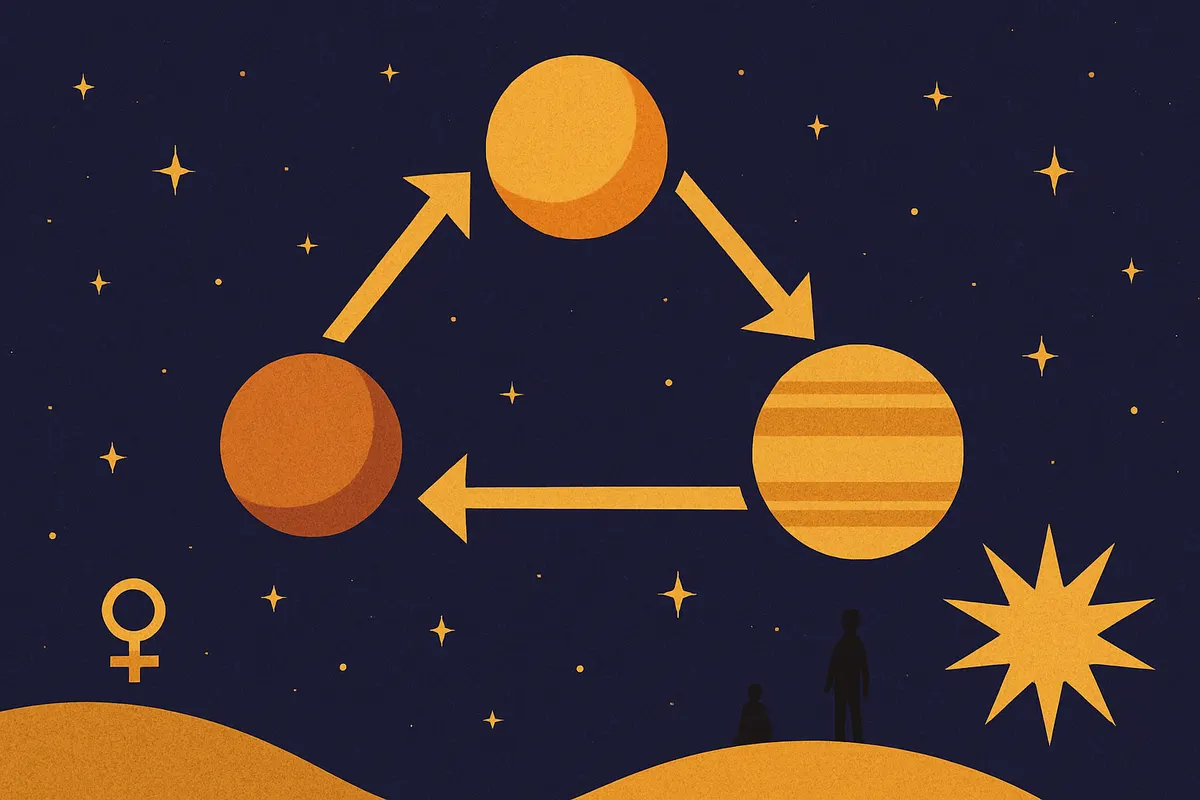
Vipreet Raj Yoga is a Vedic astrology combination in which the lords of the 6th, 8th and 12th houses associate only with each other, so that their difficulty reverses into fortune. Brihat Parashara Hora Shastra names three forms: Harsha (through the 6th), Sarala (through the 8th) and Vimala (through the 12th).
The yoga is also spelled Vipareeta Raja Yoga or Viparita Raj Yog (विपरीत राज योग), meaning "reversed royal combination". It is not a standard Raja Yoga, which forms from angle and trine lords; this one forms from the lords of the three difficult houses.
The yoga forms only when the three dushthana lords stay within their own sphere; any outside aspect from an angle or trine lord breaks the reversal.
Vipreet Raj Yoga at a glance
Form
Formed when
Classical result
Harsha
6th lord placed in the 8th or 12th house
Wealth, victory over enemies, freedom from chronic difficulty
Sarala
8th lord placed in the 6th or 12th house
Long life, integrity, unforeseen gains through hidden assets
Vimala
12th lord placed in the 6th or 8th house
Wealth through frugality, quiet reputation, contentment in solitude
Precondition
The participating dushthana lord must be unaspected and unconjoined by any kendra or trikona lord
None; the tradition treats the yoga itself as self-remedying
n/a
How does Vipreet Raj Yoga work?
It works by confining affliction to its own sphere so that it turns redemptive. The 6th house carries enmity, debt and disease; the 8th carries obstacles, hidden matters and longevity; the 12th carries expenditure, loss and displacement. Ordinarily, finding any of these three lords placed in a kendra (angle: 1st, 4th, 7th, 10th) or trikona (trine: 1st, 5th, 9th) is read as a mild compromise on that angle or trine.
This is one of several classical yogas built on house lordship from the Lagna; Gaja Kesari Yoga and Adhi Yoga use the same lordship-and-placement logic with different houses and planets. The reversal at the heart of Vipreet Raj Yoga is that the ordinary rule inverts when the three afflicted lords associate only with each other. A 6th lord in the 8th or 12th, an 8th lord in the 6th or 12th, or a 12th lord in the 6th or 8th, taken alone, would seem to compound difficulty. But affliction confined to its own quarter behaves differently from affliction that spreads: the dushthana lord is prevented from carrying its difficulty into the angles and trines, and being itself in a dushthana, it lacks the strength to act independently. The tradition reads this as a closed circuit that generates a third quality, a redemptive reversal, rather than simply cancelling out.
The precondition is strict. The yoga forms cleanly only when the participating dushthana lord is unaspected and unconjoined by any lord of a kendra or trikona, and no outside benefic disturbs the closed circuit either. Any such outside contact interrupts the reversal, because the affliction is then no longer self-contained. A chart that looks suggestive but does not meet this condition is read as not carrying the yoga, however tempting the placement appears.
How to find Vipreet Raj Yoga in your chart
You can test for all three forms in five steps.
Enter your birth date, time and place in the Lagna calculator. It gives your rising sign and the sign, degree and house of every planet.
Count signs from the Lagna to number the houses, then find the rulers of the 6th, 8th and 12th house signs: Aries and Scorpio Mars, Taurus and Libra Venus, Gemini and Virgo Mercury, Cancer the Moon, Leo the Sun, Sagittarius and Pisces Jupiter, Capricorn and Aquarius Saturn.
Look up the house each of those three lords occupies. Harsha needs the 6th lord in the 8th or 12th; Sarala needs the 8th lord in the 6th or 12th; Vimala needs the 12th lord in the 6th or 8th.
For any lord that qualifies, check whether a kendra or trikona lord is conjunct it or aspects it. Every planet aspects the 7th from itself; Mars also aspects the 4th and 8th, Jupiter the 5th and 9th, Saturn the 3rd and 10th.
If the closed circuit holds, use the Dasha calculator to see when the participating planet's mahadasha runs.
What is Harsha Yoga?
Harsha Yoga ("joy") forms when the lord of the 6th house sits in the 8th or 12th, unafflicted by kendra or trikona lords. Classical sources describe the resulting native as gaining wealth, defeating rivals, and enjoying physical vigor and freedom from chronic affliction, with gains that come through means touching the difficulties of others: dispute resolution, professions dealing with clients' hardships, or careful debt management.
The name is precise: the yoga does not promise a life without enemies, it promises that encounters with enmity become a source of satisfaction rather than defeat. Where the 6th lord falls in the 8th, the redemption tends to connect with longevity, hidden assets or research, the 8th being the house of the hidden and the buried. Where it falls in the 12th, the redemption tends to connect with foreign lands or a dissolution of opposition rather than its direct confrontation. The placement and the mahadasha of the planet involved together shape when in the life the Harsha quality becomes visible.
What is Sarala Yoga?
Sarala Yoga ("straight, unimpeded") forms when the lord of the 8th house sits in the 6th or 12th. Classical sources describe long life, integrity of character, learning, fearlessness in difficulty, and, distinctively, unforeseen gains through hidden assets: resources arriving from sources the native could not have engineered through ordinary effort, whether inheritance, unexpected legal or financial recovery, or the discovery of a forgotten asset. The eighth house article covers the wider meaning of the house involved.
The felt texture of Sarala is a kind of forward motion that surprises observers: projects begun in obscurity reach completion, difficulties that should have been chronic resolve, and opponents who appeared formidable withdraw. The yoga rewards patient maintenance of routine rather than dramatic gesture. The tradition's counsel for this form is that the gain arrives in its own season, and the native's task is to be positioned to receive it rather than to chase it.
What is Vimala Yoga?
Vimala Yoga ("pure, unblemished") forms when the lord of the 12th house sits in the 6th or 8th. Classical sources describe wealth built through frugality, a quiet reputation earned through conduct rather than announcement, and a peace that grows in solitude. Purity here is not moral perfection but the absence of the specific stain the unredeemed 12th lord would otherwise introduce. An unredeemed 12th tends to produce resources that slip away faster than they accumulate and repeated, unwanted displacement; a redeemed 12th converts that tendency into retained, gathered wealth built by not losing rather than by acquiring.
Vimala also carries an association with contemplative life. The 12th, as the house of spiritual release, does not weaken its contemplative current when its lord is redeemed within the dushthana sphere. It strengthens, because the native is no longer subject to the dispersive pressure the unredeemed 12th would generate. Middle and later life often brings a settled spiritual practice that becomes both an inner resource and a source of quiet standing.
How do Harsha, Sarala and Vimala differ?
They differ in mechanism and in outcome. Harsha is the active form: redemption through engagement with opposition, through managing and defeating named difficulty. Sarala is the passive form: redemption through the dissolution of opposition and unforeseen recovery rather than direct confrontation. Vimala is the contemplative form: redemption through stepping back from opposition altogether, converting a naturally frugal, self-contained life into a quiet form of wealth. The tradition resists flattening the three into one principle.
A single chart can carry more than one of the three forms. When two are present, the mahadasha sequence determines which dominates at a given time. When all three appear together, a comparatively rare configuration, a life often shows distinct phases: an active Harsha register in earlier life, a passive Sarala register consolidating through the middle years, and a contemplative Vimala register emerging later.
When does Vipreet Raj Yoga not form?
Many charts that look at first glance like they carry the yoga do not meet the classical conditions. The most frequent obstacle is an aspect or conjunction from a kendra or trikona lord onto the participating dushthana lord, which breaks the closed circuit. A second is the dushthana lord sitting in its sign of debilitation without a cancelling Neecha Bhanga condition, which leaves it too weak to carry the redemptive function. A third, less commonly discussed, is a chart-wide structure such as Kaal Sarpa Dosha overriding local yogas, so that the configuration may be present without visible results until the larger structure resolves.
A fourth obstacle is simply timing: a yoga whose activating mahadasha falls only in late life may do genuine work quietly without the native or family registering it, which is a consequence of where it falls in that native's sequence, not a failure of the yoga. A yoga that forms cleanly, on a reasonably strong planet, with its activation falling in the productive years, is the yoga the classical sources describe. Partial formations may produce partial or dormant results, and the honest reading includes saying so.
Is there a traditional story behind the reversal?
The broader Sanskrit literature offers more than one story built on the same structural idea: that a condition designed as protection or affliction can, by its own closed logic, produce its opposite. The demon Hiranyakashipu's boon of near-invulnerability specified death by neither man nor beast, neither day nor night, neither indoors nor outdoors, and Narasimha's form, fitting none of these categories, becomes the precise instrument of his death by the boon's own terms. In the Katha Upanishad, Yama appears in the story of Nachiketa not merely as the ender of life but as the giver of hard-won boons. Neither story is offered as historical proof of the astrological principle. They are the kind of narrative the tradition draws on to illustrate why a closed, self-contained affliction can behave differently from one that spreads.
Frequently asked questions
What is Vipreet Raj Yoga?
Vipreet Raj Yoga is a Vedic astrology combination formed when the lords of the 6th, 8th and 12th houses (the dushthana houses) associate only with each other, confined within that sphere and untouched by the angle and trine lords. It produces one of three named forms, Harsha, Sarala or Vimala, each turning the houses' natural difficulty into an indirect form of fortune.
What is the difference between Harsha, Sarala and Vimala yoga?
Harsha forms when the 6th lord sits in the 8th or 12th and brings gains through overcoming opposition. Sarala forms when the 8th lord sits in the 6th or 12th and brings unforeseen gains and long life through hidden or dormant assets. Vimala forms when the 12th lord sits in the 6th or 8th and brings wealth through frugality and a quiet, contemplative life.
What cancels Vipreet Raj Yoga?
Any aspect or conjunction from a kendra (1st, 4th, 7th, 10th) or trikona (1st, 5th, 9th) lord onto the participating dushthana lord breaks the closed circuit the yoga requires. Severe debilitation of the participating planet without a cancelling Neecha Bhanga condition also weakens the yoga significantly, since the planet is then too weak to carry the reversal.
Does Vipreet Raj Yoga need any remedy?
No. Classical sources treat the yoga itself as a self-contained, redemptive structure rather than a problem needing correction. Where it has formed cleanly, the tradition's counsel is to observe the relevant planetary periods with settled attention rather than apprehension, and to keep up ordinary good practice.
Can a chart have more than one Vipreet Raj Yoga at once?
Yes. A chart can carry two or, more rarely, all three forms together. When more than one is present, the mahadasha sequence determines which dominates at any given time. A life carrying all three often shows the active Harsha register earlier, the Sarala register consolidating in mid-life, and the contemplative Vimala register emerging later.
Is Vipreet Raj Yoga the same as a regular Raja Yoga?
No. A standard Raja Yoga forms from the association of kendra and trikona lords and produces status and authority relatively directly. Vipreet Raj Yoga forms from the association of dushthana lords with each other and produces its results through an indirect reversal of affliction, so the mechanism and the houses involved are entirely different.