A Note Before We Begin

Among the yogas — the special planetary combinations that the classical Indian astrological tradition has refined and named across centuries of practice — the Sarasvatī Yoga occupies a quietly revered position. It is not as widely cited in the popular literature as the Pañca-mahāpuruṣa yogas or the Gaja-Kesarī Yoga, perhaps because its definition is more demanding and its formation in any given chart correspondingly less common. But the older sources treat it with sustained respect, and natives whose charts genuinely carry the Sarasvatī Yoga often demonstrate, across the long arc of their lives, the constitutional gifts the goddess Sarasvatī is invoked to bless — the inner facility for learning, the cultivated arts, the speech that carries weight because it is anchored in genuine knowledge, the patient scholarship that produces durable contribution.

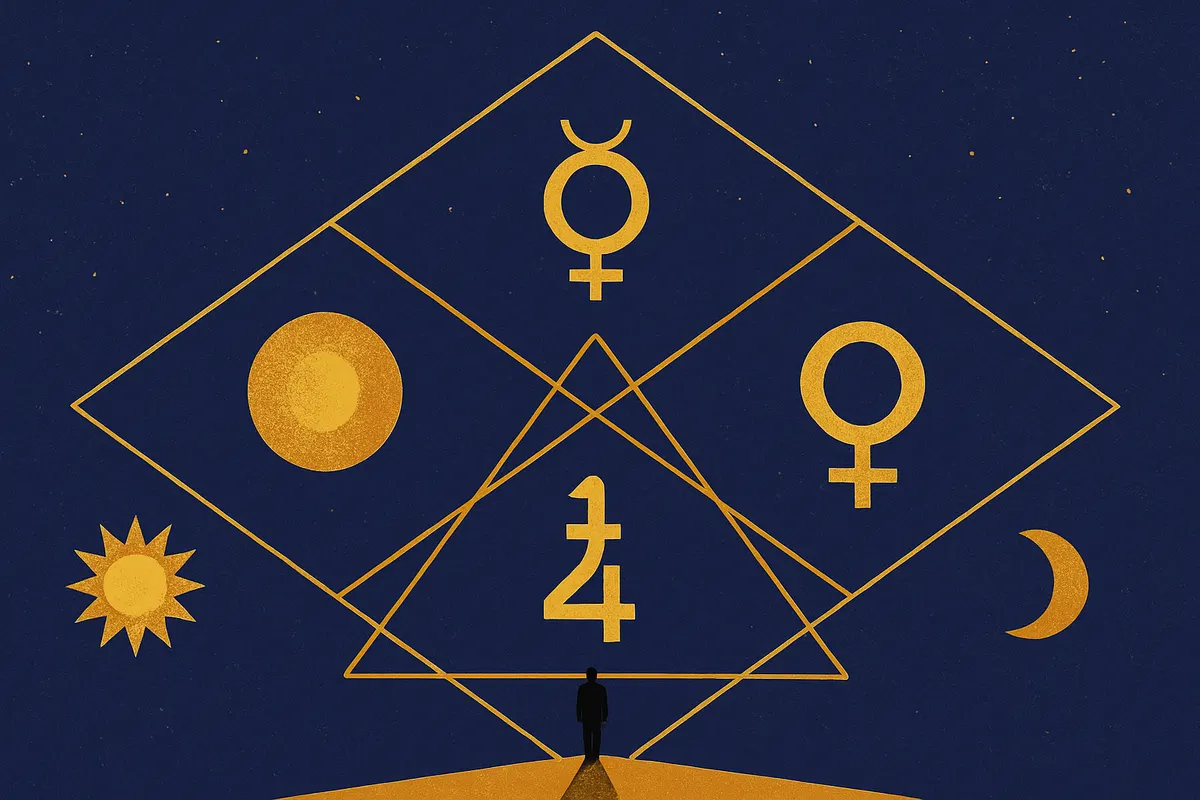
The classical sources are precise about the yoga's definition. Sarasvatī Yoga is formed when Mercury (Budha), Jupiter (Bṛhaspati), and Venus (Śukra) together occupy specific houses of the chart — the kendra (angular) houses of the first, fourth, seventh, and tenth, and the trikoṇa (trinal) houses of the fifth and ninth — in any combination, with appropriate strength. The three planets need not be in a single house; the yoga is formed when each of the three is found in one of these six designated houses, in any combination across them. The formation requires nothing exotic — the three planets are common participants in any chart — but it requires their joint placement in the strongest houses of the chart, which is the more selective condition.

This article is for the seeker who has begun to encounter Sarasvatī Yoga in their own chart consultation — perhaps because their astrologer has identified the configuration and pointed to its particular significance, perhaps because the yoga has appeared in a published reading and the seeker wants to understand what it actually means, perhaps because the matters of learning and the arts have brought the seeker to a deeper engagement with the chart. We will move slowly, beginning with the yoga's structural definition, then turning to the goddess Sarasvatī herself, the strength conditions that distinguish a fully active yoga from a nominally formed one, the modulating influence of each of the three planets, and the practical reading the yoga supports.

The Yoga's Definition: Mercury, Jupiter, and Venus in the Right Houses

Brihat Parashara Hora Shastra, in the yoga-adhyāya sections that elaborate the special planetary combinations, gives the Sarasvatī Yoga's definition with characteristic precision. The yoga is formed when each of the three benefic planets — Budha, Bṛhaspati, and Śukra — occupies one of the kendra or trikoṇa houses of the chart, in any combination among the six houses (the first, fourth, fifth, seventh, ninth, and tenth). The three planets may be in three different houses among these six, or two of them may share a house with the third in another, or all three may sit together in a single kendra or trikoṇa house — the yoga is formed in any of these arrangements, provided the three are confined to the designated houses.

The structural reasoning is consistent with the broader classical treatment of kendra-trikoṇa placements. The kendra houses are the structural pillars of the chart — the houses through which the chart's most direct expressions manifest. The trikoṇa houses are the trinal supports — the houses associated with dharma, fortune, and the inner spiritual foundation. A planet in a kendra delivers its results visibly and directly; a planet in a trikoṇa delivers them with the dharmic-fortune amplification that the trinal placement provides. The Sarasvatī Yoga, by requiring all three of the natural benefics of learning, arts, and dharma to occupy these strongest houses, configures the chart for the kind of cultivated contribution that Sarasvatī herself represents.

A second condition the older sources note — though it is sometimes implied rather than stated explicitly — is that the three planets should not be debilitated, severely afflicted, or placed in conjunction with strong malefics that would override their benefic natures. The yoga is formed by the placement, but its strength is modulated by the planets' dignity. A Sarasvatī Yoga in which Jupiter is in his sign of debilitation (Capricorn) without redemptive aspects, or in which Venus is severely afflicted by Saturn or Rāhu, is read with the appropriate caveats — the configuration is present, but its expression carries the modifications that the afflictions introduce.

The strongest classical formulation specifies that the yoga is at its full strength when Jupiter is in his own sign (Sagittarius or Pisces), in his sign of exaltation (Cancer), or in any of the three signs the older sources treat as auspicious for him. Mercury at his strongest is in his own sign (Gemini or Virgo), in his sign of exaltation (Virgo, where he is both ruler and exalted), or in friendly signs. Venus at her strongest is in her own signs (Taurus or Libra), in her sign of exaltation (Pisces), or in friendly signs. When all three benefics meet these strength conditions and occupy the kendra-trikoṇa houses, the Sarasvatī Yoga is at its most fully active, and the older sources treat such a configuration as among the more powerful learning-and-arts yogas the chart system makes available.

Why These Three Planets, and Why These Houses

The structural reasoning behind Sarasvatī Yoga's specific definition is worth dwelling on, because it illuminates why the configuration carries the weight the older sources assign to it and why it cannot be replicated by other combinations of benefic planets.

The three planets — Mercury, Jupiter, and Venus — together constitute the natural benefics of the Vedic chart system, with the Moon classed separately depending on its phase and aspects. Each of the three carries a specific natural signification that the older texts read as essential to cultivated learning. Jupiter is the kāraka of jñāna — knowledge in the philosophically weighted sense, the wisdom of the guru, the dharmic insight that gives knowledge its spiritual orientation. Mercury is the kāraka of buddhi — analytical intelligence, the precise articulation, the linguistic facility by which knowledge is held in conscious form and communicated to others. Venus is the kāraka of kalā — the cultivated arts, the aesthetic sensibility, the refinement that makes knowledge beautiful as well as useful. The integration of jñāna, buddhi, and kalā is, in the older Vedic understanding, the structural form of cultivated learning, and the Sarasvatī Yoga is precisely the chart configuration that brings the three karakas of these three faculties into the strongest houses simultaneously.

The selection of the kendra and trikoṇa houses follows the same structural logic. The kendra houses — first, fourth, seventh, and tenth — are the houses through which a planet's contribution becomes most visible to the surrounding world. A planet in a kendra delivers its results in the public registers of the chart. The trikoṇa houses — fifth and ninth — are the houses associated with dharma, fortune, and the inner spiritual foundation. A planet in a trikoṇa delivers its results with the dharmic-fortune amplification the trinal placement provides. The yoga's requirement that all three benefics occupy these strongest six houses ensures that the cultivated gifts the configuration represents are positioned for both visible expression (through the kendras) and dharmic depth (through the trikoṇas).

The exclusion of the second house, the third, the sixth, the eighth, the eleventh, and the twelfth from the yoga's qualifying houses is also structurally significant. The second house, though associated with speech and accumulated learning, is a dhana (wealth) house whose primary register is the material rather than the dharmic. The third is an upachaya but also a kāma house associated with active effort rather than cultivated learning. The sixth, eighth, and twelfth are the trika houses whose significations carry the difficulties the yoga's gifts would have to overcome rather than the support they would naturally receive. The eleventh, though favourable, is also a kāma house whose orientation toward gain and fulfilment of desire is at a slight angle to the cultivated-learning register the yoga represents. The selection of kendra-trikoṇa houses therefore reflects the older tradition's careful structural mapping of which houses support cultivated dharmic learning and which do not.

Sarasvatī: The Goddess of Learning and Speech

Let me say more about Sarasvatī herself, because the goddess after whom the yoga is named gives the configuration its specific spiritual signature, and understanding her deepens the reading of the yoga in a way no list of attributes alone can.

Sarasvatī is one of the principal goddesses of the older Hindu pantheon, the consort of Brahmā in the classical theological account, and the deity whose specific function is the patronage of vidyā — knowledge in the older sense that includes both formal scholarly learning and the cultivated arts of music, poetry, and refined speech. The Vedic hymns invoke Sarasvatī first as the river-goddess of the now-vanished Sarasvatī river, and later as the goddess of the vāk — the sacred word, the cultivated speech that carries the meaning of the Veda itself. Across the Vedic and post-Vedic literature, Sarasvatī is the deity to whom the seeker turns when the question is the depth and refinement of learning, the durability of artistic gift, the quality of the speech by which knowledge is carried into the world.

For the native who carries Sarasvatī Yoga, this divine signature shows up in two registers that are easy to miss if one only reads the popular descriptions of the yoga. The first is the vāk-pati register — the constitutional facility for cultivated speech and writing. These natives carry, often from early childhood, an ease with language that the surrounding people recognise without always being able to name. They are the children whose first reading was unusually attentive, whose early writing showed a precision the family did not particularly cultivate, whose speech carried, even in adolescence, the kind of measured weight that the older Vedic tradition treats as Sarasvatī's gift. The yoga's signature in adult life often consists in some form of cultivated communicative work — scholarship, teaching, writing, the disciplines of refined argument — through which the vāk-pati gift finds its mature expression.

The second register is the kalā-vidyā register — the cultivated arts. Sarasvatī in her iconography holds the vīṇā (the classical lute), the rosary of sacred beads, and the book — implements that together signify the cultivated arts of music, devotional discipline, and scholarship. Natives carrying the yoga often demonstrate aptitude in one or another of the cultivated arts, with the specific art reflecting the planets active in the configuration: a Mercury-prominent Sarasvatī Yoga often produces the writer or the speaker; a Venus-prominent yoga often produces the musician or the visual artist; a Jupiter-prominent yoga often produces the philosophical teacher or the religious scholar. The integration of the three planets, when all are active, produces natives whose contribution spans more than one of these registers.

The Modulating Influence of Each of the Three Planets

The three planets that together form Sarasvatī Yoga each modulate the configuration with their specific natural qualities, and the careful classical practitioner reads each planet's contribution to determine the texture of the yoga in any given chart.

Jupiter (Bṛhaspati) contributes the dharmic and philosophical register. Where Jupiter is the strongest of the three in the configuration — by exaltation, own sign, or strongest house placement — the yoga's expression takes on the philosopher's or the teacher's signature. These natives often gravitate to the disciplines of formal scholarship, classical teaching, religious instruction, or the long-form contemplative work that the dharmic register most fully supports. Their contribution tends to be patient and durable rather than rapid or fashionable, and the older sources treat the Jupiter-led Sarasvatī Yoga as the most spiritually weighted of the three modal expressions.

Mercury (Budha) contributes the articulating and analytic register. Where Mercury is the strongest of the three, the yoga's expression takes on the writer's, the editor's, the linguist's, or the analytically inclined scholar's signature. These natives often produce careful written work, develop facility in multiple languages, work as translators or editors, or build reputations for the precision of their argumentation. The Mercury-led Sarasvatī Yoga is the most communicatively oriented of the three modal expressions, and the contributions tend to be the kind that reorganise the field's thinking by the precision of the formulation rather than by the depth of the philosophical insight.

Venus (Śukra) contributes the aesthetic and artistic register. Where Venus is the strongest of the three, the yoga's expression takes on the musician's, the artist's, the poet's, or the aesthetic critic's signature. These natives often demonstrate aptitude in the cultivated arts from early childhood, develop technical command of one or more art forms, and contribute to their fields through the cultivation of beauty as much as through the cultivation of knowledge. The Venus-led Sarasvatī Yoga is the most aesthetically oriented of the three modal expressions, and the older sources connect it most directly to the kalā-vidyā dimension of Sarasvatī's patronage.

When the three planets are roughly balanced in strength, the yoga's expression integrates all three registers, and the native often demonstrates contributions across philosophy, articulation, and aesthetic cultivation. This balanced Sarasvatī Yoga is the most fully fitted to the goddess's full iconographic representation, and the older sources treat such balanced configurations as the rarest and most spiritually weighted of the yoga's possible formations.

The Strength Conditions of the Yoga

Beyond the basic definition, the older sources specify several conditions that distinguish a fully active Sarasvatī Yoga from a nominally formed one. The careful classical practitioner consults these conditions before assigning the yoga its full interpretive weight.

The first strength condition is the dignity of the three planets. As noted, Jupiter at his strongest is in own sign (Sagittarius or Pisces), in exaltation (Cancer), or in friendly placements; Mercury at his strongest is in own sign (Gemini or Virgo) or in exaltation (Virgo); Venus at her strongest is in own sign (Taurus or Libra) or in exaltation (Pisces). When all three benefics meet these dignity conditions and occupy the kendra-trikoṇa houses, the yoga is at its full strength, and the native carries the configuration's gifts in their most distilled form.

The second strength condition is the absence of severe affliction. A Sarasvatī Yoga in which Jupiter is closely conjunct or aspected by a strong Saturn or by Rāhu, or in which Venus is closely afflicted by Saturn or by Mars, or in which Mercury is severely combust by close conjunction with the Sun, carries the configuration but with the modifications the affliction introduces. The yoga is not cancelled by these afflictions, but its expression is moderated, and the practitioner reads accordingly.

The third strength condition is the placement of the three planets in mutually supportive house relationships. When the three benefics are themselves in kendra or trikoṇa relationships to each other — that is, when one is in the fifth from another, or in the ninth, or in the same kendra — the yoga's structural integrity is enhanced. When the three are scattered across the six designated houses without supportive mutual aspects, the yoga is formed but with less internal cohesion than the older sources treat as fully active.

The fourth strength condition, given particular emphasis in some classical commentaries, is the lord of the lagna's relationship to the three benefics. When the lagna lord is in a positive relationship with the three planets forming the yoga — by aspect, by conjunction, or by mutual kendra-trikoṇa placement — the yoga's gifts are integrated into the native's primary identity, and the configuration delivers its results through the central axis of the chart's expression. When the lagna lord is in difficult relationship with the yoga's planets, the yoga is still formed but its gifts may operate at a slight distance from the native's primary self-understanding.

Reading the Yoga in Different House Configurations

The specific houses in which the three planets sit modulate the yoga's expression significantly, and the practising astrologer reads the configuration with attention to which of the six designated houses each planet occupies.

A Sarasvatī Yoga with the three planets concentrated in the first house, the seventh house, or the tenth house places the configuration's gifts in the most directly visible registers of the chart. Natives with this concentration often appear, to the surrounding people, as carrying their learning and arts in a publicly recognised way — the visible scholar, the publicly performing artist, the senior teacher whose contribution the field has acknowledged. The first-house concentration emphasises the personal identity dimension; the seventh emphasises the partnership and public relations dimension; the tenth emphasises the career and public-status dimension.

A Sarasvatī Yoga with the three planets concentrated in the fourth, fifth, or ninth house places the configuration's gifts in more interior or dharmic registers. The fourth-house concentration emphasises the home-and-foundation dimension — natives who carry their learning into the household, who teach within the family, whose contribution is built around the domestic foundation. The fifth-house concentration emphasises the creative-and-progeny dimension — natives whose learning produces works the surrounding world treats as creative offspring, whose contribution often takes the form of original creation rather than commentary. The ninth-house concentration emphasises the dharmic-fortune dimension — natives whose learning is integrated into a religious or philosophical tradition, whose teaching carries the weight of the guru relationship, whose contribution is woven into the dharmic structures of their community.

A Sarasvatī Yoga with the three planets distributed across multiple of the six designated houses produces a more multifaceted expression. These natives often combine more than one of the registers above — the scholar who is also a public performer, the household teacher who is also a published writer, the philosophical teacher who is also a creative artist. The integration across the houses gives the configuration's gifts greater range, though sometimes at the cost of the depth that a single-house concentration would have produced.

The Yoga in the Daśā Sequence

The Vimśottarī mahādaśās of the three planets forming Sarasvatī Yoga — Mercury, Jupiter, and Venus — bring the yoga's gifts to the foreground of the native's experience. The classical practitioner reads these daśā periods with careful attention. A native carrying a strong Sarasvatī Yoga will often experience the relevant daśā as the chapter in which the configuration's gifts find their mature public expression — the years in which the scholarly work matures, the artistic contribution finds its audience, the teaching reaches its full institutional form.

The Jupiter mahādaśā, when Sarasvatī Yoga is present and Jupiter is well-placed in the configuration, often unfolds as the long sixteen-year chapter in which the dharmic dimension of the yoga finds its mature form. The teaching that had been quietly developed becomes the public vocation; the religious or philosophical contribution finds its audience; the seeker becomes, in some quietly recognised sense, the ācārya (teacher) of their immediate community.

The Mercury mahādaśā, when the yoga is present and Mercury is well-placed, often unfolds as the seventeen-year chapter in which the articulating dimension finds its mature expression. The writing that had been a private discipline becomes the published work; the analytical scholarship reaches the wider audience; the precision of formulation becomes the mark by which the field comes to recognise the seeker.

The Venus mahādaśā, when the yoga is present and Venus is well-placed, often unfolds as the twenty-year chapter in which the aesthetic dimension finds its mature expression. The artistic practice that had been quietly developed becomes the publicly recognised contribution; the cultivation of beauty becomes the mark by which the seeker is known.

The daśā periods of planets aspecting the yoga's planets, or of planets ruling houses that contain the yoga's planets, also bring the configuration's gifts into specific kinds of expression — the practitioner reads the daśā sequence integratively, with attention to how the yoga's planetary network unfolds across the lifetime.

Common Misreadings of the Saraswati Yoga

There are several patterns the practising astrologer encounters consistently in casual readings of Sarasvatī Yoga, and they are worth flagging because each can lead the seeker to a flatter understanding than the chart actually supports.

The first misreading is the assumption that the yoga guarantees the kind of conventional public success the popular literature sometimes implies. The yoga produces the gifts of learning and arts; it does not guarantee that the surrounding world will reward those gifts with the public recognition the seeker might prefer. Many Sarasvatī Yoga natives lead lives of quiet scholarly or artistic contribution that the surrounding world does not particularly celebrate, and the yoga's actual gift — the constitutional facility for learning and the cultivated arts — is not the same as the public recognition of those gifts.

The second misreading is the over-counting of the yoga in charts where it is only nominally formed. A Sarasvatī Yoga in which Jupiter is debilitated, Venus is severely afflicted, and Mercury is combust is technically formed but its expression is significantly modulated. The reader who sees the bare configuration and pronounces the seeker a likely scholar without checking the dignity conditions misreads the chart's actual signature.

The third misreading is the conflation of Sarasvatī Yoga with the broader benefic-rich chart. A chart with multiple benefics in kendra or trikoṇa houses may produce favourable results for many reasons; the Sarasvatī Yoga specifically requires the three named benefics in the designated houses, and the conflation of this specific yoga with the broader pattern dilutes the yoga's actual interpretive contribution.

The fourth misreading is the treatment of the yoga as a deterministic predictor. The chart's gifts must be developed through the seeker's effort. A Sarasvatī Yoga native who never engages with formal study, never cultivates an art, never disciplines their speech does not produce the yoga's results merely because the configuration is present in the chart. The yoga indicates the constitutional capacity; the seeker's life develops or fails to develop that capacity.

Practical Reading: Determining Whether You Carry the Yoga

For the seeker who wants to determine whether their own chart carries Sarasvatī Yoga, the basic procedure is approachable.

First, identify the houses occupied by Mercury, Jupiter, and Venus in your rashi chart. The kendra houses are the first, fourth, seventh, and tenth; the trikoṇa houses are the fifth and ninth. The yoga is formed when each of the three planets sits in one of these six houses, in any combination.

Second, assess the dignity of each of the three planets. Are they in own sign, exaltation, friendly sign, neutral sign, enemy sign, debilitation, or combust? Note the dignity, because it determines the strength condition of the yoga.

Third, check for afflictions. Are any of the three planets closely conjunct or aspected by Saturn, Mars, or Rāhu in adverse ways? Are any of them combust by close proximity to the Sun? Note the afflictions, because they modulate the yoga's expression.

Fourth, consider the lagna lord's relationship to the three planets. Is the lagna lord in a positive aspect or conjunction with any of them? Note the relationship, because it determines how integrated the yoga's gifts are with the native's primary identity.

Fifth, integrate the findings into a holistic reading. A clean Sarasvatī Yoga — three benefics in kendra-trikoṇa, all in good dignity, no severe afflictions, supportive lagna lord relationship — is the strongest configuration. A nominally formed yoga with weak dignity and significant afflictions is the weakest. Most actual charts that carry the yoga fall somewhere between these extremes, and the careful practitioner reads the specific texture of the configuration rather than treating it as a binary present-or-absent finding.

The Yoga's Cancelling and Weakening Conditions

Beyond the modulating influences discussed above, the older sources specify a few specific conditions under which the Sarasvatī Yoga is significantly cancelled or weakened, and the careful classical practitioner consults these conditions when assessing the configuration.

The first cancelling condition is the simultaneous formation of certain malefic yoga-cancellers. When Saturn or Rāhu sits in close conjunction with one of the three benefics forming the yoga, and when the conjunction is not redeemed by other supportive aspects, the affected planet's contribution to the yoga is significantly weakened. The yoga is not entirely cancelled, but the planet whose contribution is compromised cannot deliver its full share of the configuration's gifts.

The second weakening condition is the placement of one of the three benefics in a dusthāna (sixth, eighth, twelfth) house. The yoga, by definition, requires the three benefics in kendra-trikoṇa houses; but the popular literature sometimes counts the configuration loosely, including charts in which one of the three is actually in a dusthāna. Such charts do not, strictly, form the yoga, and the careful practitioner does not treat them as carrying the configuration's full gifts.

The third weakening condition is the presence of severe combustion. When Mercury or Venus sits within a few degrees of the Sun, the planet is asta (combust), and its contribution to the yoga is significantly weakened by the proximity. Jupiter combusts more rarely but with similar effects. The careful practitioner notes combustion as a significant modulator of the yoga's expression.

The fourth weakening condition is the planet's debilitation. A Sarasvatī Yoga in which Jupiter is in Capricorn (his sign of debilitation), Mercury is in Pisces (his), or Venus is in Virgo (hers), without redemptive aspects or Neecha-Bhanga configurations, carries the configuration with the modifications that the debilitations introduce. The seeker should attend particularly to the dignity of each of the three planets when assessing whether their chart carries the yoga in its full active form.

Closing

Sarasvatī Yoga names the cultivated gifts the goddess patrons — the facility for learning, the cultivation of the arts, the discipline of speech — and the configuration of Mercury, Jupiter, and Venus in kendra-trikoṇa houses is the structural support for those gifts, at its fullest when the three planets are in good dignity, free of severe affliction, and backed by a sympathetic lagna lord.

The caution the older sources give for this yoga, as for any named yoga, is that it names a constitutional capacity rather than a determined outcome. A native who never engages formal study, never cultivates an art, never disciplines their speech does not receive the yoga's results simply because the configuration sits in the chart; the configuration is the substrate the seeker's own effort develops, not a substitute for that effort.

Related cornerstones

If this reading was useful, the following cornerstones address related dimensions of the same broader tradition: