Why is Rohini called the Moon's own nakshatra?
No other nakshatra carries quite the reputation Rohini does among classical writers, and the reason is structural rather than poetic. Rohini is called the Moon's own mansion because the Moon is its ruling planet and the whole nakshatra lies inside Taurus, the sign where the Moon is exalted. Brihat Parashara Hora Shastra places the Moon's point of maximum exaltation at exactly 3° of Taurus, which falls just before Rohini begins at 10° Taurus, in the Taurus half of Krittika. When a graha is exalted, classical astrology reads it as functioning at its fullest, least obstructed expression. Since the Moon governs the manas — the receiving, feeling, registering layer of mind — a Moon in Rohini, in its own nakshatra and its sign of exaltation, describes a receptive faculty operating at capacity: acute sensitivity to beauty, to emotional atmosphere, to the felt quality of a room or a relationship.
This is not, in my reading, an unmixed comfort. A maximally receptive lunar nature in a culture that mostly rewards quick decisiveness is a vulnerable position to occupy. People with a strong Rohini placement — Moon, Lagna, or another sensitive point there — often describe a felt porousness to the world: they absorb beauty deeply, absorb cruelty deeply, and go on digesting an interaction for days after the people around them have moved on. Classical texts call this capacity sukha-bhogya — the capacity for enjoyment. Modern psychology, drawing loosely on Elaine Aron's work on sensory-processing sensitivity, would describe something adjacent: a nervous system tuned toward high registration of stimuli. The two vocabularies are pointing at the same territory from different angles.
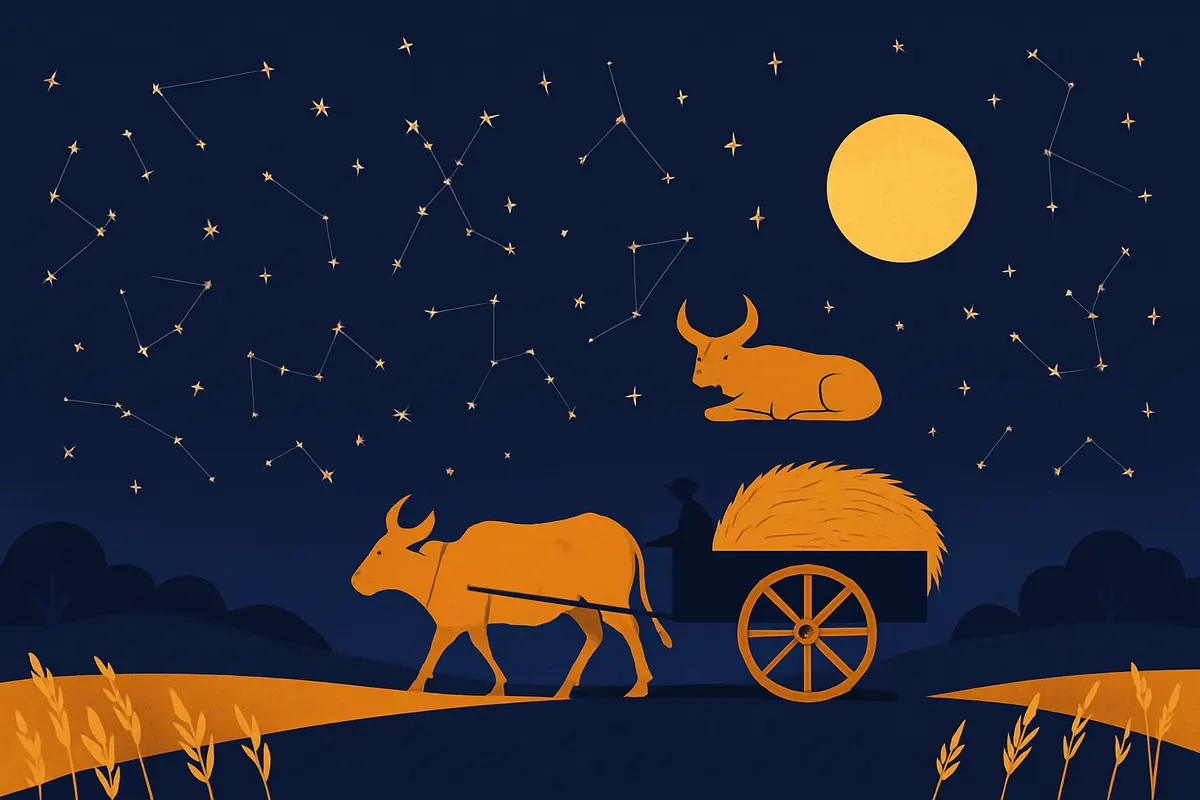
What do the ox-cart and Brahma say about Rohini?
Rohini's symbol is the covered ox-cart — the vehicle that carries a bride to her new household, or carries goods to market. It is not a swift image. A cart does not run; a cart transports, at the pace its cargo can bear. This unhurried, load-bearing quality runs through everything else the tradition says about the mansion.
The presiding deity, Brahma, deepens the same theme. Brahma is the creator, but specifically the deliberating, breath-by-breath creator of the four Vedas — closer to slow articulation than to sudden intervention. B.V. Raman's commentaries repeatedly connect Rohini to growth, fertility, agriculture, and the patient building of material life. Put the cart and the deity together and the reading is consistent: creation in this mansion tends to be slow, cumulative, and physically grounded, arriving after long gestation rather than in a single burst. The next mansion, Mrigashira, is by contrast a restless searcher rather than a settler. People with strong Rohini placements often describe exactly this pattern in their own creative or professional lives — long quiet stretches followed by a comparatively rapid, well-formed output.
Why are Rohini natives drawn to sweetness?
If I had to compress Rohini into one psychological theme, it would be this: an inborn pull toward sweetness, and a lifelong task of telling nourishment apart from indulgence. Classical authors use the Sanskrit madhurya — sweetness, charm, the quality of honey — to describe the mansion's dominant note. It is not a decorative word choice. Rohini natives are drawn, more than most, to what is sweet: food, music, faces, light, voices, attention. The pull is constitutional rather than learned; the chart is simply naming something that was already true.
In the language of attachment research, this looks like a strongly embodied secure-base orientation — wanting to be held, fed, and seen, and registering real distress when those needs go unmet. The shadow is that the same capacity for sweetness can narrow into an attachment to sweetness as such: to comfort, to the specific person, the specific home, the specific unchanging Sunday. This is, I think, the real content behind Rohini's best-known myth — the Moon loved this one wife above his twenty-six others, spent all his time in her house, and was cursed by her father to wane. Read plainly, it is a precise description of how concentrated attachment can nourish and deplete a life in the same gesture.
Rohini Nakshatra padas: signs and meanings
Each nakshatra divides into four padas of 3°20' each, and Rohini's four padas fall respectively in the Aries, Taurus, Gemini and Cancer navamsa, sub-ruled in turn by Mars, Venus, Mercury and the Moon.
The first pada (Aries navamsa, 10°00'–13°20' Taurus) is the most physically embodied of the four — natives here often have a startling, uncontrived physical presence. The second pada (Taurus navamsa, 13°20'–16°40') doubles the earth element with Venus, producing the most aesthetically attuned quarter: natives drawn to design, food, textiles, or any field where surface beauty does real work. The third pada (Gemini navamsa, 16°40'–20°00') channels Rohini's sensuous slowness through Mercury's articulacy, favoring writers and teachers who translate feeling into language. The fourth pada (Cancer navamsa, 20°00'–23°20') is the most maternal in temperament regardless of gender, with the Moon doubled through Cancer's own nurture — these natives often become the emotional anchor of their family, and the developmental task is holding that role without being consumed by it.
Moon in Rohini Nakshatra: what do the classical texts say?
Classical portraiture converges on a firm, well-formed, truth-speaking figure — attractive in appearance, self-respecting, and notably loyal in friendship, but also capable of a slow-igniting temper that, once roused, does not forget quickly. Phaladeepika associates the Moon in Rohini with dharma-priti, a love of right living grounded in beauty and tradition rather than in abstract principle — a useful corrective to the modern habit of reading Rohini as merely "sensual." The classical authors do not separate sensuality and dharma the way modern readers tend to; for them, the well-lived sensory life and the ethically grounded life are continuous, not opposed.
The texts also connect Rohini to material accumulation — not as a guaranteed windfall, but as an observation about the mansion's gathering, holding quality. Whether that shows up as wealth, a well-tended home, or simply a body that ages steadily depends on the rest of the chart and on the choices the native makes with what they have been given.
Which body part does Rohini govern?
Rohini's classical body association is the forehead and lower face, including the throat and mouth — the seat, in this reading, of voice and taste. Many Rohini natives cook well or sing well, or simply speak with a distinctive timbre. The corresponding caution the texts give is against unmoderated indulgence in heavy, sweet food, since the same constitution that loves sweetness also stores it more readily than others. This is offered as observation, not diagnosis — for any specific health concern, consult a qualified medical professional.
What does the Moon Mahadasha mean for a Rohini native?
Because the Moon rules Rohini, anyone whose Moon falls here opens life in a Moon Mahadasha, ten years in full, of which only the balance remains at birth — often, in classical reading, a period in which the chart's most strongly placed body comes fully online early. Many Rohini-Moon natives report that a formative relationship, a defining piece of work, or the shape of their adult temperament settled during this opening decade. For how a starting nakshatra determines the rest of the dasha sequence, see How to Read a Vedic Astrology Birth Chart. The corresponding caution concerns the Moon's later antardasha periods within a heavier mahadasha such as Saturn or Rahu, when the same sensitivity that makes Rohini generative can also register more disturbance than it can easily settle.
Rohini Nakshatra compatibility and relationships
Rohini's mythological inheritance — the most-favored wife, the resulting curse — describes a love that is real but unevenly distributed, and the classical texts name this without moralizing about it: anuraga-shila, naturally disposed toward deep attachment and capable of favoring one person with an intensity that can, unexamined, exclude others. In relational terms, Rohini partners tend to be steady, physically warm, and slow to leave, but can also swing toward a more anxious, preoccupied pattern under real threat to the bond. The mature Rohini relationship tends to protect its slow rituals — the long Sunday mornings, the family calendar — while deliberately building in enough separate space that stability does not calcify into a cage.
For chart-matching, Ashtakoot Milan gives the formal compatibility framework Vedic astrology uses across all nakshatra pairings, Rohini included; the specific fit still depends on the full chart rather than the nakshatra alone.
How do I find out if my Moon is in Rohini Nakshatra?
- Enter your birth date, time and place in the Nakshatra finder. It returns your Moon sign, nakshatra and pada.
- If the nakshatra shown is Rohini, your Moon lies within Taurus 10°00'–23°20'. The pada is the 3°20' quarter it falls in: pada 1 10°00'–13°20' Taurus, pada 2 13°20'–16°40' Taurus, pada 3 16°40'–20°00' Taurus, pada 4 20°00'–23°20' Taurus.
- Open the Dasha calculator to see the Moon Mahadasha balance at birth, which depends on how far the Moon had already travelled through Rohini.
Rohini begins at 10° Taurus, so a Moon in the first 10° of Taurus is in Krittika, and a Moon past 23°20' Taurus is in Mrigashira. Positions use the sidereal zodiac with the Lahiri ayanamsa and the Swiss Ephemeris (see /tools). The Moon crosses roughly one nakshatra a day, so an uncertain birth time can move you across a pada or, near an edge, into the neighbouring nakshatra. For the full chart, generate it at /kundli/new.
Frequently asked questions
What is Rohini Nakshatra?
Rohini is the fourth of the 27 nakshatras in Vedic astrology, spanning 10°00'–23°20' of Taurus. It is ruled by the Moon, presided over by the creator-deity Brahma and symbolised by a covered ox-cart. Because it lies wholly inside Taurus, the sign of the Moon's exaltation, it is called the Moon's own mansion.
What are the main personality traits of Rohini Nakshatra?
Classical sources describe Rohini natives as attractive, truth-speaking, loyal in friendship and drawn toward beauty, comfort and steady routine. The same sources note a slow-to-anger but slow-to-forgive temper and a pull toward sensory abundance that benefits from conscious moderation. Modern readings add a highly receptive, deeply feeling temperament.
Who is the ruling planet of Rohini Nakshatra?
The Moon rules Rohini in the Vimshottari Dasha system. A native with the Moon in Rohini therefore opens life in a Moon Mahadasha, which lasts ten years in full; the balance left at birth depends on how far the Moon has travelled through the nakshatra. The Moon also rules Hasta and Shravana.
Why is Rohini associated with the Moon's exaltation?
The Moon is exalted in the sign Taurus, and Rohini lies entirely inside Taurus and is ruled by the Moon itself. The Moon's exact point of maximum strength, 3° Taurus, falls just before Rohini, in the Taurus half of Krittika. Classical astrology reads the Moon in this territory as expressing its full receptive, comfort-loving nature.
Is Rohini a good nakshatra for marriage?
Rohini natives are described as loyal, steady, physically warm partners who value long-established rituals and are slow to leave. The mansion's relational task is balancing genuine intimacy against a tendency to over-attach to comfort and sameness. Formal compatibility still requires matching the full charts through Ashtakoot Milan, not the nakshatra alone.
What deity and symbol represent Rohini Nakshatra?
The presiding deity of Rohini is Brahma, the creator, and its symbol is a cart or covered ox-cart. The cart is an image of something valuable being carried carefully and without haste toward its destination, which matches the mansion's reputation for slow, cumulative, physically grounded growth rather than sudden bursts.