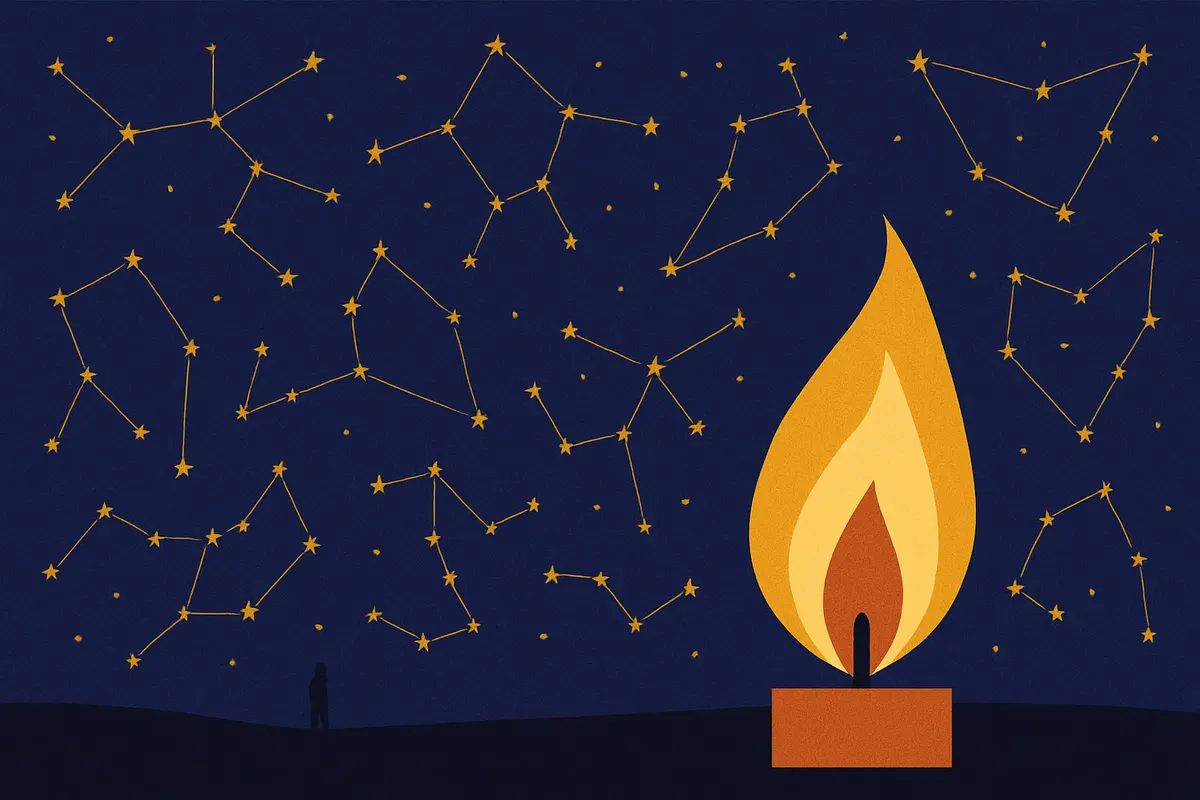
Krittika Nakshatra is the 3rd of the 27 nakshatras (lunar mansions) in Vedic astrology, spanning 26°40' Aries to 10°00' Taurus. Its ruling lord is the Sun, its presiding deity is Agni, the Vedic fire god, and its symbol is a razor or flame. The name comes from the Sanskrit root krit, "to cut", and a Moon in Krittika opens life in a six-year Sun Mahadasha.
Krittika is also spelled Kritika, is called Karthigai in Tamil, and appears as कृत्तिका in Devanagari. It is a nakshatra (a 13°20' lunar mansion), not a rashi (a 30° sign): Krittika straddles two rashis, Aries and Taurus. To see which nakshatra your own Moon occupies, use the Nakshatra finder.
What does Krittika Nakshatra mean?
Krittika means "the cutting one": its name comes from the Sanskrit root krit, "to cut." Its deity, Agni, is the fire that carries offerings between the human and divine realms — the god of transformation by combustion, present at every threshold ritual because something old has to be burned away before something new can begin. A person with a strong Krittika placement carries a small piece of that office: they notice the lie, the small theft, the unspoken resentment, and once noticed, the noticing tends to demand action — a confrontation, a refusal, an exit. This is the nakshatra's real gift. It's also its loneliness, since most social systems run on a small amount of agreed-upon not-noticing that a Krittika native usually can't supply. Krittika follows Bharani, the mansion of carrying weight, and precedes Rohini, the Moon's own slow, sweet mansion.
Moon in Krittika Nakshatra: what do the classical texts say?
Brihat Parashara Hora Shastra describes Krittika natives as resolute, honest, fond of cleanliness, sometimes harsh in speech, and inclined toward leadership in fields requiring discipline — the text doesn't flatter the placement, noting both the sharpness and the corresponding need for self-restraint. Phaladeepika adds the capacity for sustained effort, particularly the willingness to see a difficult task through to completion when it requires facing unpleasant truths, paired with a caution about temper and the social cost of relentless honesty. Both texts agree on one thread: this is a competence placement, associated with people who can act — perform surgery, conduct an investigation, end an institution that has outlived its usefulness — rather than drift or hedge. The cost of being able to act decisively is difficulty comfortably refraining from it.
Krittika Nakshatra padas: why does it span Aries and Taurus?
Krittika is split across two signs, with four padas of 3°20' each. Its single Aries pada (pada 1, in the Sagittarius navamsa) tends to cut hot and fast — the friendship ended over text, the resignation written at midnight. Its three Taurus padas (Capricorn, Aquarius and Pisces navamsas) cut slower and more finally — the years-long marriage that quietly ends one ordinary morning. Both are the same blade; one just looks more dramatic than the other. This split also shows up temperamentally as a tension between the desire to charge forward and the desire to settle and possess — between the warrior and the householder — that many Krittika natives describe feeling as an internal push-pull rather than a settled preference.
What are the psychological traits of Krittika natives?
Krittika's pattern — a strong inner sense of right and wrong, a willingness to act on it, and real difficulty with ambiguity — often maps onto a precocious, early-taken-on sense of responsibility: children who become adultified sooner than their peers, carrying a small flame of moral seriousness from a young age. This is both an asset and a cost. The asset is competence and a clear conscience. The cost is the missed phase — the years of carefree ambiguity that other children get to inhabit and that Krittika children often skip past, developing a well-lit persona of capable rectitude while the ordinary, messy, occasionally-wrong parts of the self get pushed underground earlier than is healthy. When Krittika natives arrive in therapy in their thirties or forties, this is very often the material that surfaces.
What happens when the Krittika razor turns inward?
Every nakshatra has a characteristic shadow, and Krittika's is among the more painful. When the cutting energy has no external object — because the environment is healthy, because the native was taught not to confront, or because they're simply too compassionate to wield the blade outward — the energy doesn't disappear. It turns inward: constant self-critique, every relationship audited for whether love given or received was sufficient, an internal standard so high that satisfaction becomes nearly impossible. The way out is rarely "try to be kinder to yourself," which asks the same blade to do the opposite job and predictably fails. It works better to give the cutting energy a worthy external object — something that genuinely needs ending or reorganising — while separately, in small daily measures, practicing the deliberate non-cutting of the self.
Which body parts does Krittika govern?
Classical sources connect Krittika to the head and face — fitting for a Sun-ruled mansion — and, through Aries and Taurus, to the upper digestive tract more broadly. In practice, the Krittika pattern of turning the blade inward when it has no external object often shows up somatically as jaw and upper-back tension, digestive sensitivity, and disturbed sleep — the mind running an internal ledger at three in the morning, totalling the day's failures. This is a temperament pattern, not a diagnosis, and any specific or persistent health concern is worth taking to a qualified medical professional. The practices that tend to help are the ones that give the fire a steady, contained outlet rather than trying to extinguish it — a daily sunrise practice such as Surya Namaskara is the classical anchor, since it works with the Sun's own rhythm rather than against Krittika's underlying intensity.
What does the Sun Mahadasha mean for a Krittika native?
Because the Sun rules Krittika, its 6-year Mahadasha (the shortest of the nine, of which only the balance remains at birth) tends to be especially formative for these natives, bringing questions of standing, integrity, and the willingness to take the consequences of one's own positions to the surface. Sun sub-periods within other Mahadashas can bring smaller, intense Krittika episodes: a few months where the native either finally stands up for something they'd been letting slide, or finally makes a decision that requires choosing clarity over comfort. For how the Sun period unfolds independent of nakshatra, see Sun Mahadasha: 6 Years of Identity and Authority.
Which careers and relationships suit Krittika natives?
Krittika natives tend to flourish in surgical and dental work, investigative journalism, forensic accounting, editorial roles, judicial work, reform-oriented consulting, and emergency-services leadership — anywhere the cutting and clarifying nature has a legitimate object. They tend to struggle in open-ended creative work without external standards, purely diplomatic roles that require keeping every party happy, and customer-facing work that asks them to pretend a customer is right when they aren't.
In relationships, Krittika natives carry a particular grief: they see what's wrong, can't unsee it, name it, and the relationship either transforms or ends as a result — what they can't do is what they notice other people doing, which is pretending not to see and continuing anyway. This produces direct, loyal, but sometimes exhausting partnerships, in which the native is often more patient with colleagues and acquaintances than with the people who share their life. The healthiest matches, per Ashtakoot compatibility and general classical guidance, tend to be with a similarly direct temperament, or a complementary one — often a strong Revati or Pisces-Cancer placement — that offers a softness the Krittika native can learn to receive gratefully rather than dismiss.
Krittika Nakshatra remedies and integration practices
A few practices reliably help Krittika natives keep the blade pointed at what actually needs cutting rather than at themselves or the people closest to them. A daily Surya Namaskara at sunrise, performed slowly with attention to the breath, helps integrate the placement's active and receptive sides over months rather than days. A specific journaling prompt tends to work better than open reflection for this temperament: "What did I do today that was simply ordinary, neither admirable nor a failure — and can I let it be?" And a single trusted person — a partner, a close friend, a long-term therapist — whose role is to gently name it when the cutting shows up where it isn't needed, tends to matter more than any solitary practice. The blade doesn't see itself; someone else has to, and being willing to hear it without immediately defending is most of the integration work this nakshatra asks for.
How do I find out if my Moon is in Krittika Nakshatra?
- Enter your birth date, time and place in the Nakshatra finder. It returns your Moon sign, nakshatra and pada.
- If the nakshatra shown is Krittika, your Moon lies within Aries 26°40' – Taurus 10°00'. The pada is the 3°20' quarter it falls in: pada 1 26°40'–30°00' Aries, pada 2 0°00'–3°20' Taurus, pada 3 3°20'–6°40' Taurus, pada 4 6°40'–10°00' Taurus.
- Open the Dasha calculator to see the Sun Mahadasha balance at birth, which depends on how far the Moon had already travelled through Krittika.
Krittika crosses from Aries into Taurus, so the pada matters: pada 1 sits in Aries and padas 2–4 in Taurus, and the reading above changes noticeably between the two. Positions use the sidereal zodiac with the Lahiri ayanamsa and the Swiss Ephemeris (see /tools). The Moon crosses roughly one nakshatra a day, so an uncertain birth time can move you across a pada or, near an edge, into the neighbouring nakshatra. For the full chart, generate it at /kundli/new.
Frequently asked questions
What is Krittika Nakshatra?
Krittika is the third of the 27 nakshatras in Vedic astrology, spanning 26°40' Aries to 10°00' Taurus. It is ruled by the Sun, presided over by Agni the fire god, and symbolised by a razor or flame. Its name comes from a root meaning to cut, and it is read as the mansion of cutting clarity.
Who is the ruling planet of Krittika Nakshatra?
The Sun rules Krittika in the Vimshottari Dasha system. Anyone born with the Moon in Krittika therefore opens life in a Sun Mahadasha, which lasts six years in full, the shortest of the nine periods; the balance left at birth depends on how far the Moon has travelled through the nakshatra. The Sun also rules Uttara Phalguni and Uttara Ashadha.
What traits are associated with Krittika Nakshatra?
Classical sources describe Krittika natives as resolute, honest, fond of cleanliness and inclined toward disciplined leadership, but sometimes harsh in speech. Modern readings add a strong inner sense of right and wrong and difficulty leaving things unsaid. The texts pair that competence with a caution about temper and the social cost of relentless honesty.
Why does Krittika span two zodiac signs?
Every nakshatra is 13°20' wide and every sign is 30° wide, so the two grids do not line up. Krittika begins at 26°40' Aries and ends at 10°00' Taurus, which puts its first pada in Aries and its remaining three padas in Taurus. The traditional reading treats the Aries pada as hotter and faster and the Taurus padas as slower and more final.
Is Krittika a difficult placement for relationships?
Krittika is demanding rather than inherently difficult. Natives notice what is wrong in a relationship, cannot unsee it and name it, so the bond either transforms or ends. Partnerships tend to be direct and loyal but sometimes exhausting. The classical guidance suggests the healthiest matches are with a similarly direct temperament, or a softer complementary one.
How does Krittika differ from Bharani?
Bharani, the nakshatra before Krittika, is ruled by Venus and presided over by Yama, and its theme is carrying weight and consequence. Krittika is ruled by the Sun and presided over by Agni, and its theme is cutting away what is false or finished. Bharani bears the load; Krittika decides what is left standing.