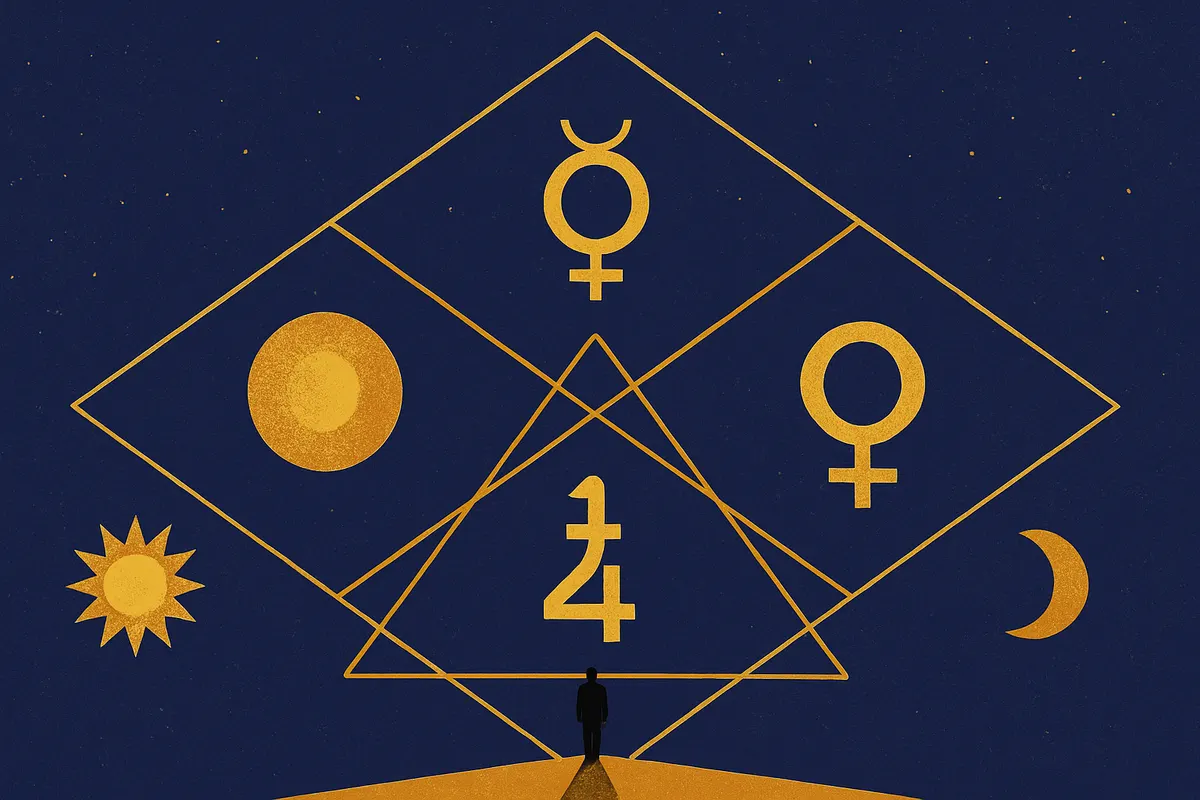
Budha-Aditya Yoga is a Vedic astrology combination formed when Mercury (Budha) and the Sun (Aditya) occupy the same sign in the birth chart. Because Mercury never strays more than about 28 degrees from the Sun, it is common, and its effect turns mainly on whether Mercury is combust: clean, it gives articulate intelligence; combust, a mind overheated by its own ego.
The yoga is also spelled Budhaditya or Budh Aditya Yoga (बुधादित्य योग), the "Mercury-Sun yoga". It needs no house lordship, unlike a Raja Yoga, and it is a different thing from Mercury's combustion on its own: the yoga is the sharing of a sign, combustion is how close Mercury sits within it.
The same conjunction reads very differently depending on how close Mercury sits to the Sun.
Common: Mercury is never more than about 28° from the Sun
Key variable
Whether Mercury is combust (roughly within 12-14° of the Sun)
Strongest signs
Virgo (Mercury's own sign) or Leo (Sun's own sign)
Weakest sign
Pisces (Mercury debilitated)
Peak activation
Mercury or Sun Mahadasha, and their mutual antardashas
How does Budha-Aditya Yoga form?
It forms when Mercury and the Sun sit in the same sign in the natal chart. The mechanical definition is simple. What is not simple is what that shared sign means for the person, and this is where the popular "you have a Raja Yoga" framing flattens something more textured. You can read the sign and degree of both planets in the free Lagna calculator.
Three factors change the reading substantially. First, combustion: Mercury sitting close enough to the Sun to be "burnt" by its rays. The classical orb is roughly twelve to fourteen degrees in most treatments, tighter when Mercury is retrograde. A combust Mercury inside the conjunction behaves very differently from a Mercury sitting eighteen or twenty degrees away in the same sign, close enough to form the yoga and far enough to keep its own voice.
Second, the sign: the conjunction in Virgo (Mercury's own sign) has a researcher's precision; in Leo (the Sun's own sign) it has a radiant, teaching quality; in Pisces (Mercury debilitated) speech can be fluent but strangely unmoored. Third, the house the conjunction occupies: the 10th house gives it a public, career-facing expression, the 12th a withdrawn, inward one, and other houses shade it differently again.
Brihat Parashara Hora Shastra treats the Sun-Mercury combination broadly as conducive to intelligence, articulate expression and standing gained through it, with the standard caveat that combustion damages Mercury's significations: speech, learning, the analytical mind. Later compilers who name this a "Raja Yoga" producing administrative ability generally attach the same conditional clause: the benefit accrues when Mercury is not unduly afflicted. That clause is exactly what the popular, WhatsApp-forwarded version drops. For how any yoga is defined, see the Yoga entry.
What does Budha-Aditya Yoga do to the mind?
It joins the mind to identity. Read symbolically, the Sun represents the conscious sense of self; Mercury represents thinking, speech and the linguistic-symbolic capacity. When the two share a sign, self and speech occupy the same room of the chart, and three recurring patterns emerge.
The articulate self. Thinking and speaking are barely distinguishable for this pattern. Identity rests heavily on the capacity to articulate. Take the words away, through illness or exhaustion, and access to the self itself feels diminished, not just quieter.
The burnt mind. This is the combust version. The intellectual capacity is real, but using it feels like being drowned by the Sun's proximity: sentences get edited mid-stream, emails get written and not sent, and the person consistently undersells intelligence that is actually there.
The public-private split. More common when the conjunction sits in a publicly-facing house (10th, 7th, 11th) while the rest of the chart points inward. Eloquent at the podium, wordless at the kitchen table: the yoga built a public voice without a matching private one.
What is a clean Budha-Aditya Yoga?
A clean Budha-Aditya has Mercury well outside the combustion orb, in a sign friendly to both planets (Virgo, Gemini or Libra tend to read best), ideally with a benefic aspect, Jupiter's being the most commonly cited, landing on the pair. Under these conditions the lived experience tends to be a person whose intelligence and identity are at peace: they know what they think, can say it, and can lose an argument without losing themselves.
Fields where the work is speech and writing, such as teaching, editing, analysis, and law in the general sense rather than as legal advice, reward this configuration particularly well. Many go on to become the kind of mentor who hands language back to people who have been quiet for a long time.
Is combust Mercury bad in Budha-Aditya Yoga?
Combust Mercury weakens the yoga, but it is common rather than a rare defect. A substantial share of Sun-Mercury conjunctions fall within the combustion orb, so the stressed version is closer to a base rate than an exception. The everyday shape of it is the bright person who undersells, the writer who deletes more than they keep, the speaker who is fine in low-stakes rooms and freezes in the one that matters. None of this reflects lower intelligence; it reflects a hotter channel between the ego and the analytical mind. A conjunction in a difficult house sharpens the pattern: in the 6th it can put the articulate mind into a near-permanent argumentative posture, and in the 8th it can produce intelligence that only shows up under real pressure.
The developmental task this configuration points to, in plain terms, is giving the mind back a private room to think in without an audience. Unstructured journaling that no one else reads is the most commonly useful practice, not to produce anything, but to let Mercury operate without the Sun watching. This is a general reflection on a recurring pattern, not a diagnosis; anyone concerned about a real, persistent decline in mood or functioning should speak with a qualified mental-health professional rather than treat an astrological reading as a substitute.
What can you do with Budha-Aditya Yoga in practice?
Knowing the yoga is less useful than knowing which developmental task it points to. For the clean version, the practical move is finding work where articulate intelligence is the actual product rather than a side effect of some other role. Many people with this configuration spend careers using their mind only in the gaps between meetings, when the yoga's fuller expression tends to want speech or writing at the centre of the work itself.
For the stressed, combust version, the more useful move is restoring Mercury's access to a private register: unhurried journaling nobody else reads, reading classical texts aloud regardless of full comprehension, or practising slower, more deliberate speech. Articulate people with this yoga tend to talk at the pace of their own thought rather than the listener's ability to absorb it. Neither practice is a fix for a flaw; both are ways of letting an already-real capacity work more cleanly.
How does the house placement change Budha-Aditya Yoga?
The house the conjunction falls in matters roughly as much as the sign.
1st house: lands on the personality directly. Verbally quick, identified early as "the smart one," with the risk of over-identifying with that label.
5th house: favours teaching and creative intelligence, sometimes at the cost of over-tutoring one's own children.
7th house: favours an intellectually engaged marriage, with the corresponding risk of over-analysing what should simply be felt.
9th house: favours formal learning, publishing and articulated worldview, with a risk of rigidity dressed as principle.
10th house: the placement most popular sources assume by default. It shapes the public career and reputation directly.
When does Budha-Aditya Yoga activate?
The yoga's effects tend to peak during Mercury's own Mahadasha, during the Sun's Mahadasha, and during the antardashas that combine the two. Use the Dasha calculator to see when these periods run for you. For a clean Budha-Aditya, a Mercury period tends to be a strong stretch for writing, teaching or communication-driven work, and a Sun period tends to bring public recognition for that same work. For a stressed, combust version, the same periods sharpen the underlying task rather than resolve it: a Mercury period surfaces the burnt-mind pattern directly, and a Sun period tends to force identity questions into the open through some form of public exposure.
How does Budha-Aditya Yoga differ from Kalanidhi, Adhi and Vipareeta Raja Yoga?
Budha-Aditya is a conjunction yoga, which puts it in a different family from configurations built on angular relationships or house ownership. Kalanidhi Yoga turns on Jupiter placed in the 2nd or 5th house rather than any Mercury-Sun contact, and produces a different kind of cultivated, artistic standing. Adhi Yoga also involves Mercury, but as one of three benefics supporting the Moon from a distance rather than sitting beside the Sun: a supportive-ground signature rather than an identity-and-speech one. And where Budha-Aditya's difficult version comes from the Sun overheating a naturally cooperative planet, Vipareeta Raja Yoga describes the opposite mechanism: elevation that arrives specifically through affliction rather than through a benefic's proximity to the Sun.
How to find Budha-Aditya Yoga in your chart
You can check for the yoga and its quality in four steps.
Enter your birth date, time and place in the Lagna calculator. It lists the sign, degree and house of every planet.
Compare the sign of the Sun with the sign of Mercury. If they match, the yoga is present.
Subtract the two degrees. If Mercury is within about 12 to 14 degrees of the Sun, it is combust; if it is further, the yoga is the clean version.
Note the sign (Virgo and Leo strongest, Pisces weakest) and the house, then check the Dasha calculator for whether a Mercury or Sun period is running.
A full chart at /kundli/new shows the same details alongside your other yogas.
Frequently asked questions
What is Budha-Aditya Yoga?
Budha-Aditya Yoga is a classical configuration formed when Mercury and the Sun occupy the same sign in the natal chart. It is associated with articulate intelligence and, in its stronger forms, professional recognition gained through speech or writing. Its practical effect depends heavily on whether Mercury is combust.
Is Budha-Aditya Yoga rare?
No. Since Mercury never travels far from the Sun in the geocentric view, a large share of birth charts carry some form of this conjunction. What varies, and what actually matters for the reading, is the degree of separation between the two planets, the sign and the house.
What does it mean if Mercury is combust in this yoga?
Combustion, roughly within 12 to 14 degrees of the Sun, weakens Mercury's contribution. The classical concern is damaged speech and analytical clarity. The everyday experience is often a bright person who second-guesses themselves mid-sentence rather than one who lacks capacity.
Which sign is best for Budha-Aditya Yoga?
Virgo (Mercury's own sign) and Leo (the Sun's own sign) are generally read as the strongest placements, and Gemini and Libra read well when Mercury is outside the combustion orb. Pisces, where Mercury is debilitated, tends to produce fluent but less grounded speech.
Does Budha-Aditya Yoga guarantee fame or a high position?
No. Classical sources describe the conditional benefit of articulate intelligence and administrative aptitude, always qualified by Mercury's dignity and freedom from combustion. It is a signature of mental-identity integration, not a guaranteed public outcome, and many charts with the yoga lead quiet lives.
When does Budha-Aditya Yoga show its strongest effects?
Typically during Mercury's own Mahadasha, the Sun's Mahadasha, or the antardasha periods that combine the two. This holds whether the version in the chart is the clean or the stressed one; the difference is whether the period rewards the capacity or sharpens the burnt-mind task.